Cranberry is one of the most popular supplements for urinary tract health, and it has more trial evidence behind it than most. But shopping for it is confusing. Most cranberry pills do not say how much of their active compounds, proanthocyanidins (PACs), they contain, and the ones that do often use lab tests that give very different numbers for the same powder. Meanwhile, the supplement with the best placebo-controlled results contains very little PAC by the most widely used test.
We screened about 20 cranberry supplements sold on Amazon US and ranked seven. The ranking rewards products that match what was actually tested in trials, state their PAC content with a recognized test method, carry testing we could confirm, and cost a reasonable amount per day, and it deducts for marketing that overreaches. For the wider picture, including non-cranberry options, see our guide to supplements for urinary tract health.
The short version
- Best overall: TheraCran One, 36 mg of PACs with its lab test method (DMAC) printed on the label and NSF contents certification we confirmed, at about $1.20 a day.
- Trial-dose picks: Sports Research ($0.47 a day), Oregon's Wild Harvest (organic, $0.71) and AZO (the lowest cost, $0.21) all give 500 mg a day of Pacran, the ingredient and dose used in the best placebo-controlled supplement trial.
- The 36 mg PAC target is a convention, not a proven threshold. It comes from juice and urine lab studies, and a 72 mg a day trial in nursing homes found no benefit.
- A PAC number means little without its test method. The same cranberry powder is specified at more than 0.3 percent PACs by one method and more than 7.2 percent by another.
- The benefit is modest and specific. In a 2023 Cochrane review, cranberry probably reduced repeat infections in women who get them often, by about 6 per 100 women, but showed no benefit in nursing-home residents or pregnancy.
- Prevention only. Cranberry does not treat an active infection; see a clinician for symptoms.
How we ranked them
To qualify, a product had to use cranberry as its main active ingredient and show a readable Supplement Facts panel. We then scored each one:
- Trial match (25%). Full marks when the product uses the same branded ingredient at the same daily dose as a placebo-controlled trial that met its main goal. Less when the maker's capsules were tested at a different dose or setting, less again for products like those tested with mixed results or no benefit, and least with no trial match.
- PAC disclosure (20%). Full marks for a PAC amount with the DMAC test method on the Supplement Facts panel, slightly less when the method appears elsewhere on the package or only in the listing, and less for a PAC number with no method or none at all.
- Third-party verification (15%). Full marks only for a contents certification we could confirm on the certifier's own site for this product.
- Cost per day (15%), at the label's daily dose, from Amazon prices on November 2, 2026.
- Formulation (10%). Points off for added colors, sugar, or added ingredients without urinary evidence, such as D-mannose.
- Marketing restraint (15%). Products start at 4 of 5, and half a point comes off for each category present: unverifiable superiority claims, disease or benefit claims beyond the evidence, PAC or juice-equivalent claims that overreach, and a listing that contradicts its label.
PAC disclosure and verification together carry more weight (35%) than trial match (25%) because label PAC numbers often fall short: a 2026 government lab survey found that products declaring PAC contained significantly less than stated. Products are ordered by their unrounded scores, shown rounded to one decimal; Utiva and Ellura tie, and ties go first to PAC disclosure and then to the lower cost per day. Just missed: Zazzee (a stated 72 mg of PACs with no test method and fast-acting claims), Life Extension's Cran-Max products (the only trial we found of the Cran-Max ingredient compared it with an antibiotic; the Optimized version adds hibiscus), Inner Brightness (its posted lab report measured PACs by HPLC, not DMAC, and it adds D-mannose), and plain whole-fruit or concentrate capsules such as Nature's Way and Horbaach, which state no PAC and match no trial. Combinations built around D-mannose (Pure Encapsulations, Solaray, Uqora and Amazon Basics) did not qualify, because D-mannose, not cranberry, is their largest active ingredient. Costco's trunature Cranberry is sold on Amazon only by a third-party reseller, and AZO Cranberry Pro shows no Supplement Facts panel on its listing, so neither was ranked. No brand paid to be included, and none sent product.
What cranberry can and cannot do, and the PAC problem
What the trials show. A 2023 Cochrane review pooled 50 randomized trials with 8,857 people. In women with repeat urinary tract infections, cranberry products probably reduced culture-confirmed infections, meaning infections confirmed by a urine lab test (from about 24 to 18 per 100 women, moderate-certainty evidence). Benefits were also seen in children and after medical procedures such as catheterization, the latter on lower-certainty evidence. There was little or no benefit in older people in care homes, in pregnancy, or in people whose bladders do not empty properly. Many of these trials, including most of those in women with repeat infections, used juice rather than capsules. In 2025, the American Urological Association moved to saying clinicians should offer cranberry as an option for women with recurrent infections.
The best supplement evidence is for whole cranberry powder. In an Australian trial of 150 women aged 18 to 65 with a history of repeat infections, 500 mg a day of Pacran whole cranberry powder for 6 months cut culture-confirmed infections from 34.7 to 17.8 percent compared with placebo. It was sponsored by Swisse, and the Pacran supplier helped design it; it stopped at half its planned size, and the result was not significant when only women who completed the study as planned were counted. An earlier Pacran trial was significant only after excluding six women, and Europe's food safety agency has twice declined to authorize a Pacran claim. In the US, FDA has said it will not object to a qualified health claim, with the words limited scientific evidence, for supplements giving 500 mg a day of cranberry fruit powder to healthy women who have had an infection.
Concentrated PAC extracts have mixed results. Capsules from Theralogix lowered infections after gynecological surgery in a placebo-controlled trial. A Greek trial of Cysticlean in 172 women with repeat infections (160 analyzed) found about half as many infections over a year; it lists a Greek state scholarship grant, but we could not access its full methods or any statement on company involvement. But a year-long trial giving 72 mg of PACs a day to nursing-home residents found no benefit, and a trial comparing 37 mg with 2 mg a day missed its main goal.
Where 36 mg comes from. The figure traces to a 1994 juice study in older women and a 2010 lab study of urine from 32 women taking PAC capsules, in which anti-adhesion activity rose with dose and lasted longest at 72 mg. French authorities accepted a 36 mg claim in 2004, then concluded in 2011 that the clinical data were insufficient. Meanwhile, the positive Pacran trials supplied only about 2 to 3 mg of PACs a day by the DMAC test. In other words, 36 mg is a useful way to compare extracts, not a proven dose.
Why PAC numbers disagree. PACs can be measured several ways. The DMAC method, a color test that reacts with the end units of PAC molecules, is more specific for cranberry than older methods. BL-DMAC is the version several labs validated together (BL stands for Brunswick Laboratories), and a label that says DMAC/A2 is naming the reference compound used to calibrate the test. Other methods give far higher numbers: the same Pacran powder is specified at more than 0.3 percent PACs by BL-DMAC, more than 1.5 percent by HPLC (a separation method) and more than 7.2 percent by the European Pharmacopoeia method, which breaks PACs apart with acid and measures the color. A 2026 analysis by USDA researchers, supporting the NIH, tested 53 US cranberry supplements and found only 3 delivered 36 mg or more of soluble PAC a day, and that products declaring PAC contained significantly less than stated. A 2012 analysis found only 4 of 19 products would supply 36 mg a day.
Compared with antibiotics. In a Dutch trial, women taking cranberry capsules had more infections over a year than women taking a low-dose antibiotic (4.0 versus 1.8 a year), but antibiotic-resistant bacteria did not rise on cranberry. A smaller UK trial of the Cran-Max ingredient against trimethoprim found no significant difference but trended toward the antibiotic. Pooling two trials, the Cochrane review found cranberry may make little or no difference compared with antibiotics for culture-confirmed infections, on very low certainty evidence.
What about D-mannose? Many cranberry products add D-mannose. In the largest placebo-controlled trial, 598 women taking about 2 g a day for 6 months had no fewer clinic visits for suspected infections than those on placebo, so we give it no credit.
Safety. Cranberry is generally well tolerated; in the Cochrane review, stomach side effects were probably no more common than on placebo, though juice upsets some people's stomachs. Controlled studies mostly found no interaction with warfarin, but case reports exist, so people on warfarin should tell their prescriber and have their INR, a blood clotting test, checked. In a small study, cranberry concentrate tablets raised urinary oxalate by 43 percent, so people with kidney stones should ask a clinician first.
The 7 best cranberry supplements
Tap any product to jump straight to its full review.
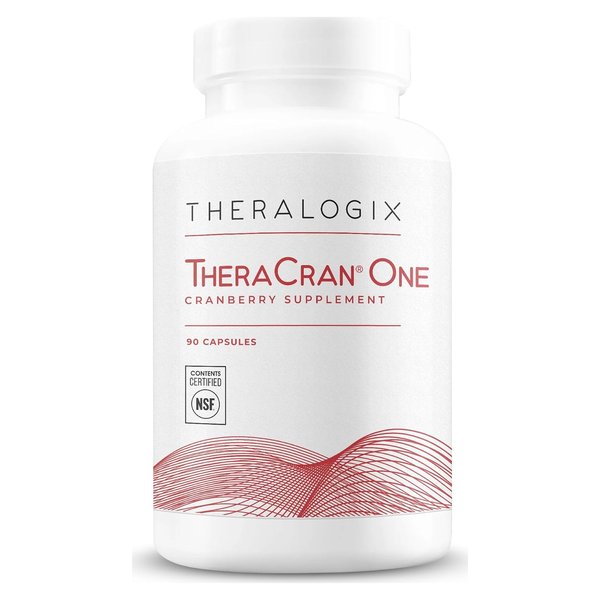
Theralogix TheraCran One (90 capsules)
Best for: Verified PAC content
The top pick because it is the most transparent and best verified: 36 mg of PACs with the DMAC method printed on the panel, NSF contents certification we confirmed, and the maker's capsules have a positive trial after surgery. It ranks first on what we could verify rather than on trial results: the Pacran picks below match the strongest supplement trial for less, but none states its PAC content by DMAC, and when ConsumerLab tested one Pacran product it found about a quarter of the PAC the ingredient should supply. It costs about $1.20 a day, and its claim to be the only independently certified product of its kind is broader than we could verify.
- The only product here that prints its PAC amount and test method on the Supplement Facts panel: 36 mg by the DMAC/A2 method from 500 mg of extract
- Contents certified by NSF (NSF/ANSI 173), which we confirmed on NSF's listing, the only such certification we found for a cranberry PAC product on Amazon
- Theralogix capsules were used in a placebo-controlled trial after gynecological surgery that met its main goal
- About $1.20 a day, and the 90-count bottle costs over $100 up front
- That surgical trial used a different dose and setting, and a trial of a 72 mg PAC capsule in nursing-home residents found no benefit
- Calls itself the only independently certified cranberry supplement made for its purpose, though NSF also certifies several other cranberry supplements (none we found on Amazon); also compares one capsule to 8 to 10 oz of juice
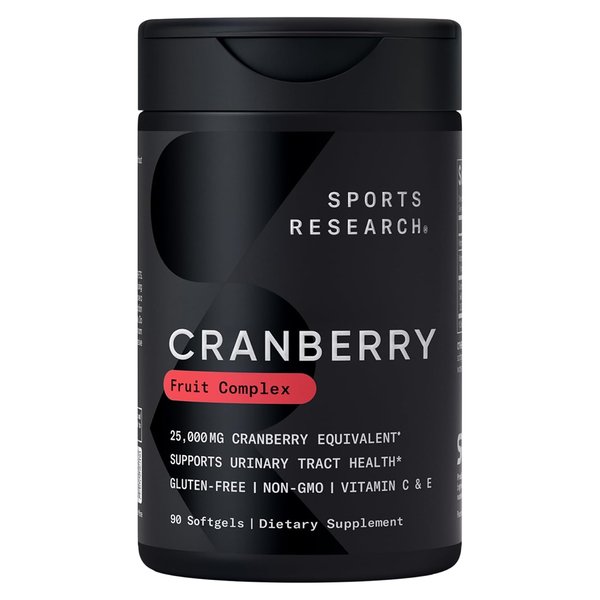
Sports Research Cranberry Fruit Complex (90 softgels)
Best for: The trial dose at a low price
The ingredient and daily dose from the strongest supplement trial, 500 mg of Pacran whole cranberry powder, for about $0.47 a day with no added colors. It edges Oregon's Wild Harvest on price and AZO on formulation, states no PAC amount, its 2X PACs claim has no number behind it, and a bullet describes the whole-fruit powder as juice.
- 500 mg a day of Pacran whole cranberry powder, the same ingredient and daily dose as the best placebo-controlled supplement trial
- About $0.47 a day, with vitamins C and E in an olive oil softgel
- 500 mg of cranberry fruit powder a day is the amount FDA's qualified health claim for supplements is based on
- Says it has 2X the proanthocyanidins without saying how many or compared with what
- A bullet calls it pure cranberry juice, but the label and the Pacran ingredient are whole fruit powder
- Gelatin softgel, not vegetarian; its testing claim names no lab
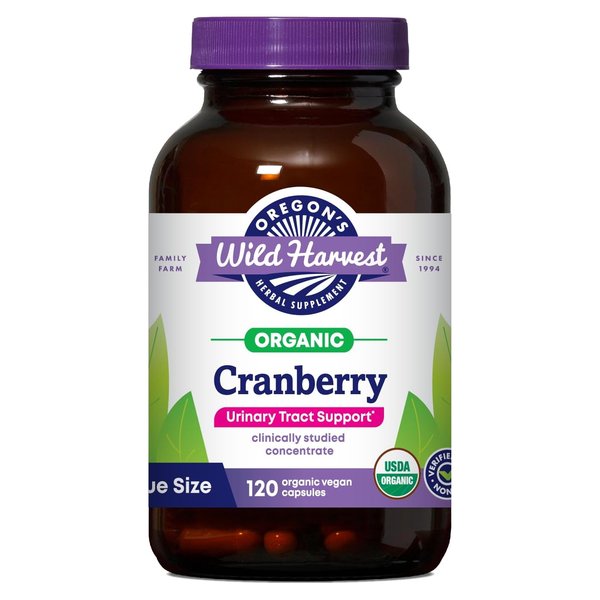
Oregon's Wild Harvest Organic Cranberry (120 capsules)
Best for: An organic, plant-based capsule at the trial dose
The trial dose of Pacran, 500 mg a day, in an organic, plant-based capsule with nothing else in the shell and a notably restrained listing. It costs about $0.71 a day, adds rose hips that have no urinary evidence, and states its PAC percentage without a test method.
- 500 mg a day of organic PACran whole cranberry concentrate, the ingredient and daily dose used in the best placebo-controlled supplement trial
- A pullulan capsule with nothing else added, USDA organic and certified by Oregon Tilth
- A restrained listing; the label prints FDA's qualified claim wording in full; 4.8 stars from about 245 ratings
- About $0.71 a day, more than the two Pacran softgels
- Adds 340 mg of rose hips, which have no urinary evidence
- States 1.5 percent PAC without a test method, and its testing claim is the brand's own
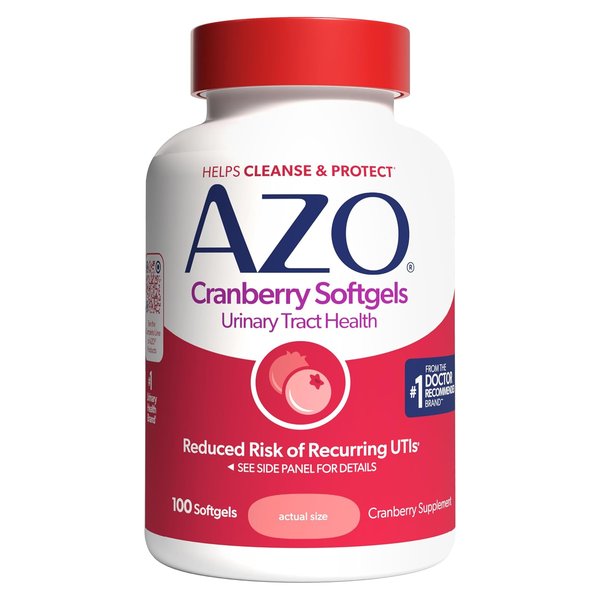
AZO Cranberry Softgels (100 softgels)
Best for: The lowest daily cost
The same 500 mg a day of Pacran for about $0.21, the lowest cost here. It states no PAC, uses a gelatin softgel with carmine and other colors, and ConsumerLab's public review calls its one-glass-of-juice claim misleading.
- 500 mg a day of Pacran, the same ingredient and daily dose as the best placebo-controlled supplement trial
- About $0.21 a day, the lowest here
- About 65,000 ratings averaging 4.7 stars, with vitamin C added
- States no PAC amount; ConsumerLab's public review reports finding about 0.54 mg of soluble PACs per serving, against about 2 mg expected from the ingredient's specification
- Gelatin softgel with carmine, carob and annatto colors, so not vegetarian
- Claims one serving gives the benefits of a glass of cranberry juice and that it helps flush the urinary tract; the front headlines a reduced-risk claim and leaves FDA's limited-evidence wording to the side panel
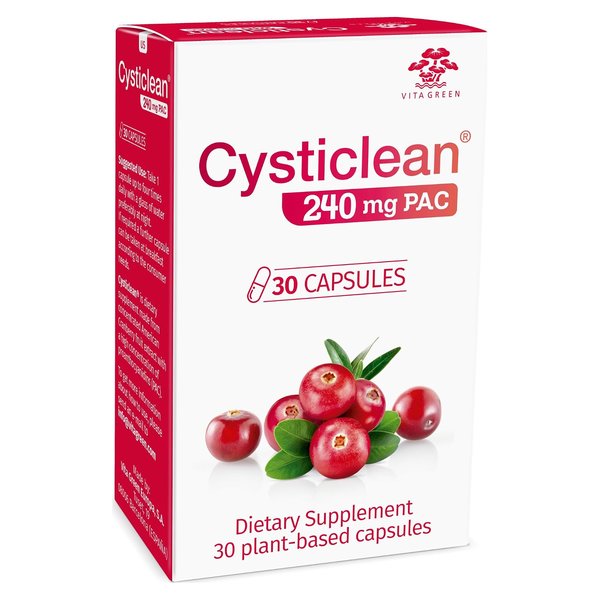
Cysticlean 240 mg PAC (30 capsules)
Best for: A product tested in its own trial
The one product here tested in its own placebo-controlled trial, which met its main goal over a year. Its 240 mg PAC figure is not comparable with DMAC numbers, we could not access the trial's full methods, and its listing oversells the result.
- The same product and dose was tested in a 12-month placebo-controlled trial in women that met its main goal
- A simple capsule: the extract, a plant capsule and one flow agent
- About $0.83 a day
- Its 240 mg PAC figure works out to about 70 percent of the extract, far above what DMAC testing finds in cranberry extracts, so it likely reflects a different test and cannot be compared with 36 mg DMAC products
- We could not access the trial's full methods or any statement on company involvement, and its registry status is listed as unknown
- Headlines its trial result as clinically proven and says it is up to 300 percent more effective without saying compared with what
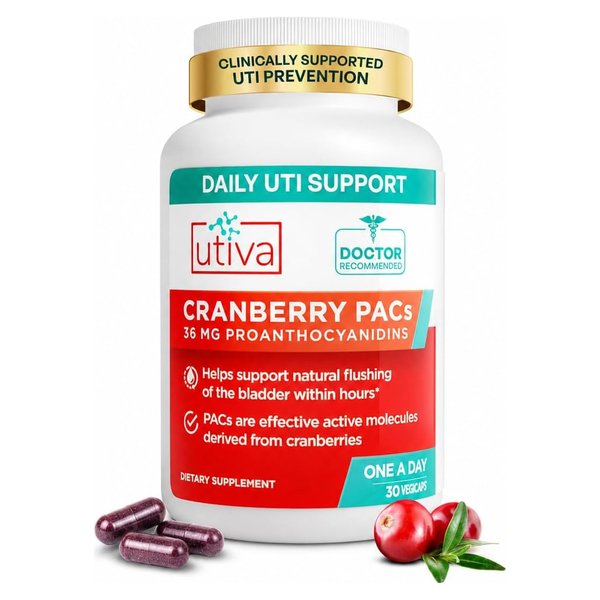
Utiva Cranberry PACs 36 mg (30 vegicaps)
Best for: A simple 36 mg PAC capsule
A clean 36 mg PAC capsule, DMAC per the listing, with almost nothing else inside. At about $1.33 a day it costs more than the Pacran picks, we found no trial of the product itself, and its claims go well beyond what similar capsules showed in trials.
- 36 mg of PACs per capsule from a juice extract, measured by the DMAC/A2 method according to the listing
- Only rice flour and the capsule besides the extract
- About 1,070 ratings averaging 4.7 stars
- About $1.33 a day; we found no trial of this product itself, and trials of similar 36 to 72 mg PAC capsules were mixed
- Front label claims clinically supported prevention, the gallery says it cleanses the bladder of all problem bacteria, and the brand's site says one capsule equals 9 regular cranberry pills
- Testing claim names no lab
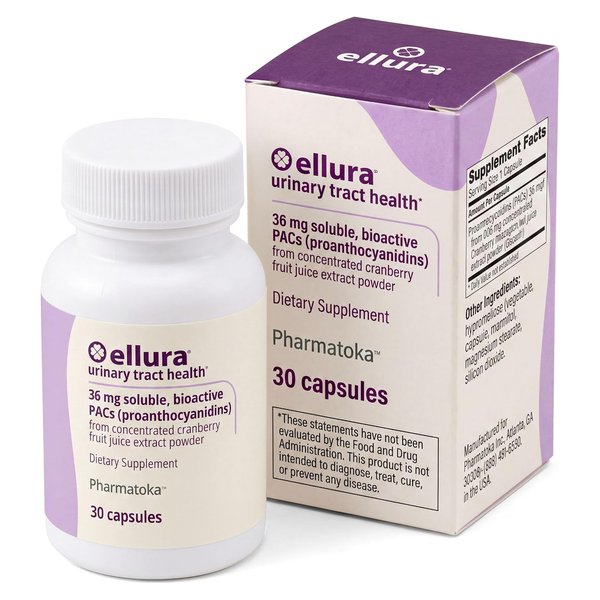
Ellura Urinary Tract Health 36 mg PAC (30 capsules)
Best for: A soluble-PAC juice extract
A 36 mg soluble PAC capsule from the maker whose capsules were used in the urine lab studies behind the 36 mg idea. It is the priciest per day, and two of the maker's 36 mg capsules a day (72 mg) found no benefit in a nursing-home trial.
- 36 mg of soluble PACs per capsule from a juice extract, DMAC/A2 per the carton
- The maker's capsules were used in the urine lab studies behind the 36 mg idea
- 4.8 stars from about 380 ratings
- The most expensive per day here, about $1.50
- Two of the maker's 36 mg capsules a day found no benefit in a year-long trial in nursing-home residents
- A gallery chart rates other cranberry products as inferior, and the listing says it starts working within a few hours
The full lineup, side by side
Amounts come from each product's Supplement Facts panel on its Amazon listing, read November 2, 2026. A PAC number is only comparable when the test method is the same; most cranberry products state no PAC at all. These products are for daily use over months, not for symptoms you have now.
| Product | Cranberry per day | PAC stated (method) | Closest trial | Testing | Cost per day | Score |
|---|---|---|---|---|---|---|
| #1 TheraCran One | 500 mg extract | 36 mg (DMAC, on panel) | Theralogix capsules, after surgery | NSF/ANSI 173 (confirmed) | $1.20 | 4.2 |
| #2 Sports Research | 500 mg Pacran | Not stated | Pacran 500 mg (positive) | Unnamed claim | $0.47 | 3.9 |
| #3 Oregon's Wild Harvest | 500 mg PACran | 1.5% (method not stated) | Pacran 500 mg (positive) | Organic, non-GMO (sourcing) | $0.71 | 3.8 |
| #4 AZO Cranberry | 500 mg Pacran | Not stated | Pacran 500 mg (positive) | None claimed | $0.21 | 3.7 |
| #5 Cysticlean | 340 mg extract | 240 mg (method not stated) | This product (positive) | None claimed | $0.83 | 3.5 |
| #6 Utiva | 240 mg extract | 36 mg (DMAC, listing) | None found; class mixed | Unnamed claim | $1.33 | 3.4 |
| #7 Ellura | 206 mg extract | 36 mg (DMAC, carton) | Maker's capsules: lab studies; no benefit in nursing homes | None claimed | $1.50 | 3.4 |
Prices are single-bottle, one-time Amazon prices on November 2, 2026 and change often. Cost per day uses the label's daily dose. Closest trial is the placebo-controlled trial that best matches the product's ingredient and dose; testing is what we could confirm on a certifier's own site.
How to choose, and what to check first
Decide which evidence you want to follow. The strongest supplement trial used 500 mg a day of whole cranberry powder (Pacran), which is also the amount behind FDA's qualified claim. Concentrated PAC extracts (usually 36 mg a day) are better standardized but have mixed trial results. Either is reasonable for a woman with frequent infections who has discussed a prevention plan with her clinician.
Read the PAC line carefully. A PAC number without a test method, or a very high percentage of the extract, usually reflects a less specific test. Look for DMAC or BL-DMAC. A front label that says "equivalent to 25,000 mg of cranberries" describes a drying ratio, not a dose.
Give it time and keep it simple. Most prevention trials ran for 6 to 12 months. Skip combinations that charge more for D-mannose, and avoid juice cocktails with added sugar if you take cranberry as juice. For other options, see our kidney and urinary top picks.
- Symptoms now. Burning, urgency, cloudy or bloody urine need a clinician; fever, back or side pain, or vomiting need urgent care. Cranberry is not a treatment.
- Who should not self-treat. Men, children, pregnant women, older adults with confusion, and anyone with a catheter, kidney disease or diabetes should get medical advice first.
- Warfarin. Tell your prescriber and check your INR when starting or stopping cranberry.
- Kidney stones. Concentrated cranberry tablets raised urinary oxalate in a small study; ask your clinician.
- Frequent infections. Two or more in 6 months, or three in a year, deserve a prevention plan, which may include options with stronger evidence than cranberry.
Frequently asked questions
Do cranberry supplements work?
For some people, modestly. A 2023 Cochrane review found cranberry products probably reduce repeat infections in women who get them often, by about 6 per 100 women, and the best supplement trial used 500 mg a day of whole cranberry powder. There was no benefit in nursing-home residents or pregnancy, and cranberry does not treat an active infection.
How many mg of PACs do I need?
No dose is proven. The common 36 mg target comes from juice and urine lab studies, not infection trials, and a 72 mg a day trial in nursing homes found no benefit, while the positive whole-powder trials supplied only about 2 to 3 mg a day by the DMAC test. Compare PAC numbers only when they use the same method.
What is the difference between DMAC and other PAC tests?
DMAC is more specific for cranberry PACs than older methods, and BL-DMAC is a version validated by several labs. Older methods based on acid hydrolysis or absorbance can give numbers many times higher for the same powder, so a 36 mg DMAC product is not comparable with a product claiming hundreds of milligrams by another method.
Is cranberry juice better than pills?
Many trials in the Cochrane review used juice, and the one trial that compared juice with tablets found them similar. Juice cocktails add sugar, and you need a daily glass for months. Capsules avoid the sugar; the best capsule evidence is for 500 mg a day of whole cranberry powder.
Can I take cranberry with D-mannose?
You can, but in the largest placebo-controlled trial, about 2 g a day of D-mannose for 6 months did not reduce clinic visits for suspected infections. Combination products often contain less than that, so the added cost may not buy much.
Is cranberry safe with warfarin?
Controlled studies mostly found no interaction at normal juice amounts, but case reports exist, including with large amounts. Tell your prescriber and have your INR checked when you start or stop cranberry.
How long should I take cranberry?
Most prevention trials ran for 6 to 12 months of daily use. Cranberry is for prevention, so it only helps while you keep taking it; it will not clear an infection that has already started.
The bottom line
Cranberry has real but modest evidence for women who get repeat urinary tract infections, mostly from juice, and the best supplement trial used 500 mg a day of whole cranberry powder. TheraCran One is the most transparent and best verified pick; Sports Research, Oregon's Wild Harvest and AZO are ways to take the trial dose of Pacran, AZO at the lowest cost; and Cysticlean is the one product with its own placebo-controlled trial. Treat 36 mg of PACs as a way to compare extracts rather than a proven dose, check the test method behind any PAC number, give it months rather than days, and see a clinician for symptoms or frequent infections.