Choline supplements do two different jobs. The first is plain nutrition: your body needs choline to build cell membranes and the messenger chemical acetylcholine, and most American adults eat less than the recommended amount. The second is the "brain" job, where products like citicoline and alpha-GPC are sold for focus and memory. The two jobs call for different products, and the labels make them hard to compare: a capsule that says 300 mg may contain 300 mg of choline, or 300 mg of a compound that is only a fifth choline.
We read the Supplement Facts panels of 25 choline products sold on Amazon US and ranked seven. The ranking rewards products that deliver a researched amount of their form, state their choline or active amount plainly, carry testing we could confirm, and cost a reasonable amount per day, and it deducts for marketing that overreaches. Each product is scored on its own job, so a citicoline can outrank a choline salt without supplying more choline. Choline salts top the list because meeting the Adequate Intake is the one job with solid evidence behind it, and they do it for a few cents a day. For the basics of the nutrient itself, see our choline guide.
The short version
- Best overall: Nutricost Choline Bitartrate Powder, 400 mg of choline per scoop for about $0.04 a day, and NOW Choline 300 mg, the best capsule at about $0.10 a day. The two tied on score.
- Choline by weight is not what the marketing implies. Alpha-GPC (about 40 percent choline) and choline bitartrate (about 41 percent) are nearly equal; citicoline is only about 20 percent.
- To meet your daily need, cheap choline salts win. Only about 8 percent of US adults reach the Adequate Intake (425 mg for women, 550 mg for men), and the typical shortfall is roughly 150 mg a day.
- Brain claims rest on small trials. The largest healthy-adult citicoline trial missed its main goal, Europe's food safety agency rejected a citicoline memory claim in 2024, and alpha-GPC's trials are small, mostly maker-funded and mixed.
- Best tested: Momentous Alpha GPC is NSF Certified for Sport, the only single-ingredient choline product we found on NSF's sport list.
- Ask first if you are 50 or older or have heart or stroke risk factors before taking alpha-GPC daily: a large Korean records study linked it with more strokes, though it cannot show cause.
How we ranked them
To qualify, a product had to use one choline source as its main active ingredient (a choline salt, citicoline, alpha-GPC or phosphatidylcholine), be sold on Amazon by the brand or by Amazon, and show a readable Supplement Facts panel. So the list covers the main forms rather than seven near-identical bitartrate capsules, we ranked at most three products of each form group (choline salts, citicoline, alpha-GPC) and one product per brand within a group. We then scored each one:
- Dose match (20%). Full marks when the label's daily dose falls in the researched range for its form: 150 to 550 mg of choline for choline salts, enough to close the typical gap to the Adequate Intake; 250 to 500 mg for citicoline; 250 to 630 mg of active alpha-GPC. Less for doses above or below.
- Evidence for the form (15%). Choline salts score highest for meeting the Adequate Intake, which is an established requirement. Cognizin citicoline scores below that (three small trials run with the brand owner), and generic citicoline and alpha-GPC lower again. No product gets top marks, because no form is proven to improve memory.
- Label transparency (20%). Full marks for choline stated in milligrams on the panel. Less for alpha-GPC that shows its active amount and carrier, less again for a compound amount with no choline figure, and least for an unclear purity basis or a headline that reads as more than the label.
- Third-party verification (15%). Full marks only for a contents certification we could confirm on the certifier's own site for this product.
- Cost per day (15%), at the lowest daily dose on the label, from Amazon prices on November 3, 2026.
- Formulation (5%). Points off for added ingredients without evidence for the goal, such as inositol.
- Marketing restraint (10%). Products start at 4 of 5, and half a point comes off for each category present: unverifiable superiority claims, benefit claims beyond the evidence, absorption or brain-delivery claims that overreach, and a listing that contradicts its label.
Products are ordered by their unrounded scores, shown rounded to one decimal. Nutricost's powder and NOW's capsule tie, as do Healthy Origins and Jarrow Citicoline; ties go first to label transparency and then to the lower cost per day. We counted marketing claims from what a buyer sees on Amazon: the listing, its images and the label. Survey-based "#1" and team-endorsement claims count as unverifiable superiority. Just missed: Sports Research Choline with VitaCholine (its score would have placed it seventh, but it was a fourth choline salt), Jarrow Citicoline (lost the tie on cost), NOW Choline & Inositol (a second NOW choline salt, and its added inositol has no evidence for this goal), Nature Made Choline (a survey "#1" claim and a focus claim beyond the evidence; like Sports Research, it gives 800 mg of choline a day, more than most people need from a supplement), Nootropics Depot Cognizin (brain-protection and immediate-effect claims), Life Extension Cognizin (about $0.85 a day at its two-capsule dose, and a survey "#1" claim), Double Wood citicoline (generic, with no choline on the label and a listing that contradicts it), alpha-GPC from Double Wood, NOW, Jarrow, Sports Research, Toniiq and Nutricost (absorption or superiority claims, or a listing that contradicts the label), BulkSupplements choline bitartrate (its title reads as 600 mg of choline; the label gives 600 mg of the salt, about 247 mg of choline) and Double Wood phosphatidylcholine (about 60 mg of choline per softgel under a 1,200 mg headline). NOW Alpha GPC 600 mg and Nature's Way Choline & Inositol are sold on Amazon only by resellers, and Thorne Phosphatidylcholine by a third-party seller we could not confirm as authorized, so none was ranked. No brand paid to be included, and none sent product.
Choline by form: what each one delivers and what the trials show
How much choline you need. The Adequate Intake is 425 mg a day for women, 550 mg for men, 450 mg in pregnancy and 550 mg while breastfeeding; the upper limit for adults is 3,500 mg, set to avoid low blood pressure and a fishy body odor. In national survey data (2009 to 2014 for adults, 2005 to 2014 for pregnant women), only about 8 percent of US adults and of pregnant women met the Adequate Intake (the analysis was written by a researcher who has consulted for Balchem, which makes VitaCholine, and for the Egg Nutrition Center). Average food intake is about 400 mg for men and under 300 mg for women, so the average shortfall is roughly 150 mg a day. Eggs are the richest common source: egg eaters averaged 525 mg a day against 294 mg for those who skipped them. True deficiency is rare outside lab studies, but in one inpatient study most men and postmenopausal women developed fatty changes in the liver or muscle damage on a very low choline diet, reversed when choline was restored.
Choline by weight. Choline chloride is about 75 percent choline, choline bitartrate about 41 percent, alpha-GPC about 40 percent, citicoline about 20 percent and pure phosphatidylcholine about 14 percent, with lecithin lower still. Those figures come from molecular weights. A popular alpha-GPC raw material is a 50 percent powder on a carrier, which makes it about 20 percent choline, so a label should say whether "600 mg" means active alpha-GPC or powder weight. Small crossover studies in healthy men found choline chloride, choline bitartrate, alpha-GPC and egg phosphatidylcholine raised blood choline to a similar degree, with phosphatidylcholine acting more slowly. An 18-person crossover funded by an egg phospholipid supplier found egg phospholipids raised blood choline more than bitartrate. We found no human study showing that citicoline or alpha-GPC gets more choline into the brain than other forms.
Citicoline. The best healthy-person trial gave 100 adults aged 50 to 85 with mild memory complaints 500 mg a day of Cognizin or placebo for 12 weeks. Its main prespecified outcome, a spatial memory test, did not differ from placebo; two secondary memory scores improved. It was sponsored by Kyowa Hakko Bio, the brand owner, and three of its five authors worked for Kyowa companies. Two smaller 28-day trials, also run with Kyowa co-authors, found fewer errors on an attention test in 60 women aged 40 to 60 and better attention and motor speed in 75 adolescent boys. Outside the brand: an older MIT study of 1,000 mg a day for 3 months in adults aged 50 to 85 found a memory benefit only in a subgroup chosen after the fact, and a two-week trial of 500 mg a day in 40 healthy volunteers in Iraq, with no conflicts declared, reported better vigilance and working memory. In 2024, the European Food Safety Authority reviewed this evidence and concluded that a memory benefit had not been established. We also found several completed industry trials of citicoline in healthy adults that we could not find published. Citicoline is a prescription drug in some countries, but the two largest drug trials, in hospital patients with acute ischemic stroke (2,298 people) and with traumatic brain injury (1,213 people), found no benefit on their main outcomes at 2,000 mg a day. Citicoline also supplies cytidine, which the body converts to uridine; that, rather than its modest choline content, is what sets it apart chemically.
Alpha-GPC. Most healthy-adult trials of alpha-GPC were small and funded by ingredient makers. In 13 college men, 600 mg a day of AlphaSize for six days raised lower-body force more than placebo, though upper-body force did not change and the reported statistics appear to use a one-sided test, which makes the result look stronger. In 48 men, 250 or 500 mg a day for a week did not change isometric strength or attention, though jump power differed between groups (most with the lower dose), and a 20-person conference study found no effect on mood, thinking or performance. In 20 trained men, a single dose of GeniusPure improved one of three thinking tests, with no change in jumping, throwing or growth hormone; the author was a paid advisor to the sponsor. A growth hormone rise was seen after 1,000 mg in 8 men. Alpha-GPC is also a prescription drug in Korea and Italy, used in trials in people with Alzheimer's disease, which do not tell us what a supplement does in healthy people.
A safety question for alpha-GPC. A Korean study of 12 million people aged 50 and older linked prescription alpha-GPC with a higher risk of stroke over about ten years (adjusted hazard ratio 1.43, roughly 16 versus 11 strokes per 1,000 person-years before adjustment). Users were older and sicker; matching on measured factors did not remove the link, but the reasons people were prescribed alpha-GPC could still explain it. The records did not show doses in milligrams, and an observational study cannot show cause; a second Korean study, in people with mild memory problems, did not find the same increase. Until this is settled, people 50 and older or with heart or stroke risk factors should ask a doctor before taking alpha-GPC daily.
Choline salts. Choline bitartrate and choline chloride are the forms used to meet daily needs, and both are generally recognized as safe by FDA regulation. They are not a same-day memory aid: in three experiments with healthy students, 2 to 2.5 g of choline bitartrate an hour before testing did not improve memory. A Cornell feeding trial in pregnancy added choline chloride, and infants of the 13 women getting 930 mg a day had faster reaction times than those of the 13 getting 480 mg (the trial was funded partly by egg and beef industry groups), but a 2025 systematic review found the evidence on choline in pregnancy and child development insufficient either way.
TMAO. Gut bacteria turn choline into a compound that the liver converts to TMAO, which is linked to heart disease in observational studies. In a 4-week trial, about 400 mg a day of choline from bitartrate raised fasting TMAO and platelet reactivity in healthy adults, while four eggs a day or the same choline from phosphatidylcholine did not. A large genetic study suggests the TMAO link with heart disease may reflect other illness rather than cause it, so its meaning is unsettled. If you want to avoid salts, eggs and phosphatidylcholine are alternatives.
Safety. At the doses in this ranking, choline is well below the upper limit. Very high intakes cause a fishy body odor, sweating, stomach upset and low blood pressure, and people with the genetic condition trimethylaminuria should avoid choline supplements. In Europe, citicoline is an authorized food ingredient limited to 500 mg a day in supplements and not intended for children. Citicoline and alpha-GPC lack pregnancy safety data, so pregnant women should get choline from food and a prenatal that lists it; in a 2025 analysis of 47 prenatal vitamins, only 12 listed choline at all. For more, see our prenatal vitamin rankings.
The 7 best choline supplements
Tap any product to jump straight to its full review.
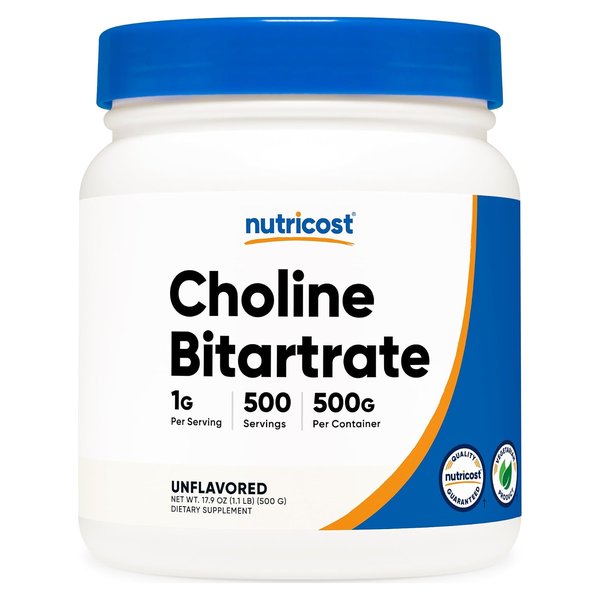
Nutricost Choline Bitartrate Powder (500 g)
Best for: The lowest cost per milligram of choline
The most choline for the money: 400 mg per scoop, stated on the label, with nothing else in the tub, for about $0.04 a day. It ties the NOW capsule on score and ranks first on cost. The trade-off is a daily scoop to mix, and its testing claim names no lab.
- States 400 mg of choline per 1 g scoop on the panel, about 73 percent of the Daily Value, and lists no other ingredients
- About $0.04 a day and about $0.01 per 100 mg of choline, the lowest cost per milligram of choline of any product ranked here
- A restrained listing with no memory or brain claims
- A powder you mix into water every day, which is less convenient than a capsule
- Its third-party testing claim names no lab
- Choline salts like this one raised TMAO, a gut-made compound, in small trials; what that means for health is unsettled
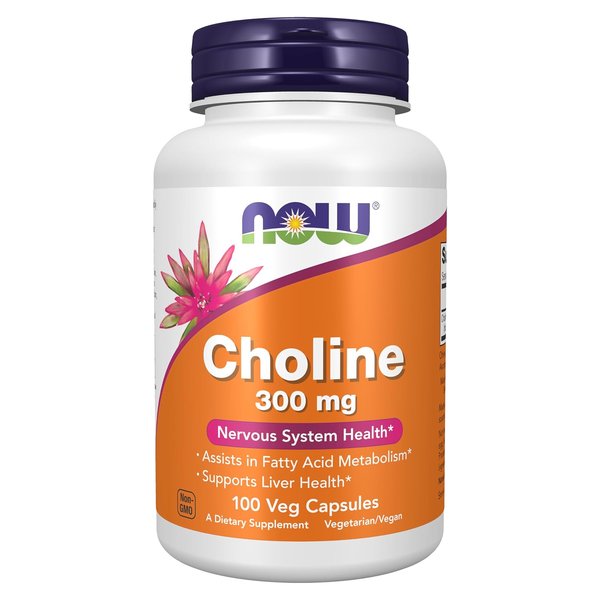
NOW Foods Choline 300 mg (100 veg capsules)
Best for: Meeting your daily choline need in a capsule
The best capsule for meeting your daily need: 300 mg of choline from bitartrate, stated on the label, for about $0.10 a day. It matches the Nutricost powder on every measure except cost, so choose it if you would rather swallow a capsule than mix a powder.
- States 300 mg of choline from 730 mg of choline bitartrate per capsule, so you know exactly what you get
- About $0.10 a day for a plant-based capsule, sold by Amazon
- One capsule a day more than covers the average gap between diet and the Adequate Intake
- Its quality claims describe a factory certification and in-house labs, not a product test we could confirm
- Choline salts like this one raised TMAO in small trials; the health meaning is unsettled
- Costs about two and a half times as much per day as the Nutricost powder for less choline
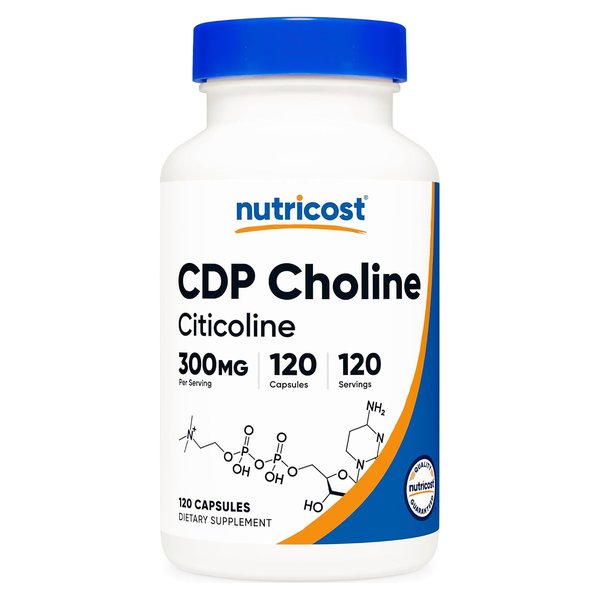
Nutricost CDP Choline (Citicoline) 300 mg (120 capsules)
Best for: Low-cost citicoline with a stated choline amount
The citicoline to buy if you want citicoline: the only one we found that states its choline on the panel, at about $0.22 a day, with a restrained listing. It is generic rather than the Cognizin brand used in the trials, and 60 mg of choline is a small amount for the price.
- The only citicoline we found that states its choline on the panel: 60 mg from 300 mg of citicoline
- About $0.22 a day, the lowest cost per day of any citicoline here
- A factual listing with no memory claims, and only rice flour, silica, magnesium stearate and the capsule besides the citicoline
- Generic citicoline: the three industry trials in healthy adults used the Cognizin brand, the same molecule
- Supplies little choline for the money, about $0.37 per 100 mg, more than 30 times the bitartrate powder
- Its third-party testing claim names no lab
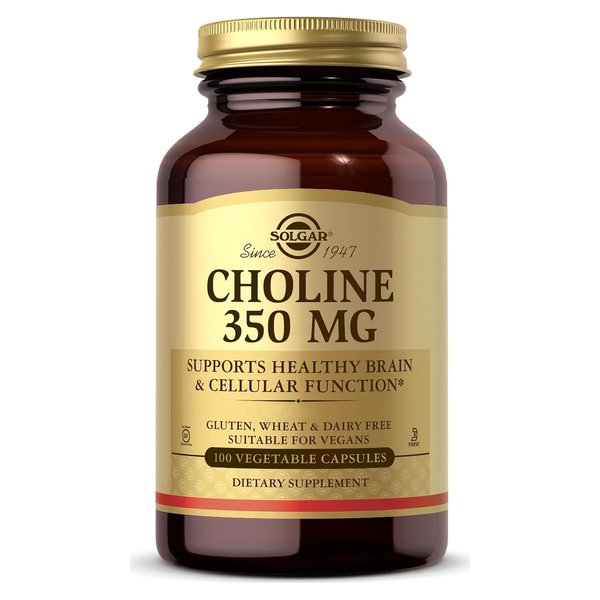
Solgar Choline 350 mg (100 vegetable capsules)
Best for: Adjusting the dose to your diet
A flexible bitartrate capsule with 350 mg of choline each, so one to three a day can be fitted to your diet, at about $0.13 for one. It makes no testing claim, and its listing tells you to take three, more than most people need.
- States 350 mg of choline per capsule, so one to three a day lets you match your own diet
- About $0.13 a day at one capsule, in a vegan capsule free of common allergens
- Sold by Amazon, from a long-established brand
- Makes no third-party testing claim
- The listing says one capsule three times daily, but the label says one to three a day; three would add 1,050 mg, more than most people need from a supplement
- Calls itself the gold standard, which we cannot verify
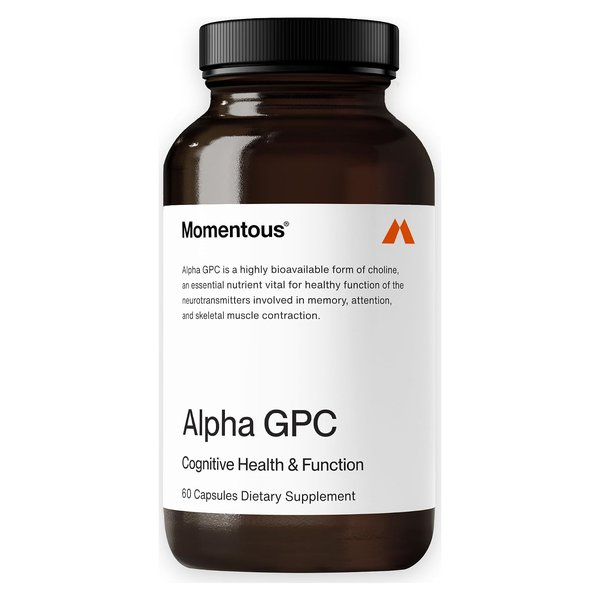
Momentous Alpha GPC 300 mg (60 capsules)
Best for: Athletes and anyone who wants certified contents
The best-verified product in the category: NSF Certified for Sport, 300 mg of alpha-GPC a day in a simple capsule. It costs about $0.72 a day, the label does not state choline, and its growth hormone and brain-protection marketing outruns the small studies behind it.
- NSF Certified for Sport, which we confirmed on NSF's listing: the only single-ingredient choline product of any form we found on NSF's sport list
- 300 mg of alpha-GPC a day, inside the range used in healthy-adult trials
- A simple capsule: cellulose, the capsule and two flow agents
- About $0.72 a day and about $0.59 per 100 mg of choline; the label does not state choline (about 120 mg)
- Its listing markets growth hormone and endurance benefits that the small trials in healthy adults do not show, and the bottle calls alpha-GPC highly bioavailable
- A large Korean records study linked prescription alpha-GPC with more strokes in people 50 and older; it cannot show cause
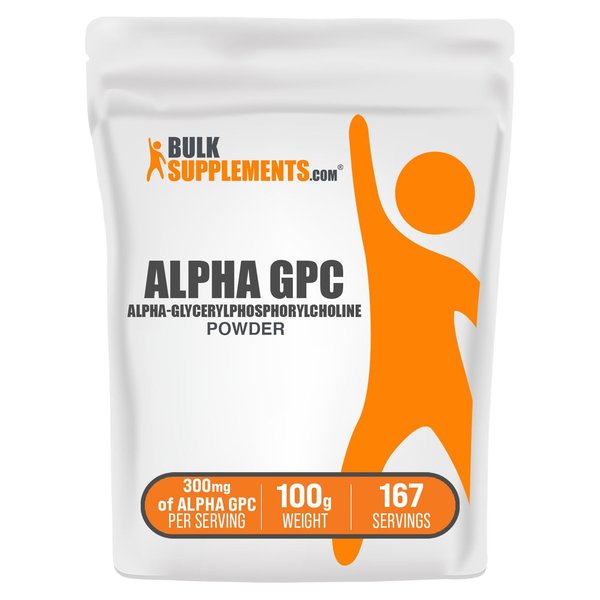
BulkSupplements Alpha GPC Powder (100 g)
Best for: Alpha-GPC on a budget
The cheapest way to take alpha-GPC at a researched dose, about $0.14 a day, with a panel that shows the active amount and the carrier. You measure it by quarter teaspoon, and a gallery image headlines the powder weight as if it were the active amount.
- The panel shows 300 mg of alpha-GPC from about 600 mg of powder, plus the calcium phosphate carrier, so the active amount is clear
- About $0.14 a day, the lowest cost per day of any alpha-GPC we compared
- Only calcium phosphate and silica besides the alpha-GPC
- A quarter-teaspoon measure is approximate; a small scale gives a more even dose
- A gallery image headlines 600 mg per serving, which is the powder weight, not the alpha-GPC
- The Korean stroke association noted above concerns alpha-GPC in general, not one brand; its testing claim names no lab
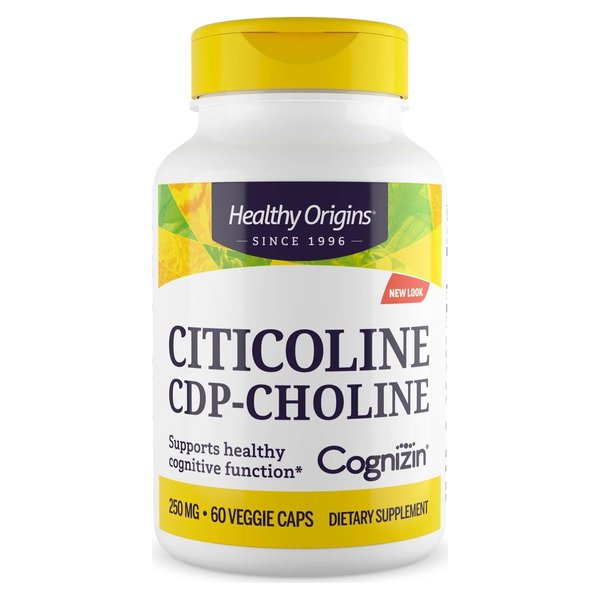
Healthy Origins Citicoline (Cognizin) 250 mg (60 veggie capsules)
Best for: The citicoline brand used in trials
The lowest-cost Cognizin we compared, the citicoline brand used in the three industry trials in healthy adults, at 250 to 500 mg a day for about $0.37 to $0.73. It does not state choline (about 50 mg per capsule), and the trials behind it were small and run with the brand owner.
- Cognizin, the citicoline brand used in the three industry trials in healthy adults, at 250 to 500 mg a day, the doses those trials tested
- The lowest cost per day of the Cognizin products we compared: about $0.37 a day at one capsule, $0.73 at two
- A vegetarian capsule with few other ingredients
- Does not state choline on the label; 250 mg of citicoline supplies only about 50 mg
- The trials behind Cognizin were small and run with the brand owner, and the largest missed its main outcome
- Says its quality standards set it apart from competitors, which we cannot verify; its testing claim names no lab
The full lineup, side by side
Amounts come from each product's Supplement Facts panel on its Amazon listing, read November 3, 2026. Choline marked as not stated is our estimate from the compound weight: alpha-GPC is about 40 percent choline and citicoline about 20 percent.
| Product | Form | Choline per day | Testing | Cost per day | Per 100 mg choline | Score |
|---|---|---|---|---|---|---|
| #1 Nutricost Powder | Choline bitartrate powder | 400 mg (stated) | Unnamed claim | $0.04 | $0.01 | 4.4 |
| #2 NOW Choline 300 mg | Choline bitartrate capsule | 300 mg (stated) | Unnamed claim | $0.10 | $0.03 | 4.4 |
| #3 Nutricost Citicoline | Citicoline (generic) | 60 mg (stated) | Unnamed claim | $0.22 | $0.37 | 4.2 |
| #4 Solgar Choline | Choline bitartrate capsule | 350 mg (stated) | None claimed | $0.13 | $0.04 | 4.2 |
| #5 Momentous | Alpha-GPC capsule | About 120 mg (not stated) | NSF Certified for Sport (confirmed) | $0.72 | $0.59 | 4.0 |
| #6 BulkSupplements Alpha GPC | Alpha-GPC powder | About 120 mg (not stated) | Unnamed claim | $0.14 | $0.11 | 4.0 |
| #7 Healthy Origins Cognizin | Citicoline (Cognizin) | About 50 mg (not stated) | Unnamed claim | $0.37 | $0.72 | 3.9 |
Prices are single-bottle, one-time Amazon prices on November 3, 2026 and change often. Cost per day uses the lowest daily dose on the label. Testing is what we could confirm on a certifier's own site; an unnamed claim is one that names no lab or program.
How to choose, and what to check first
Decide which job you want done. If you eat few eggs or little meat and want to reach the Adequate Intake, a choline salt is the simplest and cheapest choice: 250 to 400 mg a day of choline from bitartrate covers the typical gap for a few cents. If you want to try a product studied for attention or memory, citicoline at 250 to 500 mg a day (the Cognizin brand matches the trials) or 300 to 600 mg of active alpha-GPC is the usual choice, with modest expectations.
Read the choline line. Look for choline stated in milligrams. On alpha-GPC, check whether the amount is active alpha-GPC or a 50 percent powder; on citicoline, expect about 50 mg of choline per 250 mg. A title that says "choline 600 mg" may mean 600 mg of choline bitartrate, which is about 250 mg of choline.
Do not stack forms without a reason. Taking citicoline or alpha-GPC on top of a choline salt adds cost, and we found no trial that tested the combination. For other brain-focused options, see our nootropic rankings and cognitive top picks.
- Pregnancy. Choline needs rise, but citicoline and alpha-GPC lack pregnancy safety data. Choose a prenatal that lists choline and ask your provider.
- Age 50 or older, or heart or stroke risk factors. Ask a doctor before daily alpha-GPC.
- Medicines. If you take drugs for memory, Parkinson's or bladder control, ask your doctor before starting citicoline or alpha-GPC.
- Fishy body odor. It is a sign of too much choline for your body to handle; people with trimethylaminuria should avoid choline supplements.
- Memory changes. New forgetfulness or confusion needs a medical check, not a supplement.
Frequently asked questions
What is the best form of choline?
It depends on the job. For meeting your daily need, choline bitartrate or chloride is the cheapest per milligram of choline. For a product studied for attention or memory, citicoline (especially the Cognizin brand) or alpha-GPC are the usual choices, but their trials are small and mostly industry-funded, with modest results.
Is alpha-GPC or citicoline better?
We found no trial comparing their effects on memory, attention or performance in healthy people. Alpha-GPC is about 40 percent choline and citicoline about 20 percent, and citicoline also supplies cytidine. Citicoline's best trial missed its main outcome but improved secondary memory scores; alpha-GPC's trials are small and mixed. Alpha-GPC also carries an unresolved stroke association in older adults.
How much choline is in alpha-GPC and citicoline?
About 40 percent of alpha-GPC's weight is choline, so 300 mg supplies about 120 mg. Citicoline is about 20 percent choline, so 250 mg supplies about 50 mg. Choline bitartrate is about 41 percent choline, and choline chloride about 75 percent.
Do I need a choline supplement?
Many people do not reach the Adequate Intake of 425 mg a day for women and 550 mg for men, especially if they eat few eggs, meat or fish. A supplement giving 250 to 400 mg of choline closes the typical gap. True deficiency is rare, and you can also get there with food.
Is choline bitartrate safe?
At normal supplement doses it is well below the 3,500 mg upper limit for adults. Very high doses can cause a fishy body odor, sweating, stomach upset and low blood pressure. Choline salts raise TMAO, a compound linked to heart disease in observational studies, though whether it causes harm is unsettled.
When should I take choline?
Labels usually say with a meal. For meeting your daily need, timing matters little. Most citicoline trials in healthy adults gave it daily for 2 weeks to 3 months, and the few single-dose studies were mixed, so treat it as a daily supplement rather than a same-day aid; a single large dose of choline bitartrate did not improve memory in healthy students.
Can I take choline while pregnant?
Choline needs rise to 450 mg a day in pregnancy, and most pregnant women fall short. Food and a prenatal that lists choline are the usual routes; citicoline and alpha-GPC lack pregnancy safety data. Talk to your provider before adding a separate supplement.
The bottom line
For most people, the best choline supplement is the cheapest honest one: a choline bitartrate powder or capsule that states its choline in milligrams, such as Nutricost's powder or NOW Choline 300 mg, taken to close the gap between your diet and the Adequate Intake. Citicoline and alpha-GPC cost far more per milligram of choline and rest on small, mostly industry-funded trials with modest results; if you want to try one, Nutricost Citicoline states its choline, Healthy Origins is the lowest-cost Cognizin we compared, and Momentous is the best-verified alpha-GPC. Check the choline line on any label, and ask a doctor before daily alpha-GPC if you are 50 or older or have heart or stroke risk factors.