NAC, short for N-acetylcysteine, is one of the most popular antioxidant supplements for a simple reason: it is the raw material your body uses to make glutathione, the master antioxidant that protects nearly every cell. It is also a decades-old compound with a real pharmacology, used in hospitals as a mucus thinner and as the antidote for acetaminophen overdose, which is unusual company for a supplement. We compared the leading NAC products on dose, added cofactors, form, testing, and price, and ranked them with the evidence, and NAC's unusual legal status, kept honestly in view.
The short version
- Best overall: Life Extension NAC 600 mg. A clean, standard dose from a science-focused brand that publishes its testing, at a fair price.
- Best with cofactors: NOW NAC pairs 600 mg with selenium and molybdenum, and best value: Nutricost.
- Best third-party-tested: Thorne (NSF Contents Certified), and best sustained-release: Jarrow N-A-C Sustain.
- Reality check: NAC reliably supports glutathione and antioxidant defenses. Its strongest clinical evidence is in respiratory conditions studied in patients; it does not treat any disease.
How we ranked them
NAC is a commodity ingredient, so quality and formulation are what separate the products. We weighed five things, in this order:
- Dose and formulation. A clear, standard dose (600 mg is the reference), plus whether the product adds useful cofactors like selenium and molybdenum that support glutathione-related enzymes.
- Testing and quality. Third-party testing, NSF certification, published Certificates of Analysis, and a reputable manufacturer counted most.
- Form. Standard capsules versus a sustained-release tablet, and whether the product tames NAC's strong sulfur smell.
- Value. Cost per serving, since NAC is an inexpensive, take-it-daily supplement.
- Format details. Vegan capsules, clean labels, and a sensible bottle size.
Scores are our editorial assessment on a five-point scale, not customer ratings, and they reflect the realistic state of the evidence rather than treating NAC as a cure for anything.
The 7 best NAC supplements
Tap any product to jump straight to its full review.
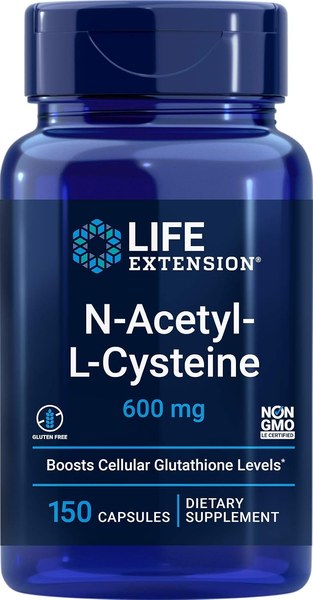
Life Extension NAC 600 mg
Form: Plain 600 mg NAC · vegetarian capsule
The pick most people should start with. Life Extension is a science-focused brand that publishes Certificates of Analysis for its batches, and this is a clean, standard 600 mg NAC in a rapidly absorbed vegetarian capsule, at a fair price and in a generous 150-count size. It skips the extras, no cofactors, no sustained-release, but as a transparent, well-priced, versatile daily NAC to support glutathione, it is the easiest to recommend.
- Science-focused brand that publishes batch Certificates of Analysis
- Standard, well-studied 600 mg dose
- Vegetarian capsule, gluten-free, good value
- Available in 60 and 150-count sizes
- No added glutathione cofactors
- Not NSF certified like some practitioner brands
- Plain NAC has the usual sulfur smell
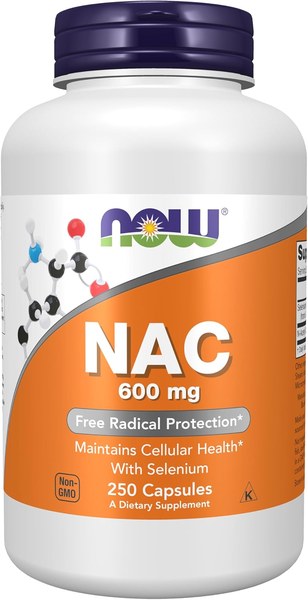
NOW Foods NAC with Selenium
Form: 600 mg NAC plus selenium and molybdenum · veg capsule
The classic reference formula, and a superb value. NOW pairs 600 mg NAC with selenium and molybdenum, two trace minerals involved in glutathione-related and sulfur metabolism, so it is the pick if you want the cofactors bundled in rather than bought separately. Add a huge 250-capsule bottle and one of the lowest costs per serving here, from NOW's long-running audited facility, and it is very hard to beat. It relies on in-house rather than third-party certification.
- Adds selenium and molybdenum, the glutathione-supporting cofactors
- Excellent cost per serving, large 250-count bottle
- Vegan, non-GMO, made in NOW's audited GMP facility
- In-house testing rather than NSF or third-party certification
- Cofactor amounts are a modest bonus, not a therapeutic dose
- Strong sulfur smell typical of NAC
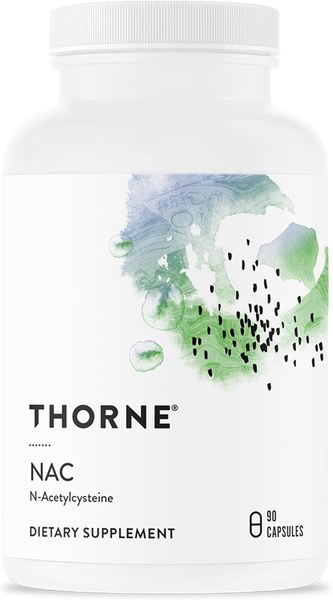
Thorne NAC 500 mg
Form: Plain 500 mg NAC · NSF Contents Certified
The pick when verified quality is the priority. Thorne is the practitioner-grade brand clinicians trust most, and this NAC is NSF Contents Certified, meaning an independent body has verified the label and screened for contaminants, in a clean, hypoallergenic capsule free of gluten, dairy, and soy. The trade-offs are a slightly lower 500 mg dose and top-tier pricing, but for third-party-verified purity, it is the standout.
- NSF Contents Certified, independently verified label
- Practitioner-grade brand used in research and clinics
- Clean, hypoallergenic, free of common allergens
- Lower 500 mg per capsule than most rivals
- Highest-tier price and a smaller 90-count bottle
- No cofactors or sustained-release
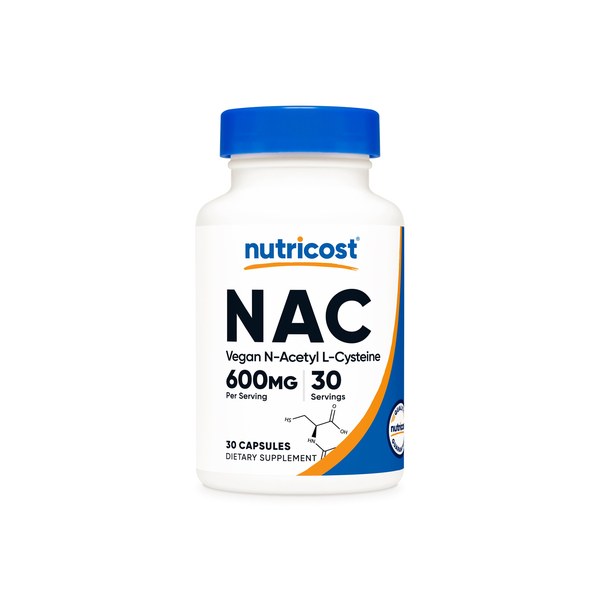
Nutricost NAC 600 mg
Form: Plain 600 mg NAC · third-party tested
The value pick that does not cut the wrong corners. Nutricost delivers a standard 600 mg NAC at the lowest cost per serving here, and unlike many budget brands it is third-party tested by ISO-accredited labs and made in an NSF-certified, FDA-registered facility. A large 180-count bottle seals the deal. If you want a no-frills, well-tested daily NAC for the least money, this is it. Vegans should pick Nutricost's clearly labeled veg-cap size.
- Lowest cost per serving from a third-party-tested brand
- Made in an NSF-certified, FDA-registered GMP facility
- Large 180-count bottle, widely available
- This SKU is not clearly labeled vegetarian; pick the veg-cap size if needed
- No cofactors and no sustained-release option
- Value brand rather than a clinician line
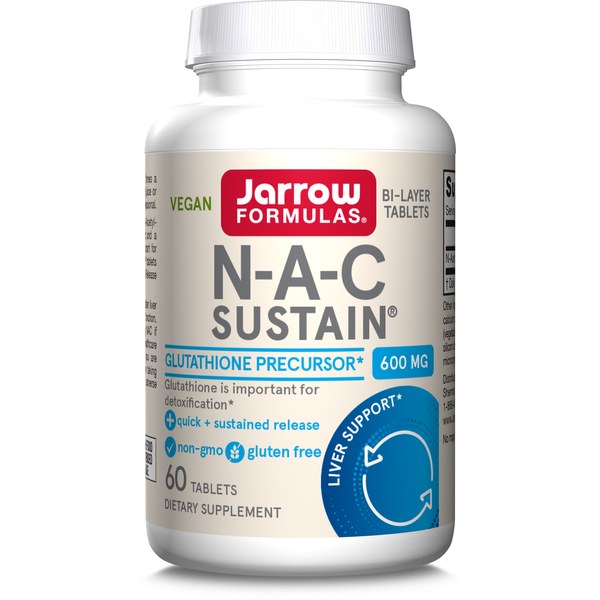
Jarrow N-A-C Sustain 600 mg
Form: Bilayer sustained-release tablet · 600 mg
The pick if you want steadier delivery. Jarrow's well-known bilayer Sustain tablet releases part of its 600 mg NAC quickly and the rest gradually, which is designed to smooth out blood levels over a longer window rather than spiking and fading. It is a vegan, non-GMO tablet from a respected brand. The bottle is smaller at 60 tablets, and there is no strong evidence that sustained-release outperforms plain NAC for results, so this is about preference and convenience.
- Bilayer quick-plus-sustained release for steadier levels
- Full 600 mg from a long-established brand
- Vegan, non-GMO tablet
- Sustained-release is not proven to work better than plain NAC
- Smaller 60-count bottle
- Tablet rather than capsule; no cofactors
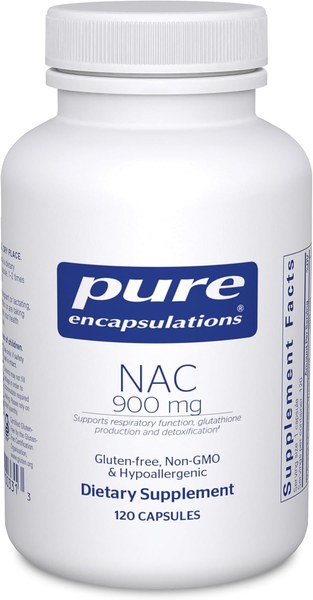
Pure Encapsulations NAC 900 mg
Form: Plain 900 mg NAC · hypoallergenic vegetarian capsule
The pick for a higher dose in a single, clean capsule. Pure Encapsulations delivers a full 900 mg of NAC per capsule, so it is convenient if you want to take more than 600 mg without doubling up, from a hypoallergenic, third-party-tested practitioner brand. It is a premium product, so you pay for the brand and the higher dose, and there is no reason to jump to a higher dose without a specific goal.
- Full 900 mg in a single capsule, convenient higher dose
- Hypoallergenic, third-party tested practitioner brand
- Vegetarian, non-GMO, clean formulation
- Premium price per serving
- No cofactors and no sustained-release
- Higher dose is not automatically better for general use
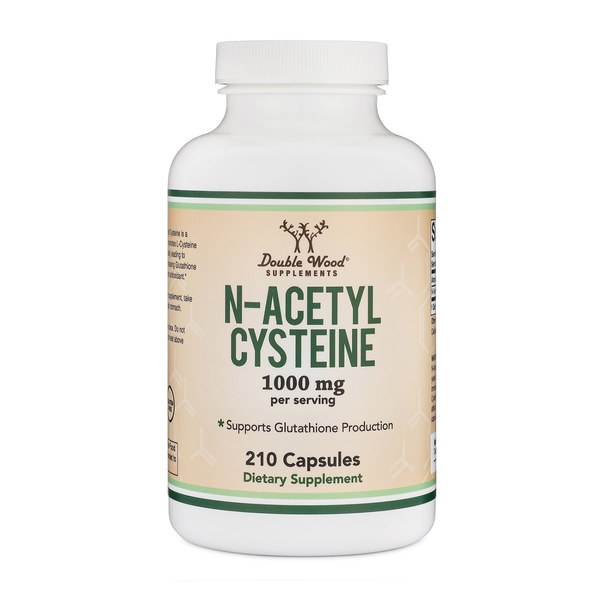
Double Wood NAC 1000 mg
Form: 500 mg per capsule, 1000 mg per serving · odor-masked
The pick for flexible, higher dosing on a budget. At 500 mg per capsule, Double Wood lets you take 500, 1000, or 1500 mg to suit your goal, and it is third-party tested with per-batch Certificates of Analysis at a fraction of the practitioner price. Its odor-masking technology also tames the sulfur smell that plagues most NAC. Reaching the 1000 mg serving takes two capsules, and it is a direct-to-consumer brand rather than a clinician line.
- Flexible dosing from 500 mg capsules, up to 1000 mg or more
- Third-party tested with per-batch Certificates of Analysis
- Odor-masking helps with NAC's sulfur smell; vegan, non-GMO
- Two capsules needed for the 1000 mg serving
- Direct-to-consumer brand, no NSF certification
- No added cofactors
The full lineup, side by side
| Product | Dose | Cofactors | Form | Testing | ~Cost/serving |
|---|---|---|---|---|---|
| Life Extension | 600 mg | None | Capsule | Published CoA | ~$0.16 |
| NOW Foods | 600 mg | Selenium + molybdenum | Capsule | In-house GMP | ~$0.11 |
| Thorne | 500 mg | None | Capsule | NSF Certified | ~$0.34 |
| Nutricost | 600 mg | None | Capsule | Third-party | ~$0.10 |
| Jarrow N-A-C Sustain | 600 mg | None | Sustained-release | cGMP | ~$0.30 |
| Pure Encapsulations | 900 mg | None | Capsule | Third-party | ~$0.35 |
| Double Wood | 1000 mg/serving | None | Capsule (odor-masked) | Third-party | ~$0.29 |
Prices are approximate and change often. Doses are per serving; check the label for how many capsules that takes. Confirm current pricing and details on the retailer page.
What NAC does, and does it work?
NAC is one of the better-studied antioxidant supplements, which makes an honest read especially useful. Here is the fair version.
The core mechanism is solid. NAC is a thiol-containing derivative of the amino acid cysteine, and its central role is as a precursor to glutathione, the body's master antioxidant, by supplying cysteine, the rate-limiting building block. It also acts as a direct free-radical scavenger and has anti-inflammatory effects, working through cellular pathways such as Nrf2 and NF-kappaB. That is well-established biology, and it is why NAC is used to support antioxidant defenses and why our guide to glutathione keeps coming back to it.
The strongest clinical evidence is respiratory. NAC has a long history as a mucolytic, or mucus thinner, and this is where the human data is strongest. A 2024 meta-analysis found that NAC significantly reduced the number of exacerbations in people with COPD and chronic bronchitis and improved symptoms and quality of life. Those are studies in patients with a diagnosed condition, so the finding describes a clinical use, not a promise for healthy people, but it shows NAC is a genuinely active compound.
Other uses are promising but mixed. NAC is studied across many areas. In polycystic ovary syndrome, a 2025 meta-analysis of 22 trials found NAC improved several reproductive markers, though PCOS is a medical condition managed with a clinician. In liver, brain, cardiovascular, and psychiatric research, results are genuinely mixed, and reviews conclude that clinical outcomes remain inconsistent and that more well-designed trials are needed. The honest summary is a strong antioxidant mechanism, solid respiratory data, and a lot of promising-but-unsettled research elsewhere. As a supplement, the sensible frame is glutathione and antioxidant support, not disease treatment.
One thing NAC is not: a home antidote. NAC is the hospital treatment for acetaminophen (Tylenol) overdose, but that is given in carefully calculated medical doses under supervision. Never try to self-treat a suspected overdose with an over-the-counter NAC supplement; that is a medical emergency that needs poison control or an emergency room.
How to choose the right one
NAC is a simple category, so a few questions narrow it fast:
- Dose. 600 mg is the standard, well-studied amount, and most people do fine taking it once or twice a day. Higher-dose products (900 to 1000 mg) are convenient if you have a reason to take more, but more is not automatically better.
- Cofactors. Adding selenium and molybdenum, as NOW does, supports glutathione-related and sulfur metabolism (selenium is part of glutathione's key enzyme). It is a nice bonus, not essential, and you can also get selenium from a Brazil nut or a multivitamin.
- Testing. For maximum confidence, choose NSF-certified (Thorne) or clearly third-party-tested products with published Certificates of Analysis.
- Form and smell. Plain capsules are fine for almost everyone. A sustained-release tablet or an odor-masked capsule is worth it if NAC's sulfur smell bothers you or you want steadier levels.
- Value. NAC is cheap, so unless you want a specific certification or feature, a well-tested budget option like Nutricost covers most needs.
Frequently asked questions
What does NAC do for the body?
NAC (N-acetylcysteine) is a stable form of the amino acid cysteine, and its main job is to supply the raw material your body uses to make glutathione, often called the master antioxidant. On top of that, NAC is a direct free-radical scavenger and has anti-inflammatory effects, and it thins mucus, which is why it has long been used as a mucolytic. In practical terms, people take NAC to support their antioxidant defenses and glutathione levels, and it is one of the better-studied antioxidant supplements, even though the strength of the evidence varies a lot by use.
Is NAC the same as glutathione?
No. Glutathione is the antioxidant your cells actually use, and NAC is a precursor, meaning it provides the cysteine that is the rate-limiting building block your body needs to make glutathione. Taking NAC is a well-established, inexpensive, and stable way to support glutathione production. Taking glutathione directly is also an option, though absorption of oral glutathione has historically been debated, which is part of why NAC remains so popular. They are related tools for the same goal, not the same molecule.
How much NAC should I take per day?
Most supplement labels and studies use 600 to 1800 mg per day, and 600 mg once or twice daily is the most common regimen. Higher doses have been used in specific clinical settings under medical supervision. There is no need to assume more is better for general antioxidant support, so a sensible approach is to start at 600 mg a day, take it consistently, and increase only if you have a specific reason. Taking it with food can reduce the mild stomach upset some people notice.
Is it legal to buy NAC supplements?
Yes. NAC has an unusual history: because it was approved as a drug before it appeared in supplements, the FDA has taken the position that it is technically excluded from the legal definition of a dietary supplement. That is why NAC briefly became hard to find online in 2021. However, in final guidance issued in 2022, the FDA said it intends to exercise enforcement discretion, meaning it does not plan to object to NAC being sold as a supplement while it considers a formal rule. In practice, NAC is widely and legally available today.
What are the side effects of NAC?
NAC has a generally favorable safety profile, and the most common side effects are mild and digestive, such as nausea, an upset stomach, or loose stools, which taking it with food can help. NAC also has a distinctive sulfur, or rotten-egg, smell that many people dislike, though it is harmless. Because NAC can have blood-thinning and other effects at higher doses, and can interact with some medications such as nitroglycerin, anyone on medication, with a bleeding disorder, or who is pregnant or breastfeeding should check with a doctor before using it.
Should I take NAC or glutathione?
For most people, NAC is the more practical and better-value choice, because it is inexpensive, chemically stable, extensively studied, and reliably raises glutathione by supplying its building block. Direct glutathione supplements, especially liposomal or S-acetyl forms, are a reasonable alternative if you prefer to supply the finished antioxidant, but they usually cost more. If your goal is simply to support your glutathione and antioxidant system, starting with a quality NAC is the sensible, evidence-supported move, and you can read more in our guide to glutathione.
The bottom line
NAC has earned its place as a staple antioxidant supplement: it is cheap, well-tolerated, genuinely active, and the most reliable way to feed your body the building block it needs for glutathione. Keep the evidence in proportion, a strong mechanism, solid data in respiratory conditions studied in patients, and promising-but-mixed research elsewhere, and treat it as support for your antioxidant defenses rather than a cure. If you want a simple, quality pick, Life Extension is the transparent all-rounder, NOW adds the glutathione cofactors, Thorne is the certified-purity choice, and Nutricost is the value buy. Match the dose and features to your goal, take it consistently, and you have one of the better-evidenced antioxidant tools in the cabinet.