Creatine monohydrate is one of the best-studied supplements there is, and gummies are the fastest-growing way to take it. They are also the riskiest. Creatine slowly breaks down into creatinine in warm, wet, acidic conditions, which describes a gummy, and lab tests in 2024 and 2025, one run by a competing creatine maker, found several brands with a fraction of their labeled creatine or none at all.
So this ranking puts proof of content first. We read the printed label on every product below, checked each one against NSF's own listings and Labdoor's, and scored all nine on the same five criteria: independent verification of the creatine, dose per serving, added sugar, cost per gram and how honest the label and listing are. For the full comparison with powder, see our creatine supplements ranking and our monohydrate vs HCl vs gummies guide.
The short version
- Best overall: Legion Creatine Gummies, 5 g in 4 sugar-free gummies, with Labdoor measuring 5.92 g per serving in August 2026.
- Best for tested athletes: Force Factor, NSF Certified for Sport, measured at 6.3 g per 5 g serving in SuppCo's 2025 test, but with 5 g of added sugar.
- Best budget pick: Nutravita, NSF/ANSI 173 listed and sugar-free at about 12 cents per gram, though its label has problems and another brand on its NSF listing failed SuppCo's 2025 test.
- Many gummies have failed. In SuppCo's 2025 test, 4 of 6 gummy brands had trace or no creatine; NOW Foods, a competing maker, reported about half of 12 brands short in 2024.
- Gummies cost far more. Our picks run 8 to 37 cents per gram, against about 5 cents for budget powder.
- The dose is the same. 3 to 5 g a day is enough; you do not need to load with 20 g, which would mean a dozen or more gummies.
- Watch sugar and sugar alcohols. Added sugar ranges from 0 to 7 g per serving here, and the sugar-free ones use up to 8 g of sugar alcohols.
How we ranked them
A creatine gummy is only worth buying if the creatine is actually in it, so verification carries the most weight:
- Creatine verification (30%). Full marks for NSF Certified for Sport or a Labdoor certification with a published measured amount, both confirmed on the certifier's site on October 18, 2026. An NSF/ANSI 173 listing scores slightly lower, a brand-published batch result that names no lab lower again, and an unnamed testing claim or nothing at all lowest. We cap the score when another product under the same NSF listing holder failed a published potency test. Only tests by parties that do not sell competing creatine count toward this cap, so NOW Foods' 2024 results are reported but not scored.
- Dose per serving (20%). Whether one labeled serving reaches 5 g of creatine.
- Added sugar (20%). Full marks for none, half a point off for each gram.
- Cost per gram of creatine (15%), from Amazon prices on October 18, 2026.
- Label integrity and marketing (15%). Points come off (half a point per category) for unverifiable "#1" or comparison claims, overstated statistics, benefit claims beyond creatine's evidence, listings that contradict the label, and Supplement Facts panels that do not add up.
We report published third-party test results on each card, but we score only current certification, because those tests covered single lots at a point in time. Scores are rounded to one decimal; ties are ordered by the heavier criterion, then by cost. Chewable tablets are covered separately below. No brand paid to be included, and none sent product.
Do creatine gummies work?
What creatine does. Creatine tops up the phosphocreatine your muscles use for short, hard efforts. In pooled trials it modestly improved strength in both the lower and upper body, and with resistance training it added about 1.1 kg of lean mass on average; without exercise, lean mass showed no significant change. In the same analysis, the gain in women was smaller and not statistically significant. In older adults training with weights, it added about 1.4 kg of lean tissue. Memory results are mixed: one meta-analysis found a small benefit, mainly in older adults, but a published critique questioned its statistics, and a 2024 review found a small memory benefit but no significant improvement in overall cognition.
How much you need. The International Society of Sports Nutrition recommends 3 to 5 g a day; loading with about 20 g a day for 5 to 7 days fills muscles faster, but 3 g a day for 28 days reached a similar rise of about 20 percent. Loading is impractical with gummies, which hold 1 to 1.5 g each, so plan on the steady 3 to 5 g route.
Why gummies are a problem. Creatine is stable as a dry powder for years, but in water it slowly turns into creatinine, and the lower the pH, the faster: in one set of measurements cited in a 2011 review, 4, 12 and 21 percent degraded in three days at room temperature at pH 5.5, 4.5 and 3.5. Gummies are made with water, heat and acid, and a 2009 study found creatine kept degrading across the whole range of water activity tested, without the slowdown near semisolid-food levels that most food reactions show. We found no peer-reviewed study of creatine stability in gummies.
What the lab tests found. In 2024 NOW Foods, which sells competing creatine, tested one lot each of 12 gummy brands by HPLC and reported that about half fell short of their labels, including Create; one disputed brand produced its own accredited-lab certificate showing it passed. In June 2025, SuppCo had an ISO 17025 accredited lab test off-the-shelf products: all 5 powders passed, while 4 of 6 gummies had trace or no creatine. Force Factor (6.3 g per 5 g serving) and Create (4.59 g per 4.5 g serving) passed, though SuppCo noted significant creatinine in both. Some formulators argue that pectin can interfere with standard test methods, which is one reason this ranking leans on certifiers that test products on an ongoing basis. Create also faces a 2026 class action alleging 4.01 g per serving, which it disputes.
The only gummy trial. A 2026 study gave 32 female volleyball players Create gummies (5 g a day) or nothing for 10 weeks. Jump height and change of direction improved, but lean mass showed no significant difference, and the study had no placebo, used donated product, and had authors who advise Create. Creatine that survives in a chew is usable: in a food-bar study it was absorbed, just more slowly.
The 9 best creatine gummies
Tap any product to jump straight to its full review.
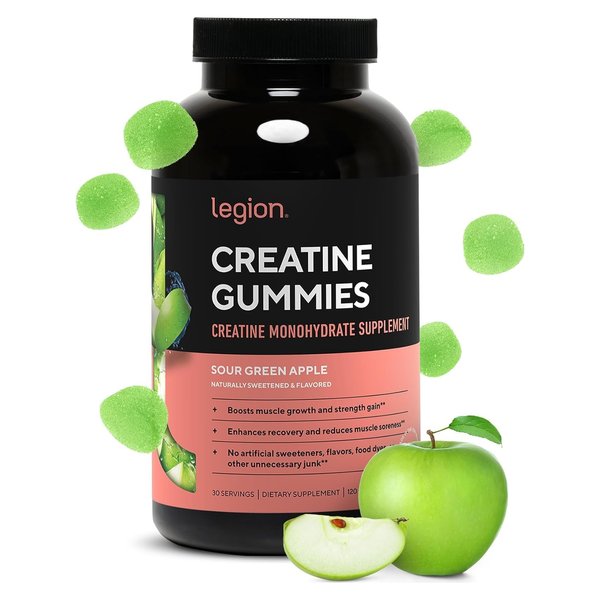
Legion Creatine Gummies
Best for: Most people who want proof of content and no added sugar
The top pick because it has the strongest public proof of what is inside: Labdoor tested a lot in August 2026 and measured 5,920 mg of creatine per serving, 118 percent of the 5 g label, and lists the product as certified on its site. Four gummies give the full 5 g with no added sugar and 30 calories, at about 23 cents per gram. The trade-offs are 8 g of sugar alcohols per serving, which can upset some stomachs, and no NSF Certified for Sport mark for athletes who need one.
- Labdoor measured 5,920 mg of creatine per serving in August 2026, 118% of the 5 g label
- Two flavors (Raspberry Lemonade, Sour Blue Raspberry) are also listed under NSF/ANSI 173
- A full 5 g dose in 4 gummies with no added sugar
- A plain listing that sticks to creatine's studied uses
- 8 g of sugar alcohols (maltitol, isomalt, erythritol) per serving can upset some stomachs
- About 23 cents per gram, several times the cost of creatine powder
- Not NSF Certified for Sport, if your sport requires it
- Only about 180 Amazon ratings
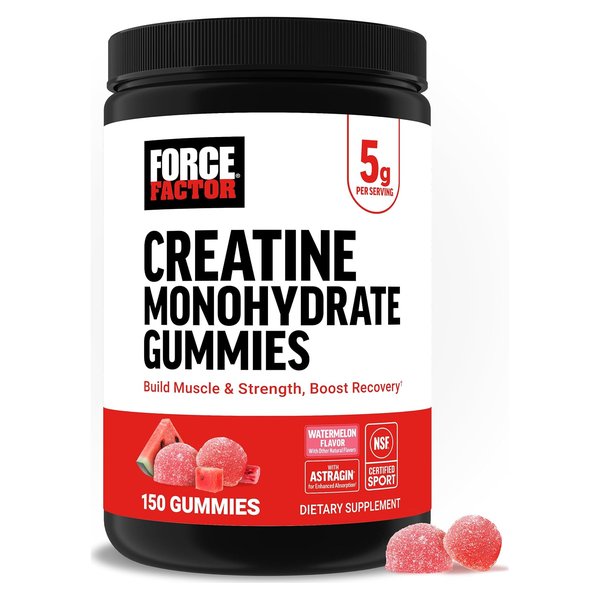
Force Factor Creatine Monohydrate Gummies
Best for: Athletes in drug-tested sports who need NSF Certified for Sport
The pick for athletes in drug-tested sports, and the strongest-verified gummy after Legion: it is NSF Certified for Sport and NSF/ANSI 173 listed, both confirmed on NSF's sites, and SuppCo's 2025 test measured 6.3 g per 5 g serving, though it also noted significant creatinine. Five gummies give 5 g at about 20 cents per gram. It loses ground for 5 g of added sugar plus maltitol, and for crediting a 25 mg AstraGin extract with better creatine absorption, which we found no independent trial showing.
- NSF Certified for Sport, which screens for banned substances, confirmed on NSF's site
- SuppCo's 2025 test measured 6.3 g of creatine per 5 g serving, though it also noted significant creatinine
- Also listed under NSF/ANSI 173
- A full 5 g dose at about 20 cents per gram
- 5 g of added sugar per serving, plus maltitol
- Five gummies per serving
- Adds 25 mg of AstraGin and claims it improves creatine absorption, which we found no independent trial showing
- A 3.6-star average rating
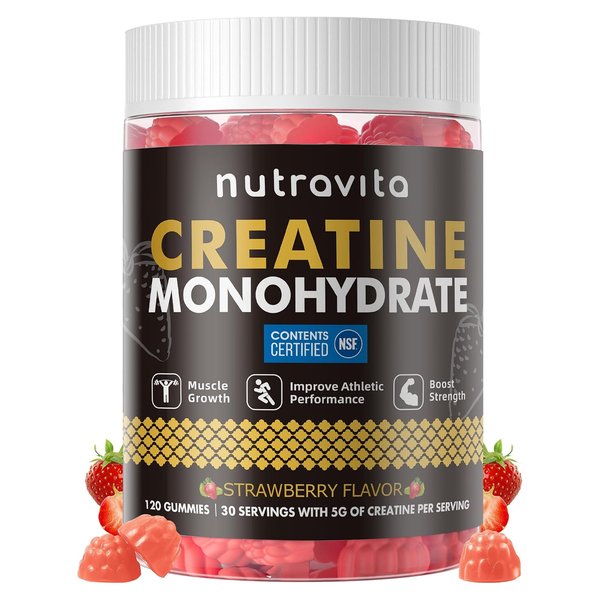
Nutravita Creatine Monohydrate Gummies
Best for: A sugar-free budget alternative to Natures Aid
A near-twin of Natures Aid under the same NSF listing holder: 5 g in 4 sugar-free gummies, NSF/ANSI 173 listed, about 12 cents per gram. It shares the same caveats: Happyummmm, another brand on that listing, had only trace creatine in SuppCo's single-lot 2025 test, and the panel lists maltitol first with only 1 g of carbohydrate per serving. A gallery image also credits magnesium for energy, though the label lists none. Its gallery shows an August 2025 Eurofins report of 5.02 g creatine monohydrate per serving. It places just ahead of Natures Aid because that listing adds superiority and absorption claims, though Natures Aid costs less.
- Listed under NSF/ANSI 173, confirmed on NSF's site
- About 12 cents per gram
- No added sugar, and more than 2,500 Amazon ratings
- Its gallery shows an August 2025 Eurofins report of 5.02 g creatine monohydrate per serving
- The panel lists maltitol first but only 1 g of carbohydrate per serving, which does not add up
- A gallery image credits "magnesium for a boost of energy", but the label lists no magnesium
- Four gummies per serving
- Its NSF listing holder, Hanibest Trading Limited, also lists Happyummmm, whose gummies had only trace creatine in SuppCo's single-lot 2025 test (Happyummmm is now on that NSF listing too)
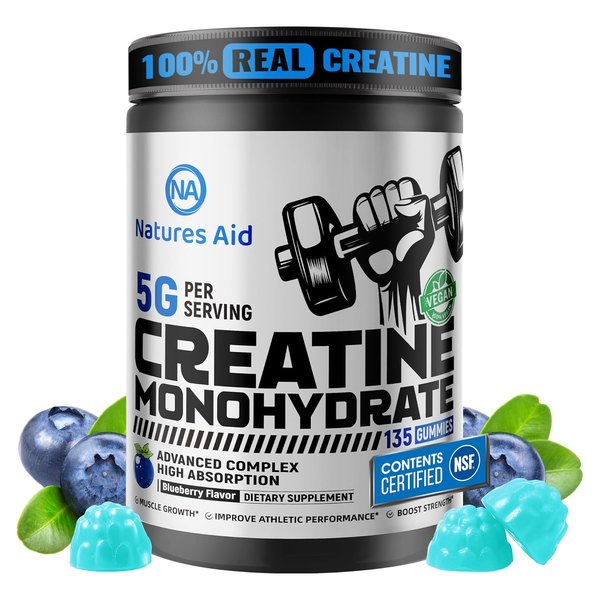
Natures Aid Creatine Monohydrate Gummies
Best for: The lowest price per gram, if you accept the caveats
The cheapest gummy we found at about 8 cents per gram, with 5 g of creatine in 3 sugar-free gummies and an NSF/ANSI 173 listing confirmed on NSF's site. Two things keep it from the top. Its NSF listing holder, Hanibest Trading Limited of Guangzhou, China, also lists Happyummmm, whose gummies had only trace creatine in SuppCo's single-lot 2025 test, so we capped its verification score; Happyummmm now appears on the same NSF listing. And its label does not add up: the panel lists 50 calories but only 2 g of carbohydrate and no fat or protein. The listing also calls it "the most effective organic formula" with no organic certification shown, and claims "high absorption". Its gallery does show an August 2025 Eurofins report of 5.85 g creatine monohydrate per serving. It tied Gorilla Mind on score and places ahead on price.
- Listed under NSF/ANSI 173, which includes checking the label's creatine amount; we confirmed it on NSF's site
- About 8 cents per gram, the cheapest gummy we found
- 5 g of creatine in 3 sugar-free gummies
- Its gallery shows an August 2025 Eurofins report of 5.85 g creatine monohydrate per serving
- The panel lists 50 calories but only 2 g of carbohydrate and no fat or protein, which does not add up
- Calls itself "the most effective organic formula" with no organic certification shown, and claims "high absorption"
- Claims creatine can raise strength "by up to 20%"
- Its NSF listing holder, Hanibest Trading Limited, also lists Happyummmm, whose gummies had only trace creatine in SuppCo's single-lot 2025 test (Happyummmm is now on that NSF listing too)
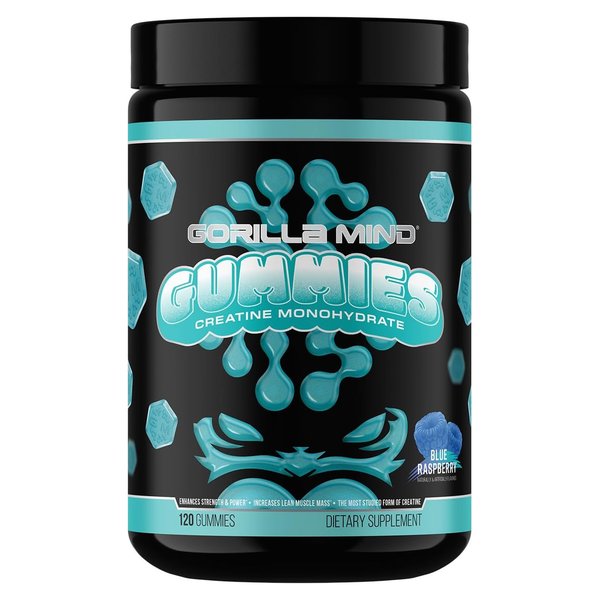
Gorilla Mind Creatine Gummies (Creapure)
Best for: Creapure fans who want to see a batch result
The most transparent batch reporting of the brand-tested gummies: its listing shows a lot result of 5.82 g of creatine per serving by HPLC, plus heavy metals and microbes, and the brand says it adds an overage to cover breakdown over shelf life. It uses Creapure and has no added sugar. It ranks below the certified products because the report names no lab, it costs about 33 cents per gram, and it claims no added sugar while the panel shows no sugar or sugar-alcohol line, although maltitol and xylitol lead the ingredients.
- Publishes a batch result: 5.82 g of creatine per serving by HPLC, with heavy metals and microbes
- Says it adds an overage so the dose holds up over shelf life
- Creapure creatine, made in Germany
- No added sugar
- The batch report image names no lab, though the brand's site says testing is done at Eurofins
- Claims "no added sugar" but the panel shows no sugar or sugar-alcohol line, though maltitol and xylitol lead the ingredients
- About 33 cents per gram
- Only about 60 Amazon ratings, averaging 3.4 stars
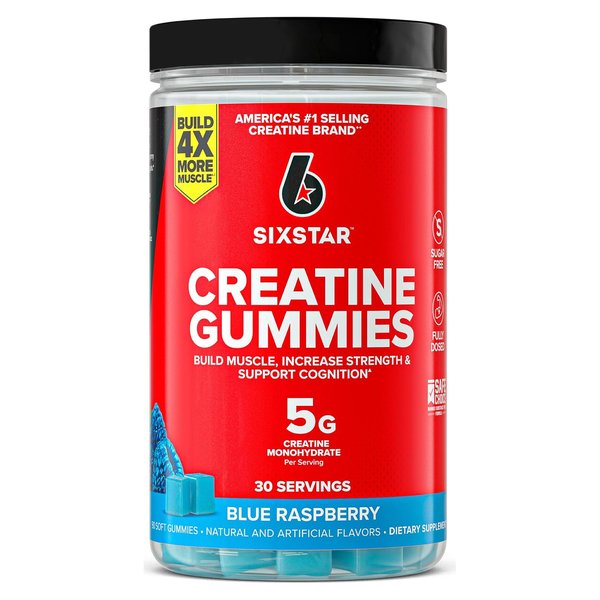
Six Star Sugar-Free Creatine Gummies
Best for: Budget buyers who can live without third-party verification
A full 5 g in 3 sugar-free gummies at about 12 cents per gram from a mainstream brand, which would rank it higher if anything verified the creatine. It shows only a "Safe Choice" banned-substance badge that names no certifier, and we found no NSF listing. Its marketing is the most aggressive here, promising to "build 4X more muscle" and "18.6% more strength" from studies of creatine in general.
- A full 5 g dose in 3 gummies
- No added sugar
- About 12 cents per gram from a mainstream brand
- A "Safe Choice" banned-substance badge names no certifier, and we found no NSF listing
- Promises to "build 4X more muscle" and "18.6% more strength" from studies of creatine in general
- A gallery image says 60 gummies while the bottle holds 90; 8 g of sugar alcohols per serving
- Only about 35 Amazon ratings
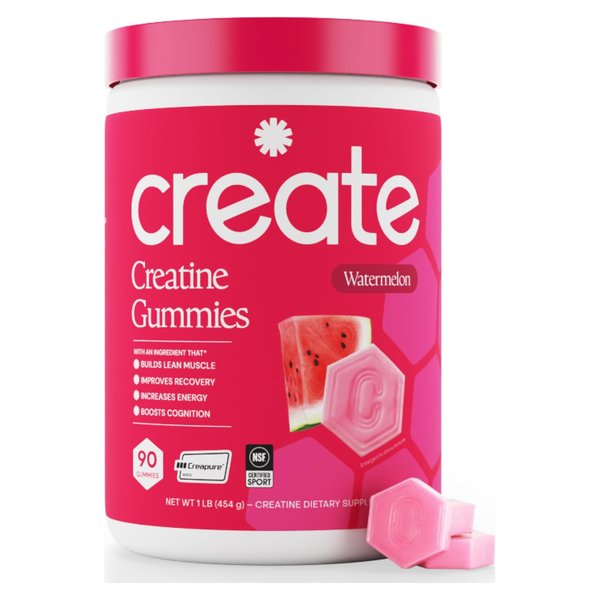
Create Creatine Monohydrate Gummies
Best for: Tested athletes who prefer Creapure and fewer gummies
The best-known creatine gummy and still a strong choice for athletes: NSF Certified for Sport and NSF/ANSI 173, confirmed on NSF's sites, with Creapure shown on the label and 1.5 g per gummy. Its testing history is mixed: it was among the brands that failed NOW Foods' 2024 test (NOW sells competing creatine), passed SuppCo's 2025 test at 4.59 g per 4.5 g serving, and faces a 2026 class action alleging 4.01 g, which it disputes. It ranks seventh mainly on price, about 37 cents per gram, 5 g of added sugar per serving, listing claims about joint pain, sleep and hydration that go beyond what creatine trials have shown, and a gallery image citing a 20% memory improvement.
- NSF Certified for Sport and NSF/ANSI 173, both confirmed on NSF's sites
- Passed SuppCo's 2025 test at 4.59 g per 4.5 g serving, with significant creatinine noted; the label shows Creapure
- 1.5 g of creatine per gummy, so 3 gummies give 4.5 g
- About 1,800 Amazon ratings averaging 4.6 stars
- Was among the brands that failed NOW Foods' 2024 test (NOW sells competing creatine), and a 2026 class action alleges 4.01 g per serving, which Create disputes
- 5 g of added sugar per 3-gummy serving, and about 37 cents per gram, the most expensive gummy here
- The listing promises less joint pain, faster sleep and better hydration, which go beyond what creatine trials have shown, and cites a 20% memory improvement
- Amazon's ingredient text lists only creatine, pectin and allulose, while the label lists tapioca syrup and sugar
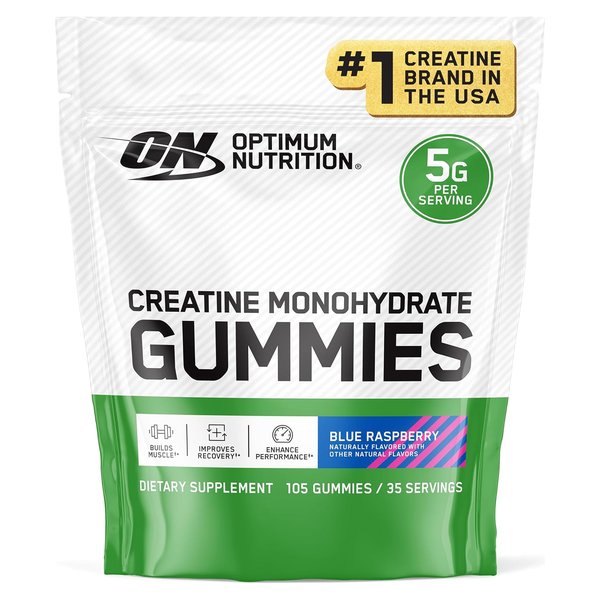
Optimum Nutrition Creatine Monohydrate Gummies
Best for: Fans of Optimum Nutrition who want low sugar
A sensible formula from a long-established brand: 5 g in 3 gummies with only 2 g of added sugar, at about 18 cents per gram. We found no NSF listing or other independent test for the gummies, though, and the listing leans on a "#1 creatine brand" claim and a chart comparing it with "most creatine gummies". If Optimum Nutrition certifies these, they would move up.
- A full 5 g dose in 3 gummies
- Only 2 g of added sugar
- About 18 cents per gram from a long-established sports brand
- We found no NSF listing or other independent test for the gummies
- Claims to be the #1 creatine brand in the USA and compares itself with "most creatine gummies"
- A 3.7-star average from about 100 ratings
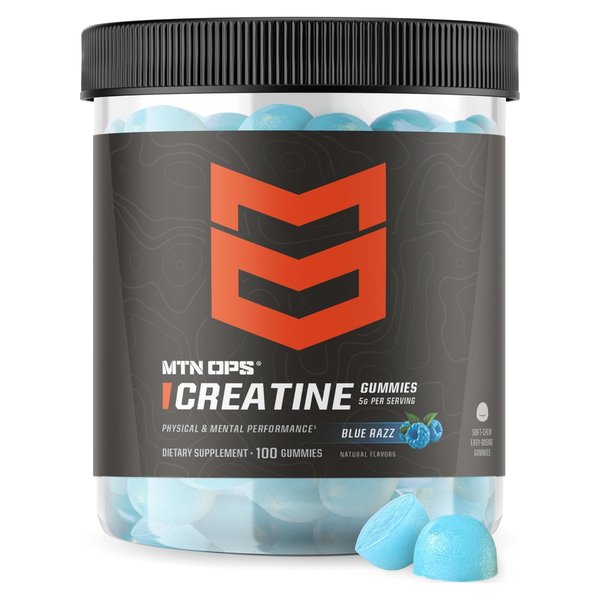
MTN OPS Creatine Gummies
Best for: People who want to split creatine into 1 g doses
The most flexible dosing, at 1 g per gummy so you can take 3 to 5, from a plain listing with restrained claims. It ranks last because a full 5 g serving carries 7 g of added sugar and 55 calories, a bottle lasts 20 days, and its testing claim names no lab.
- 1 g of creatine per gummy, so you can take 3 to 5 a day
- A plain ingredient list and restrained claims
- Made in the USA
- 7 g of added sugar per 5-gummy serving, the most here
- A bottle lasts only 20 days at the full dose
- "Ingredient tested and assured" names no lab
- About 30 cents per gram
Chewable tablets are typically pressed like a candy tablet rather than cooked with water, so they avoid the main reason gummies lose creatine. Neither is a gummy, so we did not rank them, but both are strong alternatives.
Momentous Creatine Chews. NSF Certified for Sport and NSF/ANSI 173, both confirmed on NSF's sites, with 1 g of Creapure and 1 g of added sugar per tablet; 5 tablets give 5 g, at about 33 cents per gram. Check price on Amazon $49.99 for 150 chewable tablets · seen October 18, 2026
Animal Creatine Chews. NSF/ANSI 173 listed, 4 tablets give 5 g with 2 g of added sugar, at about 21 cents per gram. It uses sucralose and acesulfame potassium, and its listing argues that gummies lose potency because they are made with water. Check price on Amazon $31.39 for 120 chewable tablets · seen October 18, 2026
The full lineup, side by side
Creatine and sugar figures come from each product's printed label; verification comes from the certifier's own listing. Check the verification column first: independent tests have found creatine gummies with almost none inside.
| Product | Creatine per serving | Gummies per serving | Added sugar | Verified by | Cost per gram | Score |
|---|---|---|---|---|---|---|
| #1 Legion | 5 g | 4 | 0 g | Labdoor (5.92 g measured); NSF/ANSI 173 for 2 flavors | $0.23 | 4.6 |
| #2 Force Factor | 5 g | 5 | 5 g | NSF Certified for Sport, NSF/ANSI 173 | $0.20 | 4.1 |
| #3 Nutravita | 5 g | 4 | 0 g | NSF/ANSI 173 | $0.12 | 4.0 |
| #4 Natures Aid | 5 g | 3 | 0 g | NSF/ANSI 173 | $0.08 | 4.0 |
| #5 Gorilla Mind | 5 g | 4 | 0 g | Brand batch result (lab not named) | $0.33 | 4.0 |
| #6 Six Star | 5 g | 3 | 0 g | Unnamed badge | $0.12 | 3.7 |
| #7 Create | 4.5 g | 3 | 5 g | NSF Certified for Sport, NSF/ANSI 173 | $0.37 | 3.6 |
| #8 Optimum Nutrition | 5 g | 3 | 2 g | None found | $0.18 | 3.4 |
| #9 MTN OPS | 5 g | 5 | 7 g | Unnamed claim | $0.30 | 3.0 |
Prices are Amazon prices on October 18, 2026 and change often. Cost per gram is the bottle price divided by the grams of creatine it holds at the labeled serving. NSF listings were confirmed on nsfsport.com and info.nsf.org; the Labdoor result was read on labdoor.com. For comparison, budget creatine powder costs about 5 cents per gram.
How to choose, and what to check first
Look for the certifier, not the claim. Many gummy listings say "NSF certified" or "third-party tested". Search the product yourself at nsfsport.com or info.nsf.org, or on Labdoor; several products here use NSF wording that refers to the factory, not the gummy.
Count the gummies. Divide 3 to 5 g by the creatine per gummy: that is 2 to 4 Create gummies, 2 to 3 of the three-per-serving brands, 3 to 4 of the four-per-serving brands, or 3 to 5 of Force Factor and MTN OPS. Check what that many gummies adds in sugar or sugar alcohols.
Consider powder or chews. If price or certainty matters most, creatine powder is about 5 cents per gram, and all five powders in SuppCo's 2025 test passed; chewable tablets are a middle ground. Our creatine supplements ranking covers powders.
- Kidneys and lab tests. In healthy people, studies have found no harm to kidney function at normal doses, but creatine can raise serum creatinine, which can look like a kidney problem on a blood test. Tell your clinician you take it; people with kidney disease should ask first.
- Stomach upset. Large single doses caused more diarrhea in one trial than split doses, and the sugar alcohols in sugar-free gummies can add to it.
- Water weight. A loading phase typically adds 1 to 3 kg, mostly water; the steady 3 to 5 g route raises it more gradually.
- Hair. One small 2009 study found a rise in DHT, a hormone linked to hair loss, but it did not measure hair, and a 2025 trial found no significant difference from placebo in DHT or hair counts.
- Children and pregnancy. Gummies look like candy, so keep them out of reach. We found no human safety trials in pregnancy; ask a clinician first.
Frequently asked questions
Do creatine gummies work?
They can, if they contain the creatine on the label. Creatine itself has strong evidence for strength and, with training, lean mass, and the one gummy trial found better jump and agility scores, though it had no placebo. The catch is content: in SuppCo's 2025 test, 4 of 6 gummy brands had trace or no creatine, so choose one verified by NSF or Labdoor.
Why do some creatine gummies have no creatine?
Creatine slowly converts to creatinine in warm, wet, acidic conditions, and gummies are made with water, heat and acid. Some products may also have been underfilled from the start. Independent tests found several brands far below their labels, while others, such as Legion, Force Factor and Create, met or exceeded them in at least one test.
How many creatine gummies should you take a day?
Enough to reach 3 to 5 g of creatine. That is usually 2 to 5 gummies, depending on whether each holds 1 g, 1.25 g, 1.5 g or about 1.7 g. Loading with 20 g a day is not necessary; 3 g a day reached a similar rise in muscle creatine after about four weeks.
Are creatine gummies as good as powder?
The creatine is the same, but powder is far cheaper, about 5 cents per gram against 8 to 37 cents for our picks, has no sugar, and all five powders in SuppCo's 2025 test passed. Gummies are worth it only if they help you take creatine every day.
Are creatine gummies safe?
For healthy adults, creatine at 3 to 5 g a day has a strong safety record, with studies finding no harm to kidney function. It can raise serum creatinine on blood tests, it may cause stomach upset at large doses, and gummies add sugar or sugar alcohols. People with kidney disease, and anyone pregnant, should ask a clinician first.
Is creatine banned in sports?
No major sports organization bans creatine, but supplements can be contaminated with substances that are banned. If you are tested, choose a product that is NSF Certified for Sport, such as Force Factor or Create among these gummies.
Does creatine cause hair loss?
The evidence does not show it. One small 2009 study found a rise in DHT but did not measure hair, and a 2025 randomized trial found no significant difference in DHT or hair density after 12 weeks.
The bottom line
The best creatine gummy is one that independent testing shows actually contains its creatine, with little sugar, at a price you will keep paying. Legion does that best, Force Factor is the pick for tested athletes, and Nutravita and Natures Aid are the cheapest NSF-listed options if you accept their label problems. Take 3 to 5 g a day, every day, and remember that plain creatine powder delivers the same molecule for a fraction of the price, and every powder in SuppCo's 2025 test passed.