Creatine monohydrate is the best-studied supplement for strength and muscle in people who train, and the usual dose is 3 to 5 g a day. Capsules skip the scoop, the grit and the taste, but they come with a catch: creatine is bulky, so 5 g takes anywhere from 4 large capsules to 10 small ones. The 4-capsule products pack 1.25 g into each capsule, which by our math needs the largest common capsule size, 000, about 26 mm long. Fewer swallows, but bigger ones.
So this ranking rewards what you can check: whether the contents were independently verified, how many capsules it takes to reach 5 g, the cost of 5 g, whether the label's own directions reach a useful dose, and how far the claims outrun the research. We read the Supplement Facts panel on every product's current Amazon listing and scored all seven on the same five criteria. Choosing between powder, pills and gummies? See our guide to powder, pills and gummies.
The short version
- Best overall: NOW Sports Creatine Monohydrate, plain 750 mg vegetarian capsules with an Informed Sport logo and a restrained listing, at about $0.59 per 5 g.
- Best 4-capsule dose: Optimum Nutrition Micronized Creatine Capsules, four 1.25 g capsules for 5 g at about $0.67.
- Best potency proof: Pristine's, which shows a certificate measuring about 12 percent more creatine than its label states.
- Lowest cost: BulkSupplements, about $0.42 for a full 5 g serving, though it takes 7 capsules.
- Capsules work. Many of the trials that established creatine's benefits gave it in capsules. We found no trial comparing capsules with powder directly.
- Fewer pills means bigger pills. A 1.25 g capsule needs, by our math, a size larger than FDA advises for generic drugs; 750 mg capsules are smaller but take about 7 for 5 g.
- Skip the special forms. In most trials, creatine HCl and buffered creatine did not beat plain monohydrate, and we found no trial testing the "less bloating" claim.
- Swallowing tip: for capsules, take a sip of water, tilt your chin toward your chest and swallow; it helped most people in a small study.
How we ranked them
Every product here is plain creatine monohydrate, so we scored what actually differs:
- Verification (25%). Highest for NSF Certified for Sport, then an NSF contents listing confirmed on NSF's site, then a brand-published batch result that measures the creatine, then a certification logo we could not confirm on the certifier's site, then contaminant-only test results, then an unnamed testing claim. None of the capsules here is on NSF Certified for Sport's listing.
- Capsules for 5 g (20%). Four capsules score highest, then 5, then 6 to 7, then 8 to 10.
- Cost per 5 g (25%), from Amazon prices on October 25, 2026.
- Label daily dose (15%). Scored on the label's standing long-term daily serving (for NOW, the one 4.5 g serving it directs for use beyond 28 days): 5 g scores highest, then 4 to 4.9 g, then 3 to 3.9 g, then less.
- Marketing restraint (15%). Products start at 4 of 5, and half a point comes off for each category present: unverifiable superiority claims; benefits beyond creatine's evidence, such as fat loss or an energy kick; absorption claims; and a listing that contradicts its own label. Strength, muscle, recovery and cognitive-support wording matches the evidence and is not deducted.
Products are ordered by their unrounded scores, shown rounded to one decimal; exact ties are broken by verification, then marketing. We also looked at NAKED's 1.25 g capsules (its label serving is 2 capsules, 2.5 g, and it claims fat loss; it scored 3.5), WeightWorld's 1 g tablets (3.4, with several binders and an "energy kick" claim), NatureBell (3.6, the cheapest at about $0.35 per 5 g, but its gallery calls 7 capsules a 3 g serving while its label says 5 g, and it claims superior absorption), Life Extension (10 capsules for 5 g), and HCl, buffered and chewable products. No brand paid to be included, and none sent product.
Do creatine capsules work as well as powder?
Many of the key trials used capsules. In a 1999 trial, men who took creatine capsules with heavy training gained more muscle fiber size and strength than those on placebo, after muscle creatine rose 22 percent in the first week. Other early performance trials also gave creatine in capsules, and a 2012 trial that used size 00 capsules found muscle creatine rose over its 28 days. Once absorbed, creatine is handled the same way: nearly 99 percent of an oral dose is either taken up by muscle or excreted in urine.
No head-to-head test. We found no trial comparing creatine capsules with powder, in PubMed or ClinicalTrials.gov. The closest data come from a 2002 study, not of capsules, in which creatine taken as a solid lozenge or as undissolved crystals produced a 20 percent lower blood peak and a 30 to 35 percent smaller area under the blood curve than the same dose dissolved in water, which the authors said may mean slightly lower bioavailability; it still raised blood creatine five- to sixfold. Muscle levels build over days of daily dosing, and capsule trials show they rise, so the difference probably matters little for a daily dose.
Dose. The International Society of Sports Nutrition recommends 3 to 5 g a day, or a loading phase of about 20 g a day for 5 to 7 days. In capsules, loading means 16 capsules a day at 1.25 g each, or about 27 at 750 mg; skipping it works too, since 3 g a day raised muscle creatine by a similar 20 percent over 28 days. In pooled trials with resistance training, creatine added about 1.1 kg of lean mass and modest strength gains.
Capsule size and swallowing. In surveys, 37 percent of German primary care patients and 26 percent of Norwegian ones reported trouble swallowing pills. FDA's non-binding 2015 advice for generic drugs is that capsules should not exceed size 00 or 22 mm, and a 1.25 g creatine capsule needs a size 000, about 26 mm. Among supplement adverse event reports to FDA from 2006 to 2015, 19 percent involved swallowing problems, mostly large multivitamins and calcium pills; we found no published report of choking or throat injury from creatine capsules.
HCl and buffered creatine. In a 2012 trial funded by a rival creatine maker, buffered creatine (Kre-Alkalyn) did not raise muscle creatine or improve strength more than monohydrate, and showed no evidence of fewer side effects. creatine HCl dissolves far better in water, but a 2024 trial found no benefit over monohydrate with training; a small 2026 trial reported the opposite, so the evidence conflicts. We found no trial testing HCl's "less bloating" claim; see creatine and bloating.
The 7 best creatine capsules
Tap any product to jump straight to its full review.
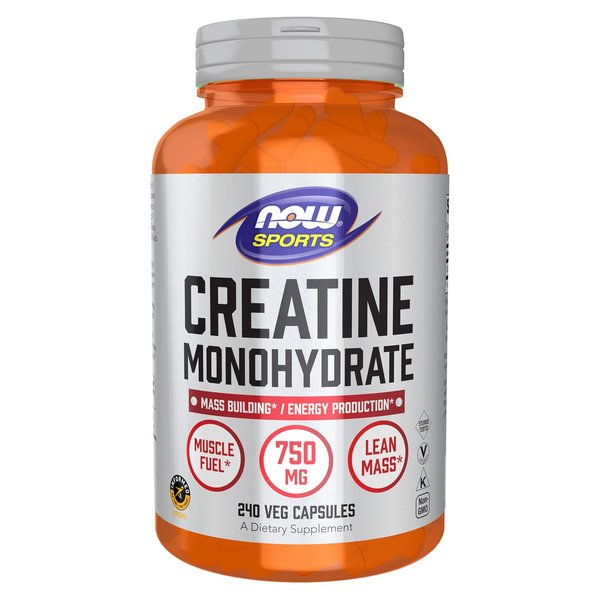
NOW Sports Creatine Monohydrate 750 mg (240 veg capsules)
Best for: Most people who want capsules
The top pick for the basics: plain 750 mg vegetarian capsules with an Informed Sport logo, at about $0.59 per 5 g, and a listing that stays within the evidence. The serving is 6 capsules for 4.5 g, and we could not confirm the current batch on the certifier's site.
- Carries the Informed Sport logo for banned-substance screening
- About $0.59 per 5 g in plain vegetarian capsules
- A restrained listing that sticks to strength, lean mass and endurance
- We could not open Informed Sport's site to confirm the current batch
- The serving is 6 capsules for 4.5 g, and the label's maintenance directions run up to 18 capsules a day
- The loading directions call for 18 to 24 capsules a day for a week
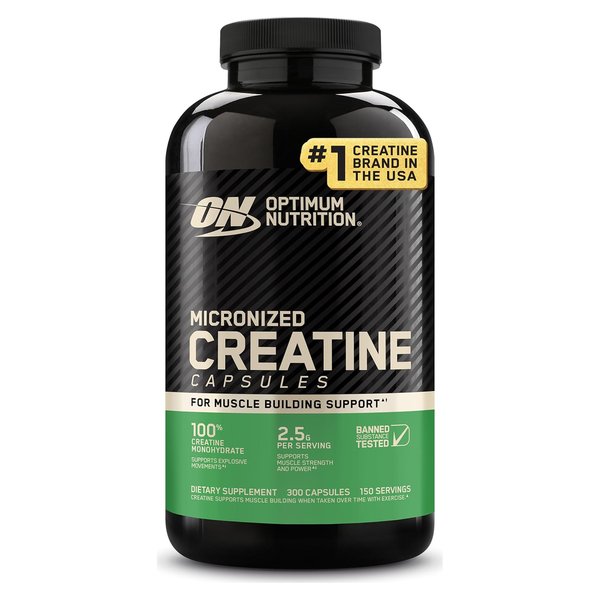
Optimum Nutrition Micronized Creatine Capsules (300 count)
Best for: 5 g in four capsules
The best way to take 5 g in four capsules: 1.25 g each, about $0.67 per 5 g in the 300-count bottle, and more than 30,000 ratings. The capsules are large enough that the listing warns about them, the listing's directions disagree with the label, and its "#1 brand" claims (one cites a 2026 U.S. News expert poll) and Informed Choice mention were not confirmed by us.
- Four 1.25 g capsules reach 5 g, and the label directs 2 capsules twice a day
- About $0.67 per 5 g in the 300-count bottle, the cheapest of the 4-capsule picks
- More than 30,000 Amazon ratings averaging 4.7 stars
- The listing itself warns the capsules are large and should be taken with a large glass of liquid
- The listing says to take 2 capsules with a meal while the label says twice daily, and it leans on "#1 brand" claims
- Gelatin capsules, and we could not confirm its Informed Choice claim
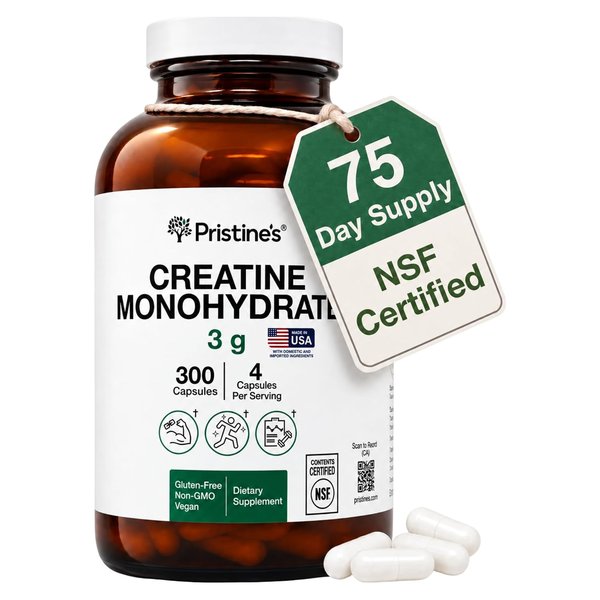
Pristine's Creatine Monohydrate Capsules (300 count)
Best for: A published potency result
It publishes a potency result: a brand-formatted certificate for a composite of 25 lots measuring 3,361 mg of creatine per 4 capsules against 3,000 mg labeled, with heavy metals not detected, and an NSF contents mark on the label. Its gallery also compares it with "generic powders". It costs about $0.58 per 5 g, but the label dose is 3 g, 5 g takes about 7 capsules, and the certificate's lab is not named.
- Shows a brand-formatted certificate for a composite of 25 lots measuring 3,361 mg of creatine per 4 capsules against 3,000 mg on the label, with heavy metals not detected
- Its label carries an NSF contents mark, and the gallery shows an NSF/ANSI 173 listing
- Plain vegan capsules at about $0.58 per 5 g, and a listing that explains water retention sensibly
- The label serving is 3 g; 5 g takes about 7 capsules
- The certificate's lab is not named, and NSF's own database could not be reached to confirm the listing
- Its gallery compares itself with "generic powders", and it has only 720 Amazon ratings
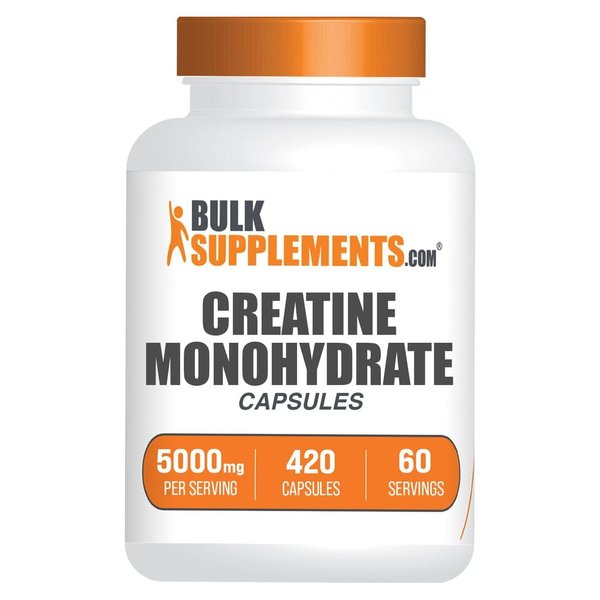
BulkSupplements Creatine Monohydrate Capsules (420 count)
Best for: The lowest cost per 5 g
A full 5 g label serving for about $0.42 with nothing but creatine and a gelatin capsule, from a listing with only general workout claims. It takes seven capsules, and its testing claim names no lab.
- A full 5 g serving on the label at about $0.42, the lowest cost here
- Creatine and a gelatin capsule, nothing else
- A plain listing with only general workout and recovery wording
- Seven capsules per serving
- "Third party tested" names no lab
- Bovine gelatin capsules, so not vegetarian
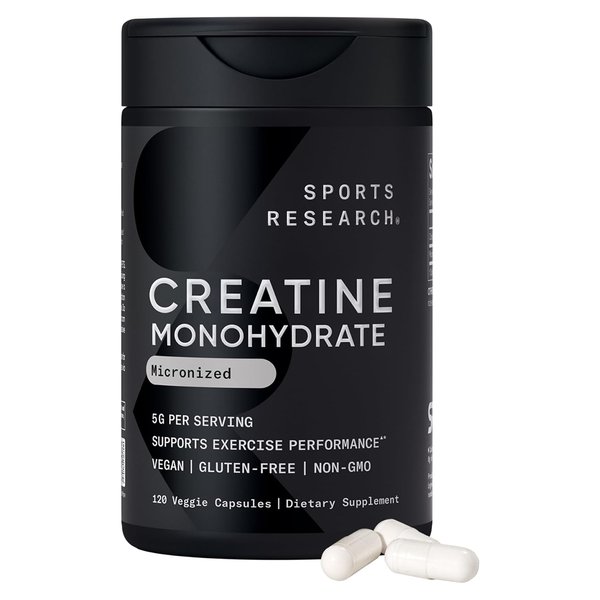
Sports Research Creatine Monohydrate Capsules 5 g (120 count)
Best for: 5 g in four vegan capsules
5 g in four vegan capsules with an Informed Sport logo and a February 2025 certification date shown, but at about $1.00 per 5 g it is the priciest here, and it says micronizing improves absorption.
- 5 g in 4 vegan capsules, the full dose on the label
- Shows an Informed Sport logo with a February 2025 certification date, plus Non-GMO Project verification
- A short ingredient list: creatine, a plant capsule and rice extract
- About $1.00 per 5 g, the most expensive here
- Says micronizing gives "better absorption"; we found no trial showing that
- We could not open Informed Sport's site to confirm the current batch
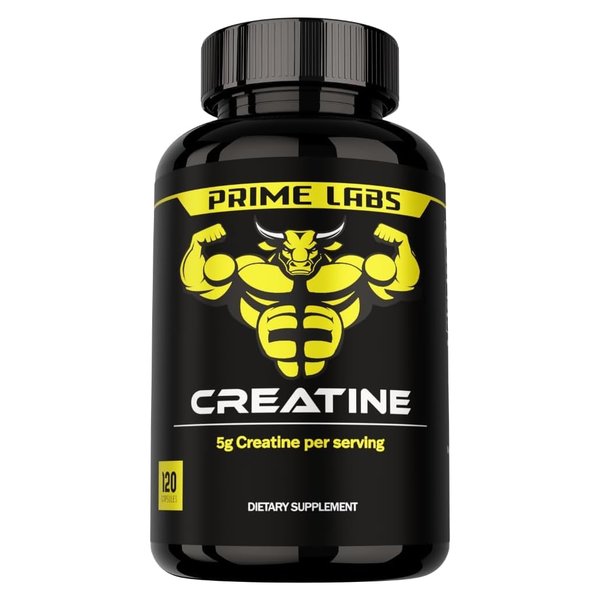
Prime Labs Creatine Monohydrate Capsules 5 g (120 count)
Best for: Four capsules, nothing added
Four 1.25 g capsules for 5 g with the shortest ingredient list here, at about $0.78. Its test summary shows microbe and heavy-metal passes and a "within spec" tick for creatine, but no measured amount, and it claims faster absorption and more results than other brands.
- 5 g in 4 capsules with nothing but creatine and a plant capsule
- About $0.78 per 5 g, cheaper than Sports Research
- Shows passing microbial and heavy-metal results
- Its test summary ticks creatine as "within spec" but does not report how much the capsules contain
- Says micronized capsules give "faster absorption" and promises "more results" than other brands
- Only 284 Amazon ratings
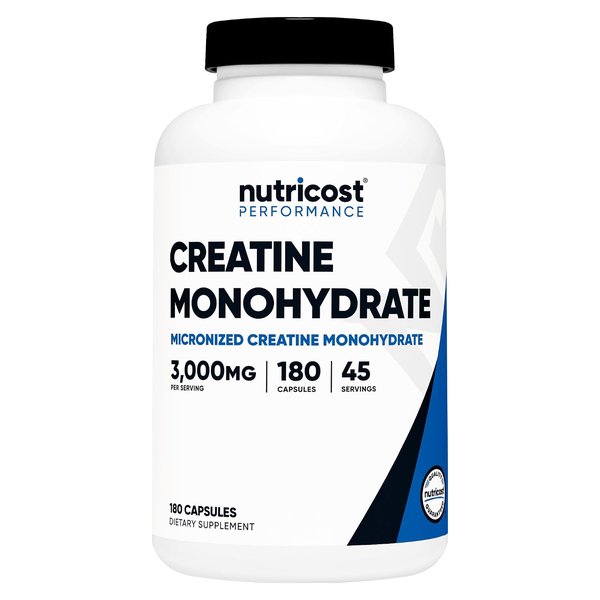
Nutricost Creatine Monohydrate 750 mg (180 capsules)
Best for: The lowest bottle price
The lowest bottle price here, $13.50, for plain micronized monohydrate with no benefit claims, at about $0.50 per 5 g. The label serving is 3 g, 5 g takes about seven gelatin capsules, and its testing claim names no lab.
- The lowest bottle price here, $13.50, at about $0.50 per 5 g
- Micronized creatine monohydrate with no benefit claims on the listing
- More than 6,200 Amazon ratings averaging 4.6 stars
- The label serving is 3 g; 5 g takes about 7 capsules
- "Third party tested" names no lab, and its NSF mention refers to the factory
- Gelatin capsules
The full lineup, side by side
Amounts come from each product's Supplement Facts panel on its Amazon listing. Every product here is creatine monohydrate, so the main differences are how much fits in each capsule, how many you swallow for 5 g, how it is tested and what it costs.
| Product | Creatine per capsule | Capsules for 5 g | Label daily dose | Testing claim or certification | Cost per 5 g | Score |
|---|---|---|---|---|---|---|
| #1 NOW Sports | 750 mg | About 7 | 4.5 g | Informed Sport logo (not confirmed) | $0.59 | 3.8 |
| #2 Optimum Nutrition | 1.25 g | 4 | 5 g | Informed Choice claim (not confirmed) | $0.67 | 3.8 |
| #3 Pristine's | 750 mg | About 7 | 3 g | NSF contents mark (not confirmed) + lot certificate | $0.58 | 3.8 |
| #4 BulkSupplements | About 714 mg | 7 | 5 g | Unnamed third party | $0.42 | 3.8 |
| #5 Sports Research | 1.25 g | 4 | 5 g | Informed Sport logo (not confirmed) | $1.00 | 3.7 |
| #6 Prime Labs | 1.25 g | 4 | 5 g | Contaminant results only | $0.78 | 3.7 |
| #7 Nutricost | 750 mg | About 7 | 3 g | Unnamed third party | $0.50 | 3.6 |
Prices are Amazon prices on October 25, 2026 and change often. Cost per 5 g is the bottle price divided by the grams of creatine monohydrate it holds, times 5. Labels do not state capsule size; 1.25 g of creatine needs the largest common size, 000. NSF's dietary supplement listing and the Informed Sport site could not be reached, so those logos and claims are reported as shown, not confirmed.
How to choose, and what to check first
Decide between fewer and smaller. Four 1.25 g capsules reach 5 g in the fewest swallows, but each is a size 000. Capsules of 700 to 750 mg are easier to swallow one at a time but take about 7 for 5 g. In a small survey, four in five people preferred several medium pills to a single jumbo one, so neither choice is wrong.
Check the label dose. Several labels direct only 3 g a day, or 2.5 g. That still works over time, since 3 g a day raised muscle creatine in trials, but if you want 5 g, count the capsules yourself. Loading is optional, and in capsules it means 16 to 28 a day.
Skip absorption and special-form claims. Micronizing helps powder mix into water; we found no trial showing it improves absorption from a capsule. Creatine HCl and buffered creatine cost more and did not beat monohydrate in most trials. For a cheaper option with no swallowing, powder is still the best value; see our overall creatine ranking. For chewables, see our creatine gummies ranking.
- Swallowing. Take capsules one at a time with plenty of water; the lean-forward method helped 31 of 35 people in a small study. If you have trouble swallowing, choose smaller capsules or powder.
- Kidneys. Trials in healthy people found no kidney harm, but creatine can raise creatinine on blood tests; tell your clinician, and ask first if you have kidney disease.
- Stomach upset. Large single doses caused more diarrhea than split doses; spreading capsules across the day may help.
- Pregnancy. We found no human safety trials; avoid it unless your clinician directs it.
- Drug-tested athletes. Creatine is not banned, but contamination is the risk; check the certifier's site for your batch, since none of these capsules is on NSF Certified for Sport.
Frequently asked questions
Do creatine capsules work as well as powder?
For a daily dose, yes. Many of the trials that established creatine's benefits gave it in capsules. We found no trial comparing capsules with powder directly; solid creatine produced a slightly lower blood peak in one study, but muscle levels build over days.
How many creatine capsules equal 5 g?
It depends on the fill: 4 capsules at 1.25 g each, 5 at 1 g, about 7 at 750 mg, and 10 at 500 mg. Check the Supplement Facts panel, since some labels list only 2.5 or 3 g per serving.
What is a size 000 capsule?
The largest common capsule size, about 26 mm long and 1.37 mL. It is what lets a brand fit 1.25 g of creatine in one capsule. FDA's advice for generic drugs is that capsules stay at size 00 or smaller, so 000 capsules are harder for some people to swallow.
Should you take creatine capsules with food?
Taking them with a meal and a full glass of water is sensible and makes the capsules easier to swallow. Timing matters less than taking creatine every day.
Is creatine HCl better in capsules?
HCl dissolves better, but trials have not consistently shown that it works better than monohydrate or that smaller doses are as effective, and we found no trial testing its less-bloating claim.
Can you open creatine capsules and mix the powder?
Yes. A capsule is just creatine powder in a shell, so emptying it into a drink is a practical option if swallowing is hard, though we found no study testing it.
Is creatine safe?
In trials of healthy adults, side effects were no more common than with placebo, and kidney function was not harmed. It can raise blood creatinine on lab tests. We found no human safety trials in pregnancy.
The bottom line
The best creatine capsule is plain monohydrate with some proof of what is inside, at a pill count you will actually take every day. NOW does that best with an Informed Sport logo, Pristine's shows a potency result, BulkSupplements is cheapest per 5 g, and Optimum Nutrition, Sports Research and Prime Labs fit 5 g into four large 1.25 g capsules if fewer swallows matter more than pill size. If you can tolerate powder, it is still cheaper per gram.