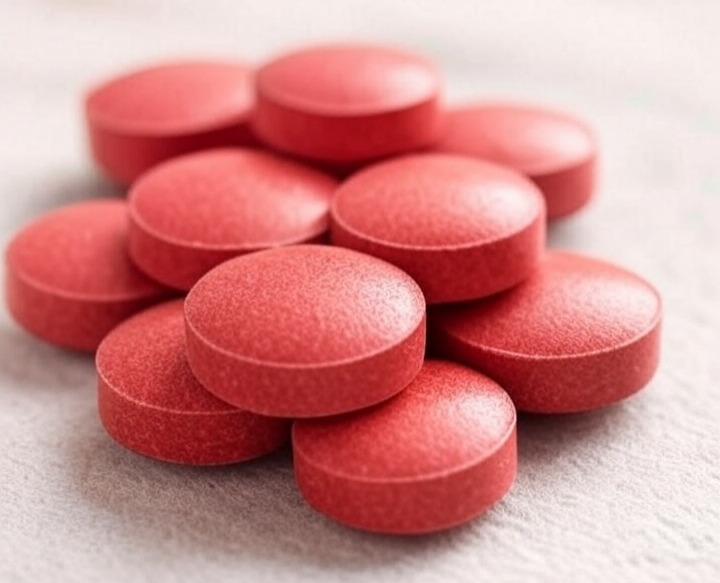
What Is Red Yeast Rice?
Red Yeast Rice is a traditional Chinese ingredient made by fermenting rice with the red yeast fungus Monascus purpureus. Fermentation produces compounds called monacolins. The main one, monacolin K, is chemically identical to lovastatin, the active ingredient in a prescription cholesterol medicine.
Red yeast rice has been used in Asian cooking and traditional medicine for centuries. In randomized placebo-controlled trials in adults with raised cholesterol, it lowered LDL cholesterol more than placebo. A meta-analysis of 13 placebo-controlled trials (804 participants) found an average LDL reduction of 0.87 mmol/L. LDL is a blood marker, and the effect depends on how much monacolin K a product contains, which varies widely between products.
Because monacolin K is the same molecule as lovastatin, red yeast rice is not a gentler version of a statin, and it is not a substitute for any medicine your doctor has prescribed. The US FDA treats red yeast rice products with enhanced or added lovastatin, or high monacolin K content, as unapproved new drugs. Testing found monacolin K varying more than 60-fold between US brands and absent from some, and the amount is often not on the label. Some products contained citrinin, a contaminant that can damage the kidneys, including some labeled citrinin-free. The EU limits a daily portion to under 3 mg of monacolins.
Red yeast rice can cause statin-type muscle and liver effects. Do not take it with a statin or another cholesterol medicine, with grapefruit juice, or in pregnancy or breastfeeding. If you have heart disease or high cardiovascular risk, follow your doctor's treatment plan and do not stop, reduce or replace a prescribed medicine on your own. Talk to your doctor before trying red yeast rice.
How we ranked these: we compared the amounts on each label, the other ingredients, price and the testing claims each maker states. We did not lab test these products. Product amounts, counts and prices below come from each maker's or retailer's listing, which we could not all recheck for this update, so read the current label before buying. Cost tiers compare the bottle prices of the products on this page when we reviewed them ($ lower, $$ mid-range, $$$ higher). Prices change often, so check the current price on Amazon. The weight of red yeast rice on a label does not tell you how much monacolin K a product delivers.
Top 5 Red Yeast Rice Supplements of 2026:
1. Weider Red Yeast Rice Plus
- Key Features: 1200mg of Red Yeast Rice Powder per serving, per the maker's listing
- Why it made it to the list: The listing pairs 1,200 mg of red yeast rice with 850 mg of plant Phytosterols and 1 mg of Astaxanthin from Haematococcus pluvialis microalgae, at a low cost per day.
- Cost tier: $$ (mid-range among these picks)
Pros:
- ✅ Plant sterols added: 1,200 mg of red yeast rice and 850 mg of phytosterols per serving. In pooled trials, plant sterols lowered LDL cholesterol at about 2 g a day split across meals, so 850 mg is below that, and results with capsules vary between trials.
- ✅ Low cost per day: 240 tablets make a 120-day supply.
- ✅ Astaxanthin: Contains 1 mg of astaxanthin from Haematococcus pluvialis algae, an antioxidant. That is well below the 4 to 12 mg used in most trials, and the largest pooled analysis found no change in LDL cholesterol.
Cons:
- ❌Large tablet: Might be hard for some to swallow.
- ❌Lots of Excipients and Fillers: The listing shows excipients used to form the tablet, including calcium carbonate and microcrystalline cellulose.
- ❌Slow Disintegration: A tablet with this much phytosterol may break down slowly.
- ❌Contains Soy: The phytosterols are derived from soy, which is an allergen.
Try Weider Red Yeast Riceaffiliate link
2. Natures Craft Red Yeast Rice and CoQ10
- Key Features: Contains 1200mg of Red Yeast Rice and 100mg of CoQ10
- Why It Made the List: Natures Craft Red Yeast Rice + CoQ10 combines 1,200 mg of red yeast rice with 100 mg of CoQ10 per serving in capsules, and the maker labels it citrinin-free.
- Cost tier: $ (lower cost among these picks)
Pros:
- ✅ Adds CoQ10: The body makes CoQ10 through the same pathway as cholesterol, which is why makers pair it with red yeast rice. Trials of CoQ10 for statin-related muscle aches disagree, so treat it as an extra, not a safety net.
- ✅ CoQ10 amount: 100 mg of CoQ10 with 1,200 mg of red yeast rice per serving, per the listing, the most CoQ10 among these picks.
- ✅Easier to swallow: Capsules are generally easier to swallow than tablets.
- ✅ Low cost per day: 120 capsules make a 60-day supply.
- ✅ Labeled citrinin-free: The maker says it is free of citrinin, a contaminant of red yeast fermentation that can damage the kidneys. Testing has found citrinin in some products labeled citrinin-free, so ask the maker for a test result.
Cons:
- ❌ Low dose of CoQ10 at 100mg. The 2-year heart failure trial of CoQ10 used 100 mg three times a day, in patients under medical care.
- ❌ Contains fillers/excipients: Contains microcrystalline cellulose, silicon dioxide and magnesium stearate which are avoided by some people.
Try Natures Craft Red Yeast Riceaffiliate link
3. Thorne Red Yeast Rice + CoQ10
- Key Features: One capsule dose of 600mg of Red Yeast Rice and 15mg of CoQ10.
- Why It Made the List: Thorne Red Yeast Rice + CoQ10 pairs 600 mg of red yeast rice with 15 mg of CoQ10 per capsule. Thorne states its red yeast rice is fermented to contain less than 0.05 parts per million of citrinin, and lists the product as gluten free and dairy free. The product page we read does not state a monacolin K amount.
- Cost tier: $$$ (higher cost among these picks)
- Pros:
- ✅ Adds CoQ10: The body makes CoQ10 through the same pathway as cholesterol, which is why makers pair it with red yeast rice. At 15 mg, the amount is small.
- ✅ Short ingredient list: Leucine is listed as the flow agent for encapsulation. Thorne notes the CoQ10 contains soy-derived monoglycerides with no soy protein.
- ✅ Citrinin tested: Thorne gives a figure, less than 0.05 parts per million of citrinin, rather than only a citrinin-free claim.
- Cons:
- ❌ Low dose of CoQ10 at 15mg. The 2-year heart failure trial of CoQ10 used 100 mg three times a day, in patients under medical care.
- ❌ Expensive: Premium price point may not suit all budgets
- The bottle costs about twice as much as the other picks. Thorne's own listing is 120 one-capsule servings, so compare the cost per day and the capsule count before buying.
Try Thorne Red Yeast Rice Capsulesaffiliate link
4. Purely Holistic Red Yeast Rice with CoQ10 and Niacin
- Key Features: Red Yeast Rice, CoQ10 and Niacin as Inositol Hexanicotinate.
- Why It Made the List: Purely Holistic lists 1,200 mg of red yeast rice per serving with CoQ10 and 35 mg of niacin as inositol hexanicotinate, in vegetarian capsules described by the maker as gluten free and non-GMO. The added niacin form is unlikely to help cholesterol (see cons).
- Cost tier: $$ (mid-range among these picks)
Pros:
- ✅ Vegetarian capsules: Described by the maker as vegetarian, gluten free and non-GMO.
- ✅ Red yeast rice amount: 1,200 mg of red yeast rice per serving, though label weight does not tell you monacolin K content.
- ✅Easier to swallow: Capsules are generally easier to swallow than tablets.
- ✅ Labeled citrinin-free: The maker says it is free of citrinin. Testing has found citrinin in some products labeled citrinin-free, so ask the maker for a test result.
Cons:
- ❌ Inositol Hexanicotinate adds little: In a 6-week trial of 120 adults, inositol hexanicotinate (no-flush niacin) at 1,500 mg a day did no better than placebo for cholesterol and showed no evidence of absorption.
- ❌ California Prop 65 warning: Our earlier review of the listing noted a Prop 65 warning, and the maker does not say which substance triggers it. Check the current listing and ask the maker before buying.
- ❌ Low dose of CoQ10: 60 mg per the listing. The 2-year heart failure trial of CoQ10 used 100 mg three times a day, in patients under medical care.
Try Purely Holistic Red Yeast Rice Capsulesaffiliate link
5. Carlyle Red Yeast Rice Capsules
- Key Features: 1800mg of Red Yeast Rice powder
- Why It Made the List: Carlyle Red Yeast Rice is a plain red yeast rice capsule with no added ingredients, listed at 1,800 mg per serving. The maker describes it as non-GMO, gluten free, lab tested and made in the USA, and it has a low price per day.
- Cost tier: $ (lower cost among these picks)
Pros:
- ✅ Red yeast rice amount: listed at 1,800 mg of red yeast rice per serving, though label weight does not tell you monacolin K content.
- ✅ Low cost per day: 250 capsules make an 83-day supply.
- ✅Easier to swallow: Capsules are generally easier to swallow than tablets.
Cons:
- ❌ Citrinin Content not Specified : The listing does not state testing for citrinin, a contaminant that can damage the kidneys.
- ❌ No supporting ingredients: No added CoQ10 or niacin. Neither has been shown to make red yeast rice work better, so this matters less than it sounds.
- ❌ Gelatin Capsule: Not suitable for vegetarians, and the gelatin source is not stated.
Try Carlyle Red Yeast Rice Capsulesaffiliate link
Final Thoughts
Red yeast rice lowered LDL cholesterol versus placebo in trials, but what any bottle delivers depends on its monacolin K, which varies widely and is often unlabeled. Talk to your doctor before using it, and never combine it with a statin.
When comparing products, look for a stated monacolin content (the EU limit is under 3 mg a day), a citrinin test result and a short ingredient list. The products above are ranked on the label details and prices we could compare, not on lab testing or head-to-head trials. If you have heart disease or high cardiovascular risk, follow your doctor's treatment plan.