TMG (trimethylglycine, sold as betaine anhydrous) is one of the simplest supplements to buy and one of the easiest to underdose. It is a single, cheap compound, so the products differ mainly in how much the label tells you to take, what else is in the capsule, and what the listing claims. That first difference matters most: in controlled trials, TMG lowered blood homocysteine from 1.5 grams a day upward, while 1 gram or less barely moved it, and several bottles direct you to take less than that.
We read the printed label on every product below, scored all seven on the same five criteria, and ranked them. This page covers plain TMG only. If you want TMG combined with methylated B vitamins, see our methylated B vitamins ranking, and for the science in more depth, our TMG guide.
The short version
- Best overall: BulkSupplements TMG Powder, nothing but TMG, with a 1.5 g serving that matches the lowest dose that lowered homocysteine in a controlled trial.
- Best value: Nutricost Betaine Anhydrous Powder, about 3 cents a gram with a 1.5 g scoop included.
- Best capsule: Double Wood TMG, the only product here that shows a certificate of analysis naming its testing lab.
- Dose is the whole game. Trials began to see homocysteine fall at 1.5 grams a day. Three labels we checked top out at 750 mg to 1 g a day, below that: Nutricost Capsules and both Life Extension products.
- More is not better. At 4 grams a day or more, betaine raised total cholesterol in pooled trials. NOW's label allows up to 6 g.
- Homocysteine is a lab marker. No TMG trial we found measured heart attacks or strokes, and folic acid lowered fasting homocysteine more than 6 g of TMG in head-to-head trials.
- Not the same as betaine HCl, a stomach-acid supplement, and not a substitute for prescription betaine, which is approved for a rare genetic disorder and used under medical care.
How we ranked them
TMG is one compound, so we did not score "quality of the TMG" on faith. We scored what the label and listing let you check, using the label's printed directions:
- Dose design (30%). Whether the label's directed daily amount reaches 1.5 grams, the lowest dose that lowered fasting homocysteine in a controlled trial, and whether its maximum stays under the 4 grams at which pooled trials saw cholesterol rise.
- Purity (20%). How much else is in the product besides TMG.
- Transparency and testing (20%). None of these products shows a USP Verified or NSF Certified for Sport seal on its label or listing, and none carries SuppCo's TESTED mark, so no product earned the independent-certification credit. A published certificate of analysis that names the lab earns credit; a third-party testing claim that names no lab costs a little.
- Cost per gram of TMG (15%), from Amazon prices on October 16, 2026.
- Marketing restraint (15%). Points come off for liver or detox claims, overstated statistics, and energy or mood claims that TMG trials do not support. We report those claims; we do not repeat them.
Scores are rounded to one decimal; products with the same rounded score are ordered by the unrounded total, and an exact tie goes to the higher dose-design score. No brand paid to be included, and none sent product.
What TMG does, and how much it takes
Homocysteine. TMG hands a methyl group to homocysteine through a pathway that runs alongside the folate and B12 cycle, turning it into methionine. In a controlled six-week trial in healthy adults, 1.5, 3 and 6 grams a day lowered fasting homocysteine by 12, 15 and 20 percent. At 1 gram a day or less, fasting homocysteine barely moved, and European food safety regulators estimate a typical diet already supplies about 830 mg a day. In a three-week crossover trial in active men, 2.5 and 5 grams a day lowered homocysteine from about 17.1 to 15.6 micromoles per liter, and the effect of dose did not differ by MTHFR genotype. In two trials that tested both against placebo, fasting homocysteine fell more with 0.8 mg of folic acid than with 6 grams of betaine. Homocysteine is a lab marker: no TMG trial we found measured heart attacks, strokes or other health outcomes, and large trials that lowered homocysteine with B vitamins made no significant difference to heart attacks or deaths. Our methylated B vitamins ranking covers that evidence.
Exercise. A 2024 pooled analysis of 17 trials and 317 participants found a small benefit to maximal strength, mostly in the lower body, and that lower-body result only just reached significance. It found no significant effect on upper-body strength, sprint power or muscular endurance. Most trials used about 2.5 grams a day. Body composition is unsettled: one pooled analysis reported less fat mass, while a larger one found no significant effect on body weight, fat or lean mass.
Cholesterol. At 4 grams a day or more, betaine raised total cholesterol in pooled trials; at 6 grams a day it raised LDL cholesterol by about 0.36 millimoles per liter, and below 4 grams a day a pooled analysis found homocysteine fell without the lipid rise. That is the main reason this ranking penalizes labels that allow more than 4 grams.
Two look-alikes. betaine HCl is a different product, taken with meals to supply stomach acid, not methyl groups. Prescription betaine (Cystadane) has been FDA approved since 1996 to lower homocysteine in homocystinuria, a rare inherited disorder, usually 6 grams a day from age 3, with medical monitoring. That approval covers the drug for that disease; it does not make supplement TMG an approved treatment.
The 7 best TMG supplements
Tap any product to jump straight to its full review.
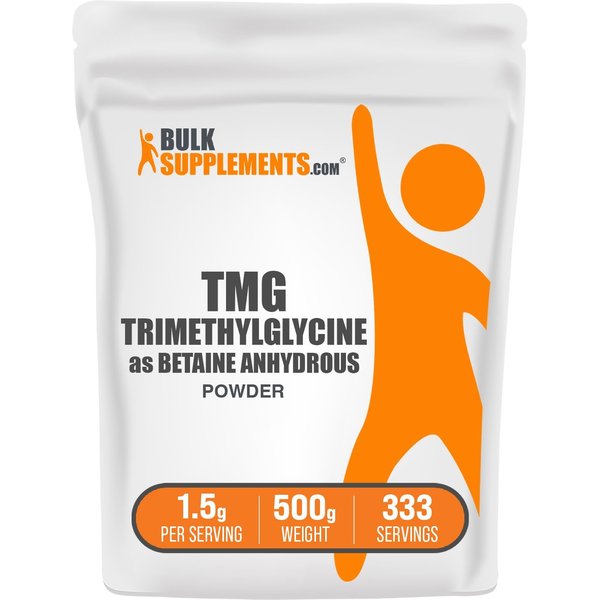
BulkSupplements.com TMG Powder (Betaine Anhydrous)
Best for: People who want pure TMG at trial doses and do not mind measuring powder
The top pick because it does the one thing that matters most and adds nothing else. The pouch contains only TMG, the label's half-teaspoon serving is 1.5 grams, and the listing's once-or-twice-daily direction keeps you between 1.5 and 3 grams, inside the range trials used and under the 4 gram cholesterol line. At about 6 cents a serving it is also among the cheapest. The trade-offs are self-measuring with a teaspoon, a testing badge that names no lab, and listing copy about energy and mood that the research does not back.
- Nothing but TMG: the label lists no other ingredients
- The 1.5 g serving sits at the lowest dose that lowered homocysteine in a controlled trial
- The listing's once-or-twice-daily direction, 1.5 to 3 g, stays under the 4 g cholesterol line
- About 6 cents a serving
- You measure it yourself with a half-teaspoon, so doses are approximate
- A "third party tested" badge names no lab
- The listing credits it with energy and mood benefits that TMG trials have not shown
- Powder means measuring and mixing it into a drink each day
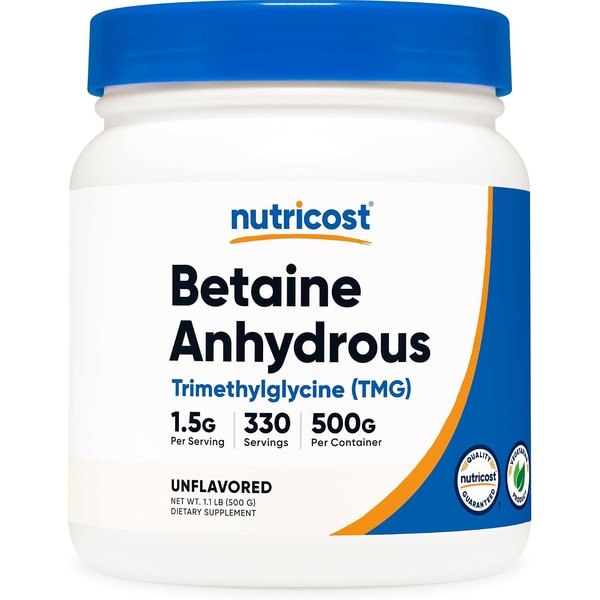
Nutricost Betaine Anhydrous (TMG) Powder
Best for: The lowest cost per gram, with a pre-measured 1.5 g scoop
Essentially tied with the top pick and the cheapest TMG we found, about 3 cents a gram. The tub includes a 1.5 gram scoop, and the label directs one scoop a day, so the default dose lands on the trial floor without guesswork. It loses a fraction of a point for a small amount of calcium silicate, an anticaking agent, and for a testing claim that names no lab. The listing makes no liver, energy or mood claims.
- The cheapest TMG per gram we found, about 3 cents
- A scoop is included, so each 1.5 g serving is measured for you
- One scoop matches the lowest dose that lowered homocysteine in a controlled trial
- Plain listing with no liver, energy or mood claims
- Contains calcium silicate as an anticaking agent
- "Tested by independent ISO-accredited laboratories" names no lab
- Powder means mixing it into a drink each day
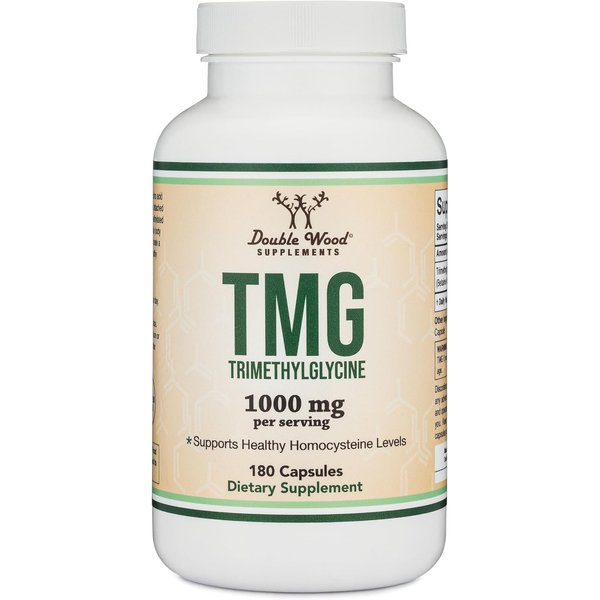
Double Wood TMG 1,000 mg
Best for: Capsule takers who want to see a named lab's test results
The top-scoring capsule, mainly for transparency: its listing shows a certificate of analysis that names the testing lab, Canyonside Labs, with passing results for microbes and heavy metals. Two capsules make a 1 gram serving, and the label's 1 to 3 servings a day lets you reach 1.5 to 3 grams, so expect 3 to 6 capsules a day. It loses points for marketing: the listing says 3,000 mg can lower homocysteine by "up to 40%", while the controlled trial at 3 grams found about 15 percent, and it leans on liver claims.
- The only product here that shows a certificate of analysis naming its testing lab (Canyonside Labs)
- The label's 1 to 3 servings a day lets you land on 1.5 to 3 g
- About 13 cents a gram, low for a capsule
- Only two other ingredients
- One serving is 2 capsules, so 1.5 g means 3 capsules a day
- The listing says 3,000 mg can cut homocysteine "up to 40%"; the controlled trial found about 15 percent
- The listing also leans on liver and antioxidant claims
- Gelatin capsule, so not vegetarian
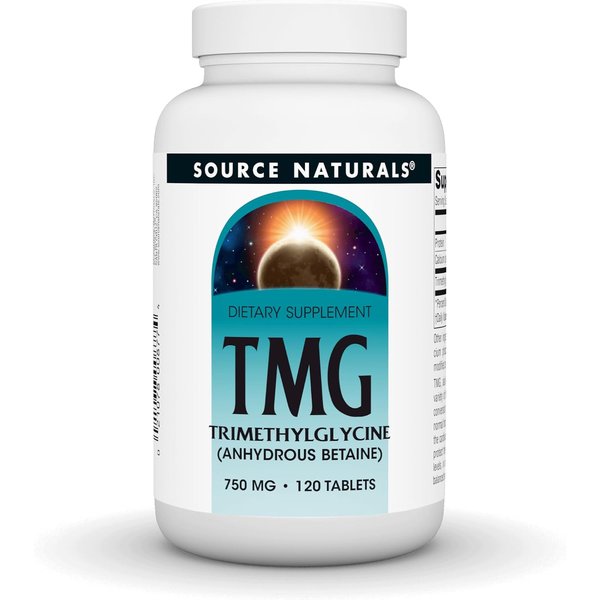
Source Naturals TMG 750 mg Tablets
Best for: Tablet takers who want a label range that stays under 4 g
A straightforward tablet with a sensible label range: 1 to 4 tablets a day, so two to four tablets give 1.5 to 3 grams without crossing 4 grams. It finished a few hundredths of a point ahead of ARG, mainly on price, despite seven binders, including calcium phosphate, and listing claims that TMG protects the liver and supports mood through SAMe, which we found no trials to support.
- The label's 1 to 4 tablets a day covers 1.5 to 3 g at 2 to 4 tablets
- Its maximum, 3 g, stays under the 4 g cholesterol line
- About 16 cents a gram
- Seven other ingredients, including calcium phosphate and cellulose binders
- The listing says TMG helps protect the liver and, through SAMe, mood; we found no trials of those
- No testing claim or certificate shown
- Only about 140 Amazon ratings
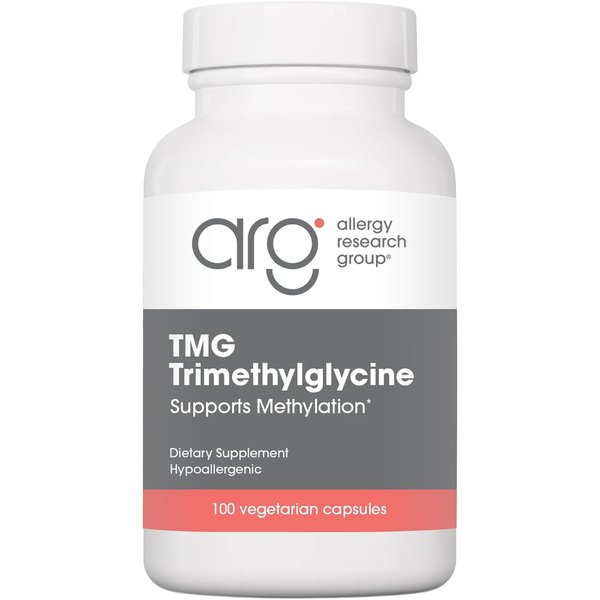
Allergy Research Group TMG 750 mg
Best for: People who want a vegetarian capsule and a label that lands on 1.5 g
The label gets the dose right: one 750 mg capsule twice daily adds up to exactly 1.5 grams, and it is the only vegetarian capsule among our ranked picks. It is also the priciest per gram here, about 35 cents, more than double the other capsules, which is what holds it back, along with a gallery claim of "50% more TMG than typical" supplements that it cannot show. Note that the Amazon listing says one to three times daily; the printed label says twice. No testing claim or certificate is shown.
- The printed label's 1 capsule twice daily adds up to exactly 1.5 g
- The only vegetarian capsule among our ranked picks
- Short ingredient list and a hypoallergenic positioning
- About 35 cents a gram, more than double the other capsules here
- The Amazon listing says one to three times daily, while the printed label says twice
- "Liver Health Support" in the listing title is a claim we do not repeat; no testing claim or certificate shown
- A gallery image says it holds "50% more TMG than typical" supplements, an unverifiable comparison
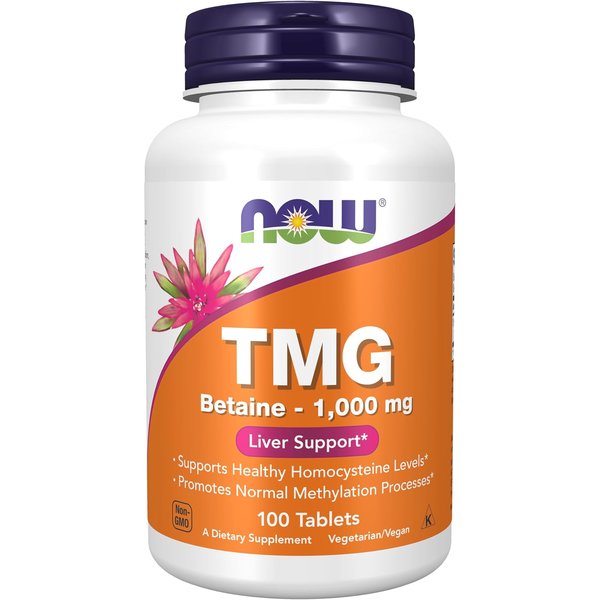
NOW TMG 1,000 mg Tablets
Best for: People who want fewer pills, as long as they stay at 2 to 3 tablets
The strongest tablet at 1 gram each, and the label's lowest amount, 2 grams a day, already sits in the range trials used. The concern is the other end: the label allows 1 to 3 tablets twice daily, up to 6 grams, past the 4 gram level at which pooled trials saw cholesterol rise. If you buy it, stay at 2 to 3 tablets. It is sold under a "Liver Support" headline, which we do not repeat.
- 1 gram per tablet, the most of any tablet or capsule here
- The label's lowest daily amount, 2 g, is already in the range trials used
- About 14 cents a gram from a widely sold brand
- The label allows up to 6 g a day, above the 4 g at which pooled trials saw cholesterol rise
- Five binders plus a coating
- Sold under a "Liver Support" headline, and the label talks about detoxification
- No testing claim or certificate shown
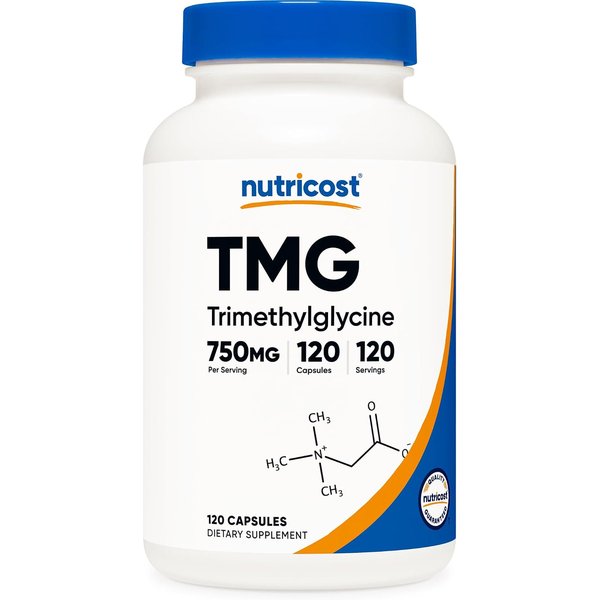
Nutricost TMG 750 mg Capsules
Best for: Budget capsule buyers willing to take 2 capsules rather than the label's 1
The cheapest capsule here at about 11 cents a gram, from a listing with no inflated claims. The problem is the label: it directs one 750 mg capsule a day, half the 1.5 grams where trials began to see homocysteine fall, so following the bottle gives you about what a normal diet already supplies. It tied NOW on the overall score and placed below it on dose design, the heaviest criterion.
- The cheapest capsule here, about 11 cents a gram
- Plain listing with no liver, energy or mood claims
- Nearly 3,000 Amazon ratings
- The label directs 1 capsule a day, 750 mg, half the lowest dose that lowered homocysteine in a trial
- Gelatin capsule with calcium silicate and magnesium stearate
- A "3rd Party Tested" claim names no lab
Life Extension TMG 500 mg. A clean liquid capsule from a brand that offers a certificate of analysis for every product, but the label directs 2 capsules, 1 gram a day, and it costs about 40 cents a gram. Check price on Amazon $19.95 for 100 liquid capsules · seen October 16, 2026
Life Extension TMG Powder. Pure TMG with no other ingredients, but its scoop holds 500 mg and the label says one to two scoops a day, so the directed dose tops out at 1 gram. Check price on Amazon $10.50 for 50 grams · seen October 16, 2026
The full lineup, side by side
Serving and daily-dose figures come from each product's printed label. The column to check first is the label daily dose: trials began to see homocysteine fall at 1.5 grams a day, and cholesterol rose at 4 grams or more.
| Product | TMG per serving | Label daily dose | Form | Other ingredients | Testing | Cost per gram | Score |
|---|---|---|---|---|---|---|---|
| #1 BulkSupplements Powder | 1.5 g | 1.5 to 3 g | Powder | None | Unnamed claim | $0.04 | 4.3 |
| #2 Nutricost Powder | 1.5 g | 1.5 g | Powder | Calcium silicate | Unnamed claim | $0.03 | 4.3 |
| #3 Double Wood TMG | 1 g (2 caps) | 1 to 3 g | Capsule | Cellulose, gelatin | Named-lab COA | $0.13 | 3.9 |
| #4 Source Naturals TMG | 750 mg | 0.75 to 3 g | Tablet | 7 binders | None listed | $0.16 | 3.7 |
| #5 ARG TMG | 750 mg | 1.5 g | Veg capsule | HPMC, cellulose, leucine | None listed | $0.35 | 3.7 |
| #6 NOW TMG | 3 g (3 tabs) | 2 to 6 g | Tablet | 5 binders, coating | None listed | $0.14 | 3.6 |
| #7 Nutricost Capsules | 750 mg | 750 mg | Capsule | Calcium silicate, Mg stearate, gelatin | Unnamed claim | $0.11 | 3.6 |
Prices are Amazon prices on October 16, 2026 and change often. Cost per gram is the bottle price divided by the grams of TMG it holds. "Named-lab COA" means a published certificate of analysis that names the testing lab; "Unnamed claim" means a third-party testing claim that names no lab.
How to choose, and what to check first
Powder or pills. Powder is the cheapest way to reach trial doses: 1.5 grams is half a teaspoon or one Nutricost scoop. With capsules and tablets, count how many it takes: 1.5 grams is 2 tablets of a 750 mg product, 3 Double Wood capsules, or 2 ARG capsules.
Check the label's range, not just the serving. Aim for a daily total between 1.5 and 3 grams. Labels that direct less than 1.5 grams give you about what food already supplies; labels that allow more than 4 grams take you into the range where cholesterol rose.
Think about folate first. If a clinician wants your homocysteine lower, folate and B12 status come first, because folic acid lowered fasting homocysteine more than 6 grams of TMG in head-to-head trials. TMG adds a smaller, separate effect. Our methylated B vitamins ranking compares products that combine them.
- Stay under 4 grams a day. At 4 grams or more, betaine raised total cholesterol in pooled trials. If you have high LDL or take cholesterol medicine, talk to your clinician first and keep the dose low.
- Stomach upset is the usual side effect. Nausea and digestive discomfort are the most common reactions on the prescription label; splitting the dose can help.
- Fishy body odor is rare. The one well-documented case involved 20 grams a day of prescription betaine in a teenager with a gene variant that affects how the body clears that odor. People with trimethylaminuria should check with a clinician first.
- Homocystinuria and kidney disease. People with homocystinuria take prescription betaine with methionine monitoring, because very high methionine has caused brain swelling in that condition; they should not self-dose. People with kidney disease handle betaine differently, so ask a nephrologist first.
- Pregnancy and children. We found no safety data for supplement doses in pregnancy or in children, and most of these labels are written for adults; ask a clinician first.
Frequently asked questions
What is TMG?
TMG, short for trimethylglycine and also called betaine or betaine anhydrous, is a compound found in foods such as beets, spinach, quinoa and wheat bran. It donates a methyl group that the body uses to turn homocysteine into methionine, through a pathway that runs alongside the folate and B12 cycle. European food safety regulators estimate a typical diet supplies about 830 mg a day.
How much TMG should you take?
In controlled trials, fasting homocysteine fell from 1.5 grams a day upward: by 12, 15 and 20 percent at 1.5, 3 and 6 grams. At 1 gram a day or less, it barely moved. At 4 grams a day or more, betaine raised total cholesterol in pooled trials. Most exercise trials used about 2.5 grams. Follow your product's label and ask your clinician what fits you.
What is the difference between TMG and betaine HCl?
TMG (betaine anhydrous) supplies methyl groups. Betaine HCl is betaine bound to hydrochloric acid and is sold to add stomach acid with meals. They are not interchangeable, so check which one a label contains.
Does TMG raise cholesterol?
At high doses it can. In pooled trials, 4 grams a day or more raised total cholesterol, and 6 grams a day raised LDL cholesterol by about 0.36 millimoles per liter. Below 4 grams a day, a pooled analysis found homocysteine fell without the lipid rise. People with high LDL should talk to their clinician before using it.
Does TMG help with workouts?
A little, possibly. A 2024 pooled analysis of 17 trials found a small benefit to maximal strength, mostly lower body, and that result only just reached significance. It found no significant effect on upper-body strength, sprint power or endurance. Effects on body fat are inconsistent across pooled analyses.
Should you take TMG with NMN or NR?
It is often sold that way, on the idea that NAD+ precursors use up methyl groups, but we found no human trial showing they deplete methyl groups or that adding TMG changes the result. If you do combine them, the same dose and cholesterol points apply.
Can TMG cause fishy body odor?
Rarely. The one well-documented case involved 20 grams a day of prescription betaine in a teenager with a common variant in the gene that breaks down the compound behind the odor. People with trimethylaminuria should check with a clinician first, and anyone who notices the odor should stop and check with a clinician.
The bottom line
The best TMG supplement is the one that gets you to 1.5 to 3 grams a day with as little else as possible, at a fair price. BulkSupplements and Nutricost powders do that best, at a few cents a gram. If you want capsules, Double Wood is the most transparent, and ARG's label lands exactly on 1.5 grams. Read the label's daily range before you buy: three products we checked direct no more than 1 gram a day, below the dose that moved homocysteine in trials, and one allows more than the 4 grams at which cholesterol rose. And keep expectations realistic: TMG lowers a lab marker, folate does more of that work, and we found no trial showing that TMG changes heart attacks, strokes or other health outcomes.