Taurine is an amino acid your body makes and gets from meat, fish and dairy, and it is one of the most common ingredients in energy drinks. It became a supplement trend in 2023, when a study reported that taurine extended lifespan in worms and mice. Supplements are almost all synthetic taurine, the same molecule whatever the label says, and no single-ingredient taurine product we found carries an NSF contents certification. That makes this a category where products differ mainly in price, form, what else is in the bottle, and how much the marketing promises.
So this ranking rewards what you can check: the cost of 3 g, the observed safe level from a 2008 safety review; whether the serving size makes that dose easy; what testing the brand will show you; what else is added; and how far the claims outrun the research. We read the Supplement Facts panel on every product's current Amazon listing and scored all ten on the same five criteria. For the aging research in more depth, see our taurine and aging guide.
The short version
- Best overall: Nutricost Taurine Powder, pure taurine in a 2 g scoop for about $0.07 per 3 g, with a plain listing.
- Best for checking your lot: NutraBio, the only brand here that says you can look up third-party results by lot number.
- Best capsule: NOW Taurine 1,000 mg, vegan capsules at about $0.21 per 3 g.
- We found no US contents certification for plain taurine. No single-ingredient taurine product appears on NSF's supplement or Certified for Sport listings.
- The aging claims rest on animals. Taurine extended median lifespan 10 to 12 percent in mice; two 2025 human studies found blood taurine does not fall with age, and no human aging trial has reported results.
- Effects in people are small. Pooled trials found blood pressure about 3 to 4.7 mmHg lower and small exercise gains, with the newest analysis rated low to very low certainty.
- 3 g a day is the observed safe level. Higher doses have less long-term safety data.
How we ranked them
Plain taurine is the same synthetic molecule in every product, so we scored what actually separates them:
- Cost per 3 g (30%), from Amazon prices on October 20, 2026, whatever the label's serving size. 3 g a day is the observed safe level and sits in the 1.5 to 3 g range a 2026 meta-analysis found most effective for blood pressure and metabolic markers.
- Dose and form (20%). Powder with a 2 g scoop scores highest; then powder with a serving near 1 g; then 1,000 mg capsules; then 500 mg capsules, which take 6 a day for 3 g.
- Content verification (20%). An NSF contents certification would score highest, but we found none for plain taurine. Next comes lot-specific third-party results you can look up yourself; then an unnamed third-party, in-house or on-request testing claim; then nothing. A certified factory or a gluten-free certification is not a contents test.
- Other ingredients (10%). Nothing added scores highest, then a flow agent only, then a vegetarian capsule with excipients, then a gelatin capsule.
- Marketing restraint (20%). Products start at 4 of 5, and half a point comes off for each category present: unverifiable superiority or grade claims; benefits beyond the human evidence, such as anti-aging, energy, workout results, fat loss, focus, detox or immune support; absorption claims for "free-form" taurine, which every taurine supplement is; and pet dosing on a human product.
Scores are rounded to one decimal. We also looked at Nutricost's 1,000 mg gelatin capsules, Designs for Health Taurine and Life Extension Taurine Powder, and left out multi-ingredient heart formulas, energy drinks and magnesium taurate, which is a magnesium supplement. No brand paid to be included, and none sent product.
What taurine research actually shows
The aging study and the pushback. In a 2023 study in Science, taurine extended median lifespan by 10 to 12 percent in mice and 10 to 23 percent in worms, and improved health markers in middle-aged monkeys. The human evidence in that paper was observational: older people had lower blood taurine, and higher levels went with healthier markers. In 2025, a National Institute on Aging team found blood taurine increased or stayed the same with age in three human cohorts, and a study of 137 men aged 20 to 93 found no link between taurine and age, strength or muscle function. We found no published trial of taurine supplements for aging in people; one is registered but has not reported results.
Blood pressure and metabolic markers. Pooled trials found small drops in blood pressure: about 3 mmHg in a 2018 analysis of 7 studies and about 4 to 4.7 mmHg systolic in larger 2020, 2024 and 2026 analyses. In the best single trial, 120 adults with blood pressure above normal but below the high range took 1.6 g a day for 12 weeks; clinic systolic pressure fell 7.2 mmHg on taurine versus 2.6 on placebo. Fasting blood sugar fell about 5.9 mg/dL in pooled trials, mostly in people with diabetes, obesity or metabolic syndrome, and a 2020 analysis found no significant difference in body weight. These are lab markers; we found no trial that measured heart attacks, strokes or deaths.
A retracted trial in the heart evidence. A 2017 heart-failure trial of 16 patients was retracted in 2026, and both 2024 meta-analyses by the same team included it; they also print the identical blood pressure estimate, so they are not independent confirmations. In Japan, taurine is a prescription drug for heart failure at 3 g a day alongside standard medicines, a foreign drug approval that is not a US supplement claim; the Japanese heart-failure trials we found were small and decades old. More in our taurine and the heart explainer.
Exercise. A 2018 meta-analysis of 10 studies found a small endurance benefit, and a 2025 analysis of 23 single-dose trials found a small benefit across exercise tasks, with the certainty of evidence rated low to very low and no significant dose-response between 1 and 6 g. An energy-drink dose of 80 mg caffeine plus 1 g taurine did not improve repeated sprints. A narrative review concluded that "limited and varied findings prohibit definitive conclusions."
Other uses. In people with chronic liver disease, 2 g a day cut muscle cramps by about seven per fortnight versus placebo in a crossover trial analyzed in the 30 of 49 patients who completed it; we found no cramp trial in healthy people. A 2025 meta-analysis of 7 trials found no significant effect on cognition. We found no human trials of taurine alone for sleep, anxiety, eyes or tinnitus.
Quality. Commercial taurine is synthetic, made from simple industrial chemicals and then purified, so plain taurine powder is vegan; check the capsule shell. Vegans have lower blood taurine than meat eaters, though we found no trial showing that supplementing changes health outcomes for them. ConsumerLab tested nine taurine products in 2018 and reported no quality problems, but that testing is old and its approved list is paywalled.
The 10 best taurine supplements
Tap any product to jump straight to its full review.
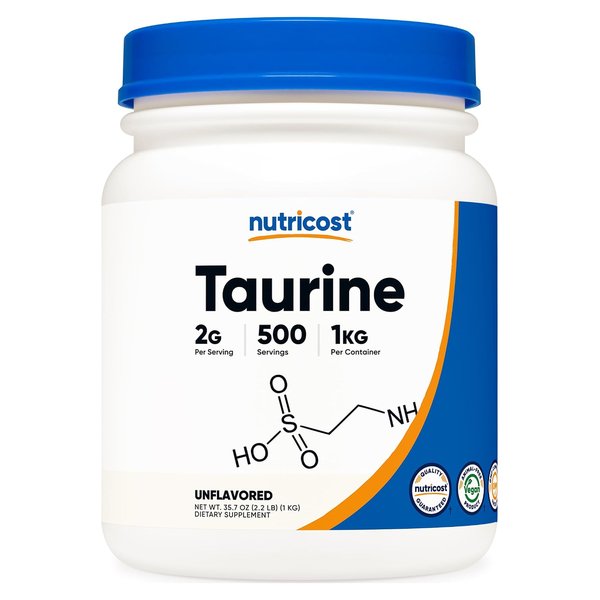
Nutricost Taurine Powder (1 kg)
Best for: Plain taurine at a low price per gram
The top pick because it does the basics best: a 1 kg tub of taurine with nothing added, a 2 g scoop, about $0.07 per 3 g, and a listing that makes no benefit claims at all. Its main weakness is common in this category: the "third party tested" line names no lab and shows no results.
- Taurine and nothing else, in a 2 g scoop
- About $0.07 for 3 g, a hair behind Micro Ingredients for the cheapest here
- A plain listing with no benefit claims at all
- More than 3,000 Amazon ratings averaging 4.5 stars
- "Third party tested" names no lab and shows no results
- Powder is less convenient than capsules for travel
- A 1 kg tub lasts well over a year at 2 g a day
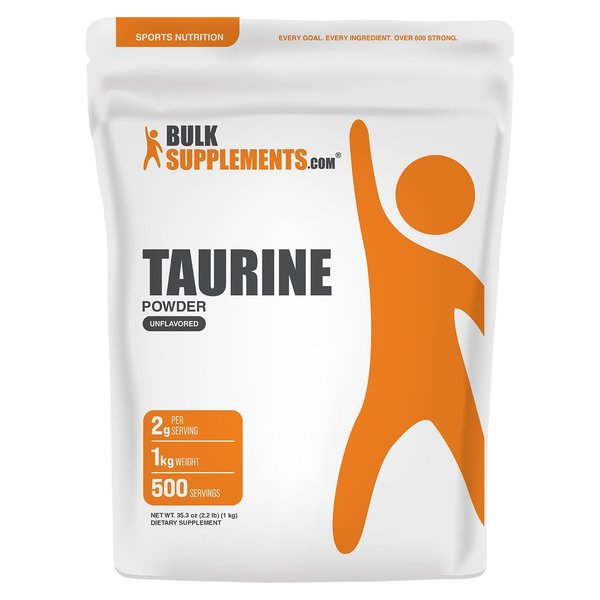
BulkSupplements Taurine Powder (1 kg)
Best for: A bulk powder with a 2 g serving
Nearly identical to Nutricost: 2 g of taurine per 3/4 teaspoon with only a flow agent, about $0.09 per 3 g. It ranks second because of the added flow agent and a gallery that pitches workout results and athletic performance, where pooled exercise effects are small and the newest analysis rates the evidence low to very low certainty. Like Nutricost's, its third-party testing badge names no lab.
- 2 g of taurine per serving, about $0.09 for 3 g
- Only a flow agent added
- More than 4,000 Amazon ratings averaging 4.6 stars
- Its "third party tested" badge names no lab
- Markets it for workout results and athletic performance, which taurine trials show only small, inconsistent effects on
- No scoop size is printed beyond "about 2 grams" per 3/4 teaspoon
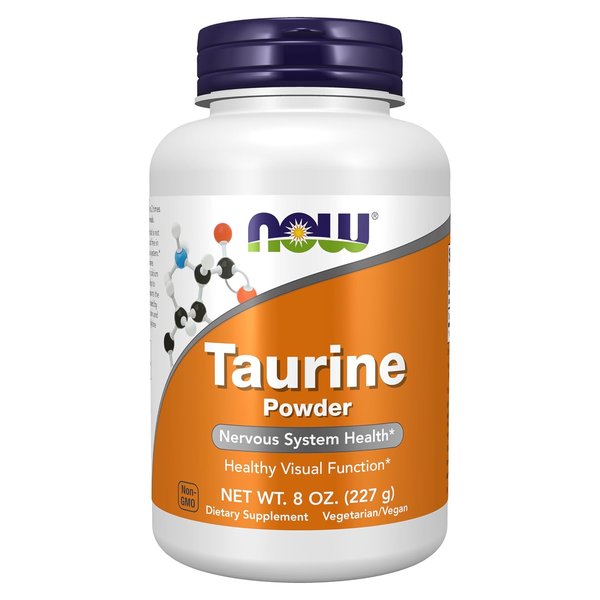
NOW Taurine Powder (8 oz)
Best for: Trying taurine without buying a kilogram
The cheapest way to try taurine, at $8.99 for a 227 g tub and about $0.12 per 3 g, with a restrained listing and a label that tells people on blood pressure or diuretic medicines to check with a doctor. The serving is a small 1/4 teaspoon, 875 mg, and testing is done in NOW's own accredited labs rather than by an independent program.
- The lowest entry price here, $8.99, for about $0.12 per 3 g
- A restrained listing that sticks to basic structure and function wording
- The label warns people on blood pressure or diuretic medicines to check with a doctor first
- The label serving is 1/4 teaspoon, 875 mg; 3 g is about 3 1/2 servings
- NOW says testing is done in its own ISO/IEC-accredited labs, not by an independent program
- A 227 g tub lasts about 2 1/2 months at 3 g a day
- The label directs 1/4 teaspoon 1 to 2 times a day, so 3 g goes beyond its own directions
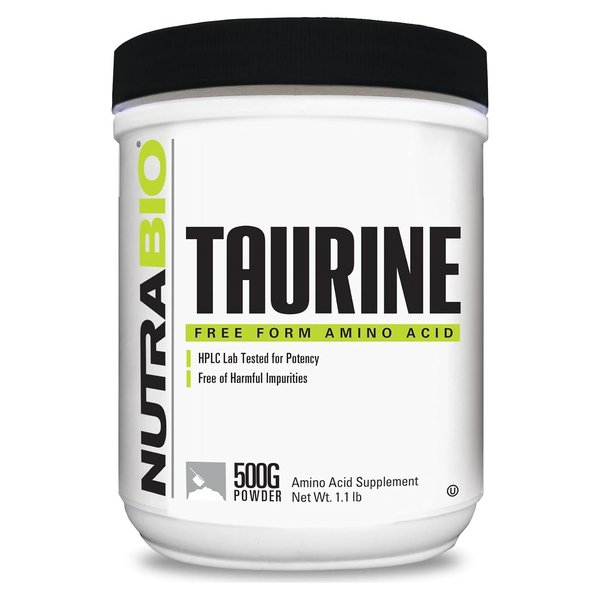
NutraBio Taurine Powder (500 g)
Best for: Buyers who want to look up their lot's test results
The most transparent testing claim here: NutraBio says you can enter the lot number from your tub to see third-party results, and its Supplement Facts panel lists taurine alone. The lookup page does not name the lab, and we could not view a taurine result without a lot number. The 1 g scoop makes 3 g three scoops, and its "Feel the Difference" timeline promises better pumps, fat oxidation and focus that trials have not shown.
- The only brand here that says you can look up third-party results by the lot number on your bottle
- The Supplement Facts panel lists taurine and no other ingredients
- About $0.14 for 3 g
- The lookup page does not name the lab, and we could not view a taurine result without a lot number
- A 1 g scoop, so 3 g means three scoops
- A "Feel the Difference" timeline promises better pumps, fat oxidation and focus, which taurine trials have not shown
- Fewer than 200 Amazon ratings
- Its title says "USP grade", but the product carries no USP Verified mark
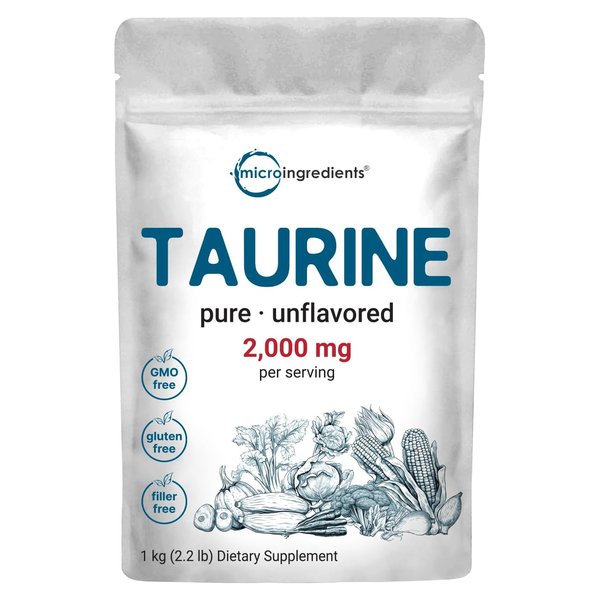
Micro Ingredients Taurine Powder (1 kg)
Best for: The lowest cost per gram
The cheapest per gram, about $0.07 per 3 g, with nothing added and a 2 g scoop. It ranks fifth because of its marketing: "natural anti-aging properties", energy claims, an absorption claim for free-form taurine, a comparison with pills, and dog and cat serving guides on a human supplement. Its testing claim names no lab.
- About $0.07 for 3 g ($21.99 a kilogram), the cheapest per gram here
- Taurine and nothing else, in a 2 g scoop
- Its third-party testing claim names no lab
- Claims "natural anti-aging properties" and energy benefits that human trials have not shown
- Says free-form taurine is "easily absorbed" and compares itself with pills that "may contain" fillers
- Prints dog and cat serving guides on a human supplement; ask a veterinarian about pets
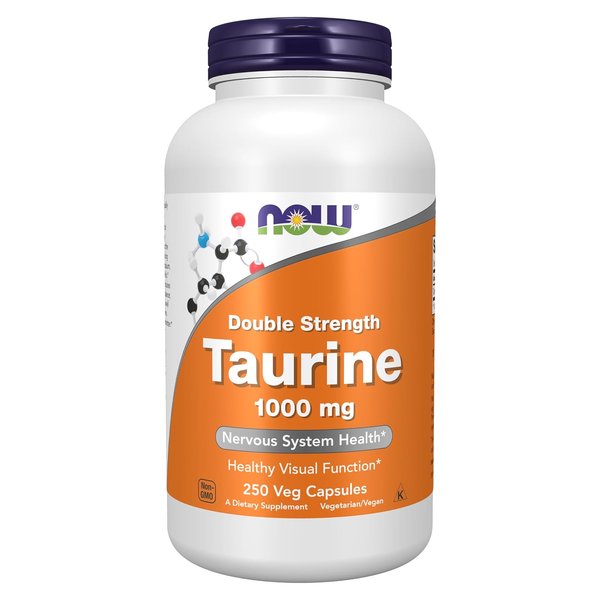
NOW Taurine 1,000 mg (250 capsules)
Best for: Capsule users who want the lowest cost
The best capsule: vegan 1,000 mg capsules at about $0.21 per 3 g, the lowest capsule cost here, with the same restrained listing and blood pressure medicine warning as NOW's powder. The label directs 1 to 2 capsules a day, and testing is in-house.
- The cheapest capsule per gram here, about $0.21 for 3 g
- Vegan capsules with a restrained listing
- The label warns people on blood pressure or diuretic medicines to check with a doctor first
- Nearly 3,000 Amazon ratings averaging 4.7 stars
- Testing is done in NOW's own labs, not by an independent program
- The label directs 1 to 2 capsules, so 3 g goes beyond the label's own directions
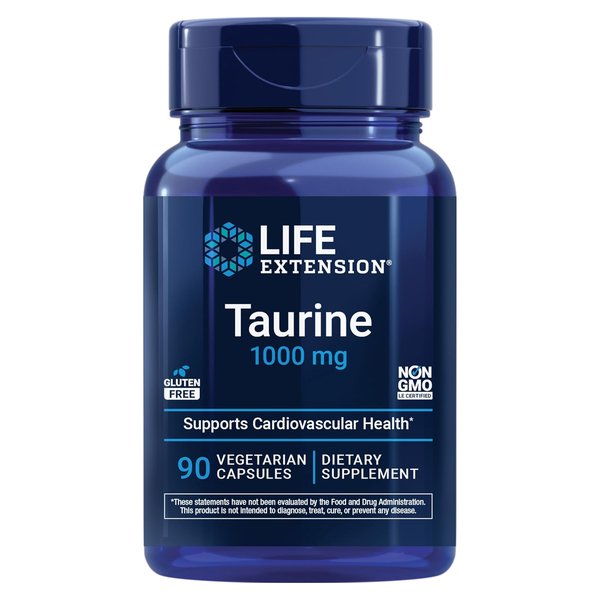
Life Extension Taurine 1,000 mg
Best for: A cheap capsule bottle with flexible dosing
A low $9.75 bottle of 1,000 mg vegetarian capsules whose directions allow up to 3 a day, with a certificate of analysis available on request. At 3 g a day it lasts a month, about $0.33 per 3 g, and the listing says taurine "encourages a healthy lifespan", which rests on animal and observational data.
- Directions allow up to 3 capsules, 3 g, a day
- A low $9.75 bottle price
- Says a certificate of analysis is available for every product
- About $0.33 for 3 g, and a bottle lasts a month at that amount
- Says it "encourages a healthy lifespan"; the aging evidence comes from animals and observational studies
- The certificate is on request, and no lab is named on the listing
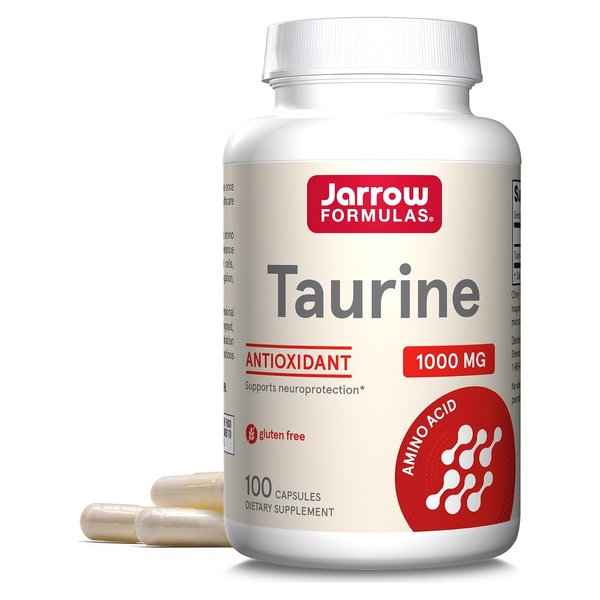
Jarrow Formulas Taurine 1,000 mg
Best for: One capsule a day, if gelatin is fine
One 1,000 mg capsule a day at about $0.38 per 3 g. It loses points for a bovine gelatin capsule, no testing claim on the listing, a "pharmaceutical grade" label that has no official meaning for supplements, and a neuroprotection claim that has not been shown in people.
- 1,000 mg in one capsule a day
- About $0.38 for 3 g
- Nearly 1,400 Amazon ratings averaging 4.6 stars
- Bovine gelatin capsule, so not for vegans or vegetarians
- No testing claim on the listing
- Calls itself "pharmaceutical grade", a term with no official meaning for supplements
- Claims "neuroprotection", which has not been shown in people
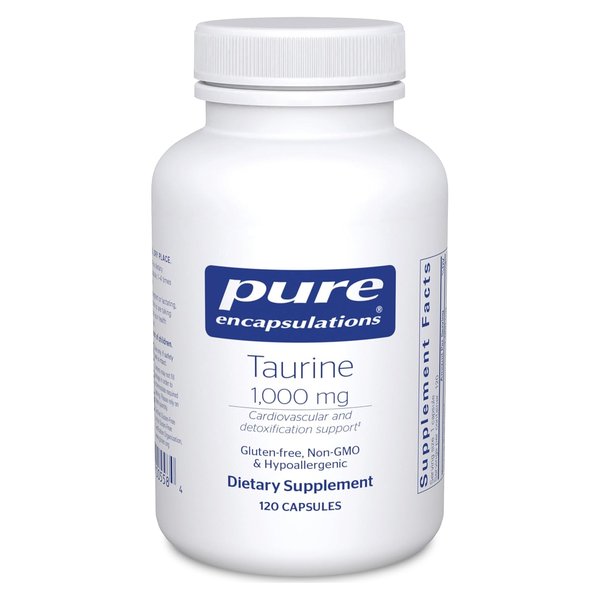
Pure Encapsulations Taurine 1,000 mg
Best for: A minimal-excipient capsule, at a price
The cleanest capsule formula here, with only a cellulose capsule and an antioxidant, and directions that allow up to 4 capsules a day. It is also by far the most expensive, about $0.88 per 3 g, its testing claim names no outside lab, and it claims detoxification and immune support that taurine trials have not shown.
- Only the capsule and an antioxidant added, with no magnesium stearate or silica
- Directions allow up to 4 capsules a day
- 4.7 stars across more than 1,800 Amazon ratings
- About $0.88 for 3 g, the most expensive here
- "Manufactured and tested to verify potency and purity" names no outside lab
- Claims detoxification support, which taurine trials have not shown
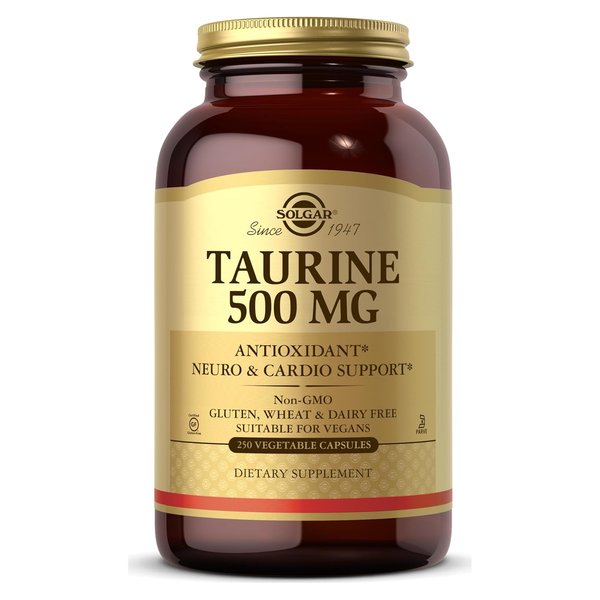
Solgar Taurine 500 mg
Best for: Small doses of 500 mg
Small 500 mg vegan capsules make low doses easy, but 3 g takes 6 capsules, more than the label's maximum of 4, at about $0.52. There is no testing claim; the NSF mark on the bottle certifies gluten-free status, not contents; and the listing credits free-form taurine with optimal absorption, which describes every taurine supplement, and the gallery calls Solgar "the gold standard" for supplements.
- 500 mg capsules make small doses easy
- Vegan, kosher and certified gluten-free
- 4.7 stars across about 600 Amazon ratings
- 3 g takes 6 capsules, more than the label's maximum of 4
- About $0.52 for 3 g
- No testing claim; its NSF mark certifies gluten-free status, not contents
- Says free-form taurine gives "optimal absorption"; all taurine supplements are free-form
- Calls Solgar "the gold standard for vitamins and supplements", a claim no one can verify
The full lineup, side by side
Amounts come from each product's Supplement Facts panel on its Amazon listing. Taurine is a cheap, simple ingredient, so cost per gram and what else is in the bottle separate products more than anything else. No single-ingredient taurine product we found holds an NSF contents certification.
| Product | Form | Taurine per serving (label) | Other ingredients | Testing claim | Cost per 3 g | Score |
|---|---|---|---|---|---|---|
| #1 Nutricost Powder | Powder | 2,000 mg (1 scoop) | None | Unnamed third party | $0.07 | 4.3 |
| #2 BulkSupplements | Powder | 2,000 mg (3/4 tsp) | Silicon dioxide | Unnamed third party | $0.09 | 4.2 |
| #3 NOW Powder | Powder | 875 mg (1/4 tsp) | Silicon dioxide | In-house lab | $0.12 | 4.0 |
| #4 NutraBio | Powder | 1,000 mg (1 scoop) | None listed | Lot lookup (lab not named) | $0.14 | 4.0 |
| #5 Micro Ingredients | Powder | 2,000 mg (1 scoop) | None | Unnamed third party | $0.07 | 3.9 |
| #6 NOW 1,000 mg Capsules | Capsules | 1,000 mg (1 cap) | HPMC capsule, stearic acid, silica | In-house lab | $0.21 | 3.7 |
| #7 Life Extension | Capsules | 1,000 mg (1 to 3 caps) | Cellulose capsule, silica, stearate | COA on request | $0.33 | 3.5 |
| #8 Jarrow | Capsules (gelatin) | 1,000 mg (1 cap) | Bovine gelatin, Mg stearate, MCC | None shown | $0.38 | 3.2 |
| #9 Pure Encapsulations | Capsules | 1,000 mg (1 to 4 caps) | Cellulose capsule, ascorbyl palmitate | Unnamed lab | $0.88 | 3.2 |
| #10 Solgar | Capsules (500 mg) | 500 mg (1 to 4 caps) | Cellulose capsule, MCC, stearic acid | None shown | $0.52 | 2.9 |
Prices are Amazon prices on October 20, 2026 and change often. Cost per 3 g is the container price divided by the grams of taurine it holds, times 3, whatever the label's own serving. Of the labels we read, only Life Extension's and Pure Encapsulations' directions reach 3 g a day; most direct 2 g or less. Testing claims are as the brands state them; we checked NSF's listings on October 20, 2026. If you take blood pressure, blood sugar or lithium medicine, or have kidney disease, ask your prescriber before adding taurine.
How to choose, and what to check first
Pick your dose, then the form. Supplement trials used 0.5 to 6 g a day, and 3 g a day is the observed safe level. If you want 2 to 3 g, powder is far cheaper and easier: one 2 g scoop versus three 1,000 mg capsules or six 500 mg capsules.
Ignore "natural" and "free-form" claims. Supplement taurine is synthetic and identical to the taurine in food, and every taurine supplement is free-form. Neither word tells you anything about quality. If you avoid animal products, check whether the capsule is gelatin.
Look for testing you can see. No plain taurine product we found holds an NSF contents certification. A lot lookup or a certificate that names the lab beats an unnamed "third party tested" badge. Energy drinks are not a substitute: they pair about 1 g of taurine per 250 mL can with caffeine and sugar.
- Blood pressure and diabetes medicines. Taurine modestly lowered blood pressure and blood sugar in trials, so its effect could add to those medicines; ask your prescriber first.
- Lithium. Drug references list a possible interaction based on a theoretical mechanism; we found no human study, so ask your prescriber.
- Kidney disease, pregnancy and breastfeeding. Taurine is cleared by the kidneys, and we found no safety trials of taurine alone in kidney disease or pregnancy.
- Dose. 3 g a day is the observed safe level from a 2008 review by authors at a supplement trade group; trials have used up to 9 to 12 g a day under medical supervision in a rare disease, but long-term safety data above 3 g are limited.
- Expectations. The effects measured in people are small changes in blood pressure, blood sugar markers and endurance tests, not longer life.
Frequently asked questions
What is the best form of taurine?
Plain taurine powder or capsules. Supplement taurine is synthetic and identical in every product, and every taurine supplement is free-form, so the differences are price, serving size, other ingredients and testing.
How much taurine should you take?
Supplement trials used 0.5 to 6 g a day, and 3 g a day is the observed safe level from a 2008 risk review. A 2026 meta-analysis found 1.5 to 3 g a day most effective for blood pressure and metabolic markers. Ask your clinician what fits you.
Does taurine slow aging?
In animals, taurine extended median lifespan 10 to 12 percent in mice and 10 to 23 percent in worms. In people, the evidence is observational, and two 2025 studies found blood taurine does not fall with age. We found no published human trial of taurine for aging.
Does taurine lower blood pressure?
Pooled trials found blood pressure about 3 to 4.7 mmHg lower on taurine, a small effect measured over weeks to months. We found no trial that measured heart attacks or strokes. If you take blood pressure medicine, ask your prescriber before adding it.
Is taurine safe?
At up to 3 g a day, trials have reported few side effects, and that is the observed safe level from a 2008 review. One case of a severe allergic reaction has been reported. People who take blood pressure, diabetes or lithium medicine, have kidney disease, or are pregnant should ask a clinician first.
Is the taurine in supplements from bulls?
No. The name comes from ox bile, where taurine was first found, but supplement and energy-drink taurine is almost always made synthetically and contains no animal products. Some capsules use gelatin shells, so check the label if that matters to you.
Does taurine help workouts?
Pooled trials found a small endurance benefit, and a 2025 analysis of single doses found a small benefit across exercise tasks, rated low to very low certainty, with no significant dose-response between 1 and 6 g. An energy-drink dose of caffeine plus 1 g of taurine did not improve repeated sprints.
The bottom line
The best taurine supplement is plain taurine at a dose you can measure easily and a price you can sustain. Nutricost's powder does that best, BulkSupplements is a near twin, and NutraBio is the pick if you want to check your lot's test results; NOW's 1,000 mg capsules are the best capsule. Keep expectations modest: the aging story comes from animals, and the effects measured in people are small changes in blood pressure, blood sugar markers and endurance.