Rhodiola rosea, also called golden root or arctic root, is the adaptogen people reach for when stress shows up as exhaustion rather than anxiety. It grows in cold, punishing places, it has a genuinely interesting research history out of Scandinavia and the former Soviet Union, and it is one of the few herbs with real trials in burnout and fatigue. It also has a problem that almost no product page mentions: rhodiola is one of the most adulterated botanicals in commerce, routinely substituted with cheaper species that lack its signature compounds. So we ranked these products on the one thing that actually protects you, proof of what is in the bottle, and kept the evidence honest about what rhodiola can and cannot do.
The short version
- Best overall: Momentous Rhodiola Rosea. Prints its rosavin and salidroside standardization and is NSF Certified for Sport on every batch.
- Best proof of contents: Nootropics Depot publishes per-lot lab certificates. Best branded extract: Supersmart uses Rhodiolife, which is DNA-authenticated to species.
- Best value: NOW Rhodiola 500 mg, which prints the full 3 percent rosavins and 1 percent salidroside spec on the label.
- The one label rule: insist on Rhodiola rosea root plus a guaranteed rosavin percentage. The common substitute species has almost no rosavins, so a rosavin guarantee is your species test.
How we ranked them
In most categories you rank on dose and price. In this one, verifying you actually bought rhodiola matters more, so identity came first:
- Species on the label. The panel should say Rhodiola rosea root, not just rhodiola. The genus contains roughly a hundred species, and material sold as R. rosea is commonly substituted with the cheaper Rhodiola crenulata.
- A guaranteed rosavin percentage. This is the load-bearing detail. R. crenulata is relatively high in salidroside but contains essentially no rosavins, so a guaranteed rosavin number is the practical species check a shopper can make. The traditional standard is about 3 percent rosavins and 1 percent salidroside, roughly the ratio found in genuine R. rosea root and the profile used in the research.
- Independent proof. Third-party certification, published per-lot certificates of analysis, or a branded extract with supplier-level identity testing.
- Dose that matches the research. Human trials have used a wide range, roughly 100 to 680 mg a day of a standardized extract, with most of the stress and fatigue studies falling between 200 and 600 mg.
- Value and formulation. Cost per serving, clean excipients, and a sensible capsule size.
What we left out, and why. This list is deliberately not the bestseller list. Several of the highest-volume rhodiola products on Amazon, including one popular option at about fifteen cents a capsule, print only a milligram count of "rhodiola extract" with no rosavin or salidroside percentage anywhere on the Supplement Facts panel. A standardization claim in a listing title is marketing; a standardization on the panel is a specification. We also left out a well-known brand's Rhodiola crenulata product, which is clearly and honestly labeled as crenulata, simply because it is not the species this guide is about. Scores are our editorial assessment on a five-point scale, not customer ratings, and they top out in the mid-fours because the evidence for rhodiola is promising rather than settled.
The 7 best rhodiola supplements
Tap any product to jump straight to its full review.
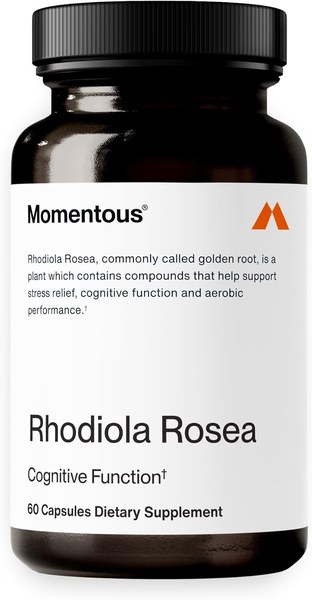
Momentous Rhodiola Rosea
Form: 100 mg R. rosea root extract · capsule
The pick that solves this category's actual problem. Momentous prints both standardization figures right in the ingredient line, 3 percent rosavins and 2 percent salidrosides, and the finished product is NSF Certified for Sport on every batch, which means an independent lab confirms the label and screens for contaminants. In a market where the default is an anonymous supply chain, that combination is rare and it is worth paying for. One planning note: at 100 mg this sits at the low end of the studied range, so if you want a mid-range dose you will take two or three capsules. A quick reassurance on the 2 percent salidroside, which is higher than the classic profile: the guaranteed 3 percent rosavins is what clears the species test, because the substitute species cannot produce rosavins at all.
- NSF Certified for Sport on every finished batch, the strongest verification here
- Rosavin and salidroside percentages printed on the panel
- Species and plant part both named as Rhodiola rosea root
- Inexpensive for a certified product
- 100 mg sits at the low end of the studied range; expect to take two or three
- The 3 to 2 rosavin-to-salidroside ratio is adjusted, not the classic 3 to 1 root profile
- No named branded extract on the label
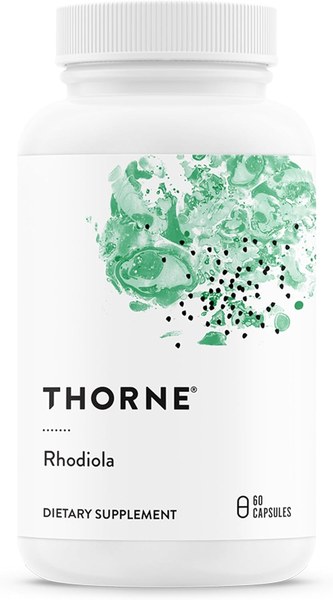
Thorne Rhodiola
Form: 100 mg R. rosea root extract, 5 to 1 · NSF Contents Certified
The brand you buy when you want the manufacturing to be beyond question. Thorne's testing program is among the most rigorous in the industry, this product is NSF Contents Certified, meaning an independent body verified what is in the bottle, and the formula is unusually clean. It is listed as a 5 to 1 extract standardized to 3 percent rosavins and 1 percent salidrosides, the classic spec. What keeps it just out of first place is the certification tier rather than the herb: NSF Contents Certified verifies label accuracy, while our top pick carries NSF Certified for Sport, which adds per-batch banned-substance screening. It is also the priciest per milligram of extract here.
- NSF Contents Certified, independently verified label
- Practitioner-grade brand with four rounds of in-house testing per batch
- Listed at the classic 3 percent rosavins and 1 percent salidrosides
- Very clean formula, stable and widely available listing
- Highest cost per milligram of extract in this roundup
- Contents certification rather than the broader Certified for Sport
- 100 mg per capsule means several capsules for a mid-range dose
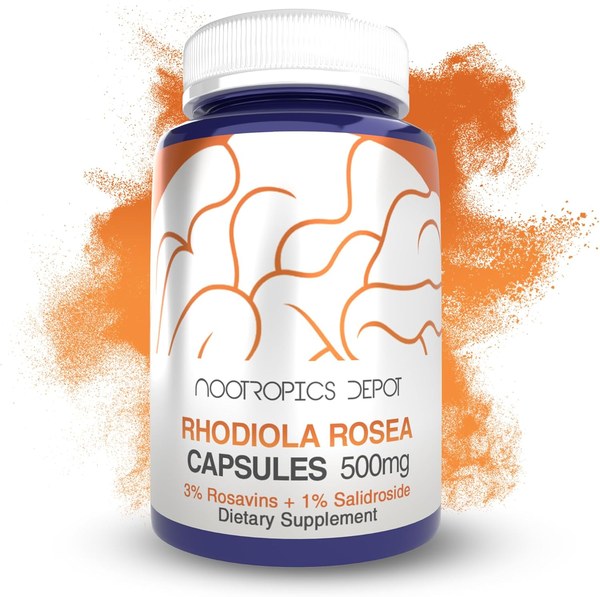
Nootropics Depot Rhodiola rosea 500 mg
Form: 500 mg R. rosea root extract · per-lot lab certificates
The most verifiable capsule here, and the direct answer to the adulteration problem. Nootropics Depot tests in its own ISO 17025-accredited lab and publishes per-lot certificates of analysis by lot number, so you can look up the exact bottle you bought, which almost nobody in this category does. The spec is the classic one: a full 500 mg standardized to at least 3 percent rosavins and 1 percent salidroside, so one capsule sits inside the studied range, and they deliberately hold salidroside at 1 percent rather than chasing the high-salidroside profile that can signal crenulata. One caution: the same brand also sells a separate Rhodiola crenulata product, so check the listing before you add to cart.
- Publishes per-lot HPLC certificates of analysis by lot number
- Full 500 mg at the classic 3 to 1 rosavin-to-salidroside ratio
- Tested in an ISO 17025-accredited in-house laboratory
- One capsule lands inside the clinically studied range
- Premium price per capsule
- Verification is their own accredited lab, not an outside certifier
- Brand also sells a crenulata product; check the listing carefully
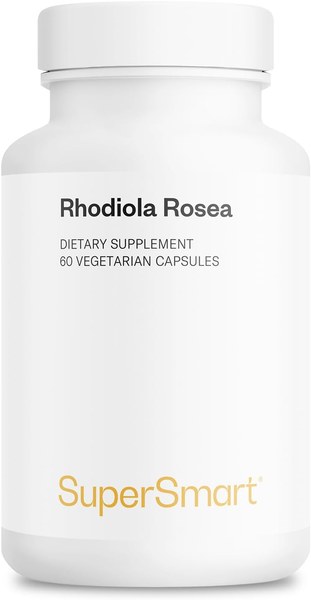
Supersmart Rhodiola with Rhodiolife
Form: 300 mg Rhodiolife per capsule · 600 mg per day
The pick if you want a named, identity-verified extract rather than an anonymous one. This uses Rhodiolife, a branded Siberian R. rosea extract that its supplier DNA-tests to species on every production run, which is the most direct answer possible to the substitution problem. It also carries the highest standardization here, 5 percent rosavins and 1.8 percent salidroside, and two capsules deliver 600 mg, the top of the studied range, without extra pills. The trade-offs are cost, it is the most expensive day in this lineup, no third-party seal on the finished bottle, and thin stock, so check availability before you count on it.
- Rhodiolife branded extract, DNA-tested to species by the supplier
- Highest standardization here at 5 percent rosavins
- 600 mg per day matches the top of the studied range
- Simple two-ingredient formula
- Most expensive per day in this roundup
- No third-party certification on the finished product
- Stock has been thin; the listing may go unavailable
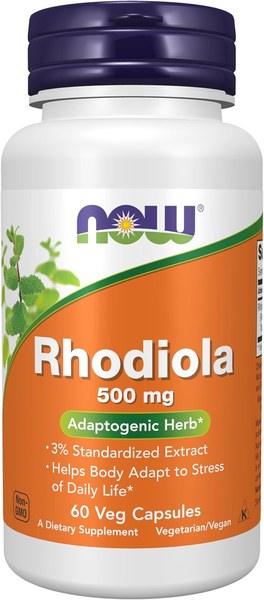
NOW Rhodiola 500 mg
Form: 500 mg R. rosea root extract · veg capsule
The value pick that refuses to cut the corner that matters. NOW's panel reads "Rhodiola Extract (Root) (Rhodiola rosea)" and prints minimum 3 percent rosavins and 1 percent salidroside, which is more disclosure than several pricier brands manage, at a fraction of the cost per milligram of rosavins. It is made in an NPA A-rated GMP facility with well-regarded in-house analytical labs. Two caveats: there is no third-party batch certification, and the price on this listing swings, so compare against the larger count before assuming a sale price is the norm. A full 500 mg in one capsule is also a lot if you are sensitive to stimulation.
- Best rosavin content per dollar in this roundup
- Species, plant part, and both standardization percentages on the panel
- NPA A-rated GMP facility with in-house analytical testing
- Widely stocked, with a larger count available for better value
- Price fluctuates; verify before buying
- No third-party batch certification
- 500 mg in a single capsule is a lot for stimulation-sensitive users
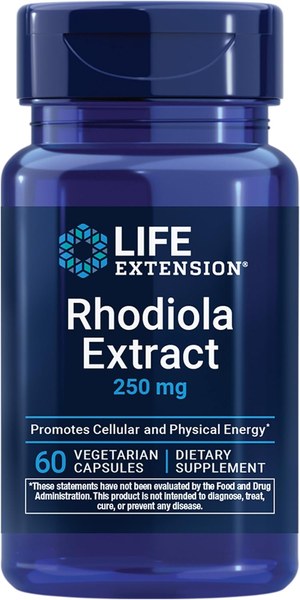
Life Extension Rhodiola Extract 250 mg
Form: 250 mg rhodiola root extract · two capsules daily
The cheapest capsule here that still proves its rosavin content. The panel prints standardized to 3 percent rosavins and not less than 1 percent salidrosides, and at 250 mg it splits neatly into a morning and midday schedule, which is closer to how much of the fatigue research actually dosed it. The transparency gap is small but real: the Supplement Facts line reads only "Rhodiola extract (root)" without the Latin binomial, which appears in the marketing copy instead. There is no third-party certification, and it contains maltodextrin, which some buyers prefer to avoid.
- Lowest cost per capsule while still printing both standardizations
- 250 mg splits well into a morning and midday schedule
- Easier to titrate than a single 500 mg capsule
- Long-established listing with stable supply
- Panel omits the Latin binomial, a small species-transparency gap
- No third-party certification
- Contains maltodextrin as an excipient
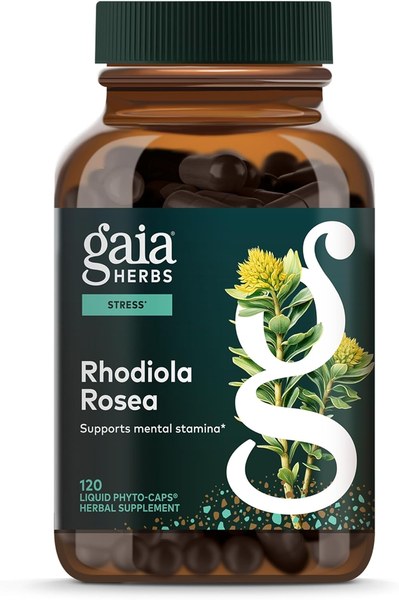
Gaia Herbs Rhodiola Rosea
Form: 120 mg liquid root extract · 6 mg rosavins · two capsules daily
The best option if you prefer a liquid extract to a dry powder. Gaia uses a Siberian Rhodiola rosea root extract in a liquid-filled vegan capsule, states 6 mg of rosavins per 120 mg of extract, roughly 5 percent, which is unusually strong identity evidence, and its traceability program lets you look up batch test results by the lot ID on your bottle. It finishes last here for two reasons: salidroside is not quantified anywhere on the label, so half the active picture is missing, and it is expensive per milligram, with the labeled two capsules a day landing at only the low end of the studied range.
- Roughly 5 percent rosavins, strong evidence of genuine R. rosea
- Batch-level test results searchable by lot ID
- Liquid extract in a vegan capsule, which many prefer
- Species, region, and rosavin milligrams all printed
- Salidroside is not standardized or quantified on the label
- Expensive per milligram of extract
- Only 120 mg per capsule; the labeled two a day sits at the low end of the studied range
The full lineup, side by side
| Product | Extract dose | Rosavins | Salidroside | Species on panel | Testing | ~Cost/capsule |
|---|---|---|---|---|---|---|
| Momentous | 100 mg | 3% | 2% | R. rosea root | NSF Certified for Sport | ~$0.33 |
| Thorne | 100 mg | 3% | 1% | R. rosea | NSF Contents Certified | ~$0.40 |
| Nootropics Depot | 500 mg | 3% min | 1% min | R. rosea root | Per-lot HPLC CoA | ~$0.52 |
| Supersmart (Rhodiolife) | 300 mg | 5% | 1.8% | R. rosea, DNA-tested | Supplier identity testing | ~$0.53 |
| NOW Foods | 500 mg | 3% min | 1% min | R. rosea root | In-house GMP | ~$0.27 |
| Life Extension | 250 mg | 3% | 1% min | Root, no binomial | cGMP | ~$0.23 |
| Gaia Herbs | 120 mg liquid | 6 mg (~5%) | Not stated | R. rosea root | Batch lookup by lot | ~$0.41 |
Prices are approximate and change often. Cost is per capsule so the column is comparable; note that Supersmart, Life Extension, and Gaia are labeled for two capsules a day, so their daily cost is roughly double. Confirm current pricing and specifications on the retailer page.
Does rhodiola actually work?
Rhodiola sits in an interesting middle ground: better evidence than most adaptogens, weaker evidence than the marketing implies. Here is the fair reading.
Two systematic reviews, two carefully hedged verdicts. A 2011 review in Phytomedicine examined 11 randomized controlled trials, all placebo-controlled, and found the methodological quality of most of them moderate or good. Its conclusion was that rhodiola may have beneficial effects on physical performance, mental performance, and certain mental health conditions, but that there is a lack of independent replication of the individual studies. A 2012 systematic review in BMC Complementary and Alternative Medicine looked specifically at fatigue, included 11 trials, and was harder-nosed: two of six trials examining physical fatigue in healthy populations and three of five on mental fatigue were positive, but the authors judged that all of the included studies carried a high risk of bias or reporting flaws, and concluded the research is contradictory. Neither review says rhodiola does nothing. Both say the evidence base is too small and too uneven to settle the question.
The strongest single trial is genuinely good. A double-blind, placebo-controlled study published in Planta Medica in 2009 gave 60 people diagnosed with stress-related fatigue either 576 mg a day of the standardized SHR-5 extract or placebo for 28 days. Compared with placebo, the rhodiola group improved significantly on a burnout scale and on several measures of attention, and showed a different cortisol response to waking. No serious side effects were attributed to the extract. Worth noting for calibration: both groups improved on several measures, which is exactly the placebo effect you would expect in a fatigue trial, and the drug-versus-placebo difference is the part that counts.
Two widely cited trials had no placebo group at all. This is where a lot of rhodiola marketing quietly overreaches. A 2012 study of the WS 1375 extract, 200 mg twice daily for four weeks, reported improvements across every stress measure it used, including within three days. It was open-label, single-arm, and non-randomized, meaning everyone knew they were taking rhodiola and there was no comparison group, so those improvements cannot be separated from expectation or natural recovery. Similarly, a 2015 trial of 80 mildly anxious people taking 400 mg a day reported reduced self-reported anxiety, stress, anger, confusion, and depression at 14 days, but the control group received no treatment rather than a placebo, and the authors said plainly that they could not determine a causal relationship. That study also found no improvement in cognitive performance, which is a useful corrective to the "rhodiola sharpens your brain" claim.
An awkward footnote for shoppers. A striking share of the better rhodiola research used one specific proprietary preparation, the SHR-5 extract, which means the literature supports that standardized preparation more than it supports the category as a whole. And SHR-5 products are only sporadically stocked in the US and are not a mainstream option, so the extract behind the strongest trials is generally not the one shoppers end up buying. That is a good reason to insist on a well-standardized product rather than assuming any bottle labeled rhodiola inherits the research.
How to choose the right one
Four questions get you to the right bottle:
- Does the label name the species and guarantee rosavins? Insist on Rhodiola rosea root plus a rosavin percentage, ideally with salidroside too. This single rule eliminates most of the market and nearly all of the risk.
- What dose do you need? Trials have run from about 100 mg up to 680 mg a day of a standardized extract, with most stress and fatigue studies between 200 and 600 mg. A 100 mg capsule is fine if you plan to take two or three; a 500 mg capsule is a one-and-done, but harder to fine-tune.
- When will you take it? Rhodiola is mildly stimulating for a meaningful minority of people, so it belongs in the morning, often before breakfast. Taking it late is the most common reason people report restlessness and poor sleep and conclude it did not suit them.
- Rhodiola or something else? If your stress presents as fatigue and mental flatness, rhodiola is the right lane. If it presents as anxiety and poor sleep, ashwagandha is the better-matched option, with more recent stress and anxiety trials behind it, and standardized forms like KSM-66 are the ones most often studied. We compare the wider category in our guide to energy support without caffeine, and cover rhodiola's stress research in more depth in rhodiola for stress and burnout.
Frequently asked questions
Do rhodiola supplements actually work?
The evidence is encouraging but not settled. Two systematic reviews looked at the same small body of trials and reached carefully hedged conclusions. A 2011 systematic review in Phytomedicine found that rhodiola may have beneficial effects on physical performance, mental performance, and certain mental health conditions, but flagged a lack of independent replication of the individual studies. A 2012 review focused on fatigue concluded the research is contradictory, and that while some evidence suggests it helps with physical performance and mental fatigue, methodological flaws limit how confident anyone can be. The single best trial, a double-blind placebo-controlled study of the SHR-5 extract in people with stress-related fatigue, did find real improvements in burnout scores and attention compared with placebo. So rhodiola is a reasonable, well-tolerated thing to try for stress-related fatigue, and it is not a proven treatment for any condition.
What should I look for on a rhodiola label?
Two things, and they matter more than the brand. First, the label should name Rhodiola rosea root specifically, not just rhodiola. Second, it should guarantee a standardization to both rosavins and salidroside, traditionally around 3 percent rosavins and 1 percent salidroside. That combination is the practical species test you can run at the shelf, because the cheaper substitute species Rhodiola crenulata is relatively high in salidroside but contains essentially no rosavins. A product that lists only salidroside, or only a raw milligram count of rhodiola extract with no percentages, gives you no way to know what you bought. This is not a theoretical worry: a 2020 analysis found a marker compound for R. crenulata in two of the four commercial products it examined by NMR, and across the products it tested by HPLC it confirmed the labeled amounts of salidroside and rosavins in fewer than a quarter.
How much rhodiola should I take, and when?
Human trials have used roughly 100 to 680 mg per day of an extract standardized to about 3 percent rosavins and 1 percent salidroside, with most of the stress and fatigue studies between 200 and 600 mg. The best-designed fatigue trial used 576 mg a day. More is not automatically better, so starting near the lower end and adjusting is sensible. Timing matters more than most people expect: rhodiola is mildly stimulating for a meaningful minority of users, so it belongs in the morning, and many labels suggest taking it before breakfast on an empty stomach. Taken in the afternoon or evening it can cause restlessness and vivid dreams, which is probably the single most common reason people decide it did not agree with them.
Rhodiola or ashwagandha: which is better for stress?
They are not really competitors, because they suit different presentations of stress. Rhodiola is the better fit when stress shows up as fatigue, mental flatness, and running out of gas, and it is mildly stimulating, which is why it is a morning supplement. Ashwagandha is the better fit when stress shows up as feeling wired, anxious, and sleeping badly, and it is calming, which is why it is often taken in the evening. Ashwagandha has more recent stress and anxiety trials and pooled analyses that come out positive, though those trials carry their own risk-of-bias and heterogeneity problems. If your main complaint is tiredness and low drive, rhodiola is the more likely fit. If it is feeling wired and sleeping poorly, ashwagandha is. Taking both is common, though there is little research on the combination.
How long does rhodiola take to work?
Trials have generally run for two to four weeks, and that is a fair window to judge it on. Some studies have reported improvements earlier, within days, though the studies reporting the fastest effects were also the weakest designs, with no placebo group to compare against, so early changes are hard to separate from expectation. A practical approach is to take a standardized product every morning for about four weeks before deciding. Because rhodiola can feel stimulating, some people notice something on day one, but a first-day feeling is not a reliable sign of whether it will help over time.
Is rhodiola safe, and what are the side effects?
Rhodiola is generally well tolerated in the published trials, which reported only mild adverse events, and the best fatigue study reported no serious side effects attributable to the extract. The most common complaints are being over-stimulated, restlessness, irritability, vivid dreams, and trouble sleeping if it is taken too late in the day. Because it can be activating and may affect mood, it is sensible to be cautious if you take antidepressants or other medications that affect serotonin, and it is generally advised against in bipolar disorder because of the potential for activation. There is not enough safety data in pregnancy or breastfeeding, so it is best avoided then. If you take medication or have a health condition, check with your doctor first.
The bottom line
Rhodiola is one of the more interesting adaptogens, with real trials behind it in stress-related fatigue and a good safety record, and it is also a category where what is printed on the label matters more than the brand on the front. Buy on identity first: Rhodiola rosea root, a guaranteed rosavin percentage, and some form of independent proof. Momentous is the certified all-rounder, Nootropics Depot gives you lot-level lab proof at a full dose, Supersmart is the DNA-verified branded extract, and NOW is the honest value buy. Take it in the morning, give it about four weeks, and hold the expectations where the evidence does: it may be a useful nudge for stress-related fatigue, and it is not a cure for being exhausted.