Magnesium glycinate, also sold as magnesium bisglycinate, is magnesium bound to the amino acid glycine. It is popular because it is gentle on the stomach and pairs magnesium with glycine, an amino acid studied for sleep. But many products sold as glycinate are not all glycinate: they are "buffered," blended with magnesium oxide to pack more magnesium into each capsule. Oxide is cheap, is listed by NIH among the less bioavailable forms, and is one of the forms most often linked to diarrhea, which is exactly what people buying glycinate are trying to avoid.
This ranking includes only products with real evidence that they are not buffered: a stated compound weight that fits pure magnesium glycinate, or an explicit fully reacted, non-buffered or single-form statement with no oxide on the label. Here, "fully reacted" means label evidence of no oxide, not a laboratory-confirmed chelate. We screened more than 30 products and set aside most of them, including several well-known brands whose labels, label records or brand pages describe a blend with magnesium oxide. For every magnesium form, see our overall magnesium ranking.
The short version
- Best overall: NOW Magnesium Bisglycinate Powder, with a label stating 250 mg of magnesium from 2,500 mg of Albion bisglycinate, at about $0.13 per 200 mg.
- Best tablet: NOW Magnesium Glycinate tablets, 200 mg from a stated 2,000 mg of Albion bisglycinate, about $0.22 per 200 mg.
- Best capsules: Innate Vitality (70 mg from a stated 500 mg) and Sports Research (160 mg from a stated 1,441 mg), both described as non-buffered by their brands.
- Check the math. Pure magnesium glycinate is at most about 14 percent magnesium by weight. Divide the magnesium by the compound weight: a result well above that, such as 18 to 20 percent, points to added oxide.
- Watch for oxide in the parentheses. Several popular "glycinate" products list magnesium oxide right on the label, often as a "buffered chelate."
- Keep expectations modest. Human studies do not show glycinate absorbs better than citrate, and sleep benefits in trials were small.
- Mind the limit. Adults should stay at or under 350 mg a day from supplements unless a clinician advises otherwise. Ask a doctor first if you have kidney disease, space magnesium at least 2 hours from bisphosphonates and some antibiotics, and cut back if stools turn loose.
How we ranked them
Every product had to pass a gate before scoring: magnesium glycinate or bisglycinate as the only magnesium source, no oxide or other magnesium salt on the label, and evidence that the compound is not buffered. We then scored the seven that passed:
- Non-buffered evidence (30%). Full marks when the label states the compound weight and it works out to the pure range, together with a named supplier or an explicit non-buffered statement. Slightly lower for an explicit fully reacted, fully chelated or single-form statement without a compound weight, because the ratio cannot be checked. A fully reacted or fully chelated statement is the brand's own claim: buffered Albion ingredients are also sold as chelates, and at least one buffered product's panel names only the bisglycinate chelate.
- Third-party verification (15%). No product here carries a certification of its magnesium content confirmed on a certifier's site. Named programs that check something else (Non-GMO, a manufacturing audit) or an unnamed testing claim earn partial credit.
- Cost per 200 mg of magnesium (20%), from Amazon prices on October 28, 2026.
- Label simplicity (15%). Capsules or powder with one or two other ingredients score highest; tablet binders and coatings, or an added ingredient that is not magnesium, score lower; a long excipient list scores lowest.
- Marketing restraint (20%). Products start at 4 of 5, and half a point comes off for each category present: unverifiable superiority claims, benefits beyond magnesium's evidence such as sleep through GABA, absorption claims that overreach, and a listing that contradicts its label.
Products are ordered by their unrounded scores, shown rounded to one decimal. Not ranked: Doctor's Best High Absorption (it says it is not buffered and works out to 10 percent, but it is magnesium lysinate glycinate, not glycinate alone); Pure Encapsulations, Thorne, Nature Made, Metagenics, Life Extension, Jarrow, Nature's Bounty and Seeking Health (clean single-form labels, but no compound weight and no fully reacted statement we could find, so we could not verify them either way); Douglas Labs could not be checked the same way, Bluebonnet's 400 mg glycinate is the same Albion ingredient as its ranked capsule, and Double Wood works out to 60 mg from a stated 400 mg, 15 percent, slightly above what pure glycinate can deliver even though its contents are NSF certified (label rounding may explain part of it). Labels, label records or brand pages that describe a blend with magnesium oxide: Designs for Health, Klaire Labs, Swanson's Albion capsule, Nested Naturals, Codeage and Toniiq. Multi-form blends: Snap, BioEmblem and Integrative Therapeutics; Nutricost's glycinate powder label works out to 30 percent. No brand paid to be included, and none sent product.
What fully reacted means, and how to check a label
The chemistry sets a ceiling. Magnesium bisglycinate is one magnesium atom bound to two glycine molecules, with a molecular weight of about 172. By our arithmetic, that makes the pure compound about 14.1 percent magnesium by weight. Commercial specifications vary: one supplier lists 11 to 14.5 percent and another 11.7 percent, and the Albion bisglycinate used by NOW works out to 10 percent on its labels. Albion's buffered grade, which adds magnesium oxide (about 60 percent magnesium), is listed at about 18 percent.
The label test. US labels must show the amount of elemental magnesium; the compound weight in parentheses is optional. When it is given, divide: 200 mg of magnesium from 2,000 mg of glycinate is 10 percent, consistent with pure glycinate. A product listing 600 mg of magnesium from 3,000 mg (20 percent) cannot be glycinate alone, and that label in fact names magnesium oxide. When only the elemental amount is listed, the ratio cannot be checked, so look for an explicit non-buffered or fully reacted statement and for oxide in the parentheses or the other ingredients list. A ratio in range fits an unbuffered product but does not prove chelation; lab methods such as infrared spectroscopy can check whether the magnesium is bound, but we found no published results for these products.
Why buffering matters. NIH lists oxide among the magnesium forms most often linked to diarrhea from high supplement doses, and among the less bioavailable forms. Whether glycinate itself absorbs better than other good forms is less clear: in a small 1994 study in 12 people with part of their small intestine removed, glycinate and oxide were absorbed about equally overall (23.5 vs 22.8 percent), though glycinate did better in the four who absorbed oxide worst and was better tolerated. In a 2003 trial of 46 healthy adults, citrate raised blood magnesium more than an amino acid chelate or oxide, though both organic forms beat oxide on urinary magnesium, and a 2024 single-dose crossover in 40 adults, funded by the maker of a competing oxide ingredient, found no significant rise in blood magnesium over 6 hours after bisglycinate. A 2021 review concluded that organic forms appear more bioavailable than inorganic ones such as oxide, with absorption depending on dose.
Sleep and stress. A 2021 meta-analysis of three small trials in older adults found magnesium shortened the time to fall asleep by about 17 minutes, on low to very low quality evidence, and those trials used oxide and citrate. A 2026 review of 12 trials concluded the evidence does not support magnesium as a routine insomnia treatment. A 2025 glycinate-specific trial in 155 adults with poor sleep found 250 mg of magnesium as bisglycinate improved an insomnia score slightly more than placebo over four weeks (a small effect). A 2017 review of anxiety studies in people prone to anxiety called the evidence suggestive but poor in quality, and a 2023 review found the trial evidence on sleep uncertain.
The glycine in glycinate. The amino acid glycine itself has been studied for sleep at 3 g before bed. By our arithmetic, 200 mg of magnesium as pure bisglycinate carries about 1.2 g of glycine, and reaching 3 g would take about 490 mg of magnesium, well above the supplement limit.
The 7 best fully reacted magnesium glycinate supplements
Tap any product to jump straight to its full review.
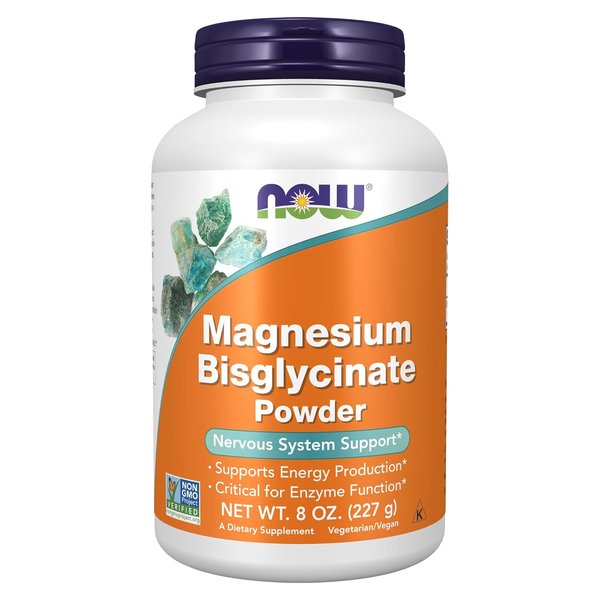
NOW Magnesium Bisglycinate Powder (8 oz)
Best for: The cheapest verifiable glycinate
The top pick because it is as verifiable as any here and by far the cheapest: the filed label states 250 mg of magnesium from 2,500 mg of Albion bisglycinate (10 percent) with only citric acid added, at about $0.13 per 200 mg. You measure it, it tastes slightly sour, and its ratings trail the capsules.
- The label in NIH's Dietary Supplement Label Database gives 250 mg of magnesium from 2,500 mg of Albion magnesium bisglycinate, a 10 percent ratio that fits an unbuffered chelate
- About $0.13 per 200 mg of magnesium, the lowest here by a wide margin
- Just bisglycinate and citric acid, so you can dose in small steps
- A powder you measure, with a slightly sour taste from the citric acid
- 4.1 stars from about 1,200 ratings, lower than the capsules
- NOW's own site now lists a newer label (300 mg per about 3 g), so check which version arrives
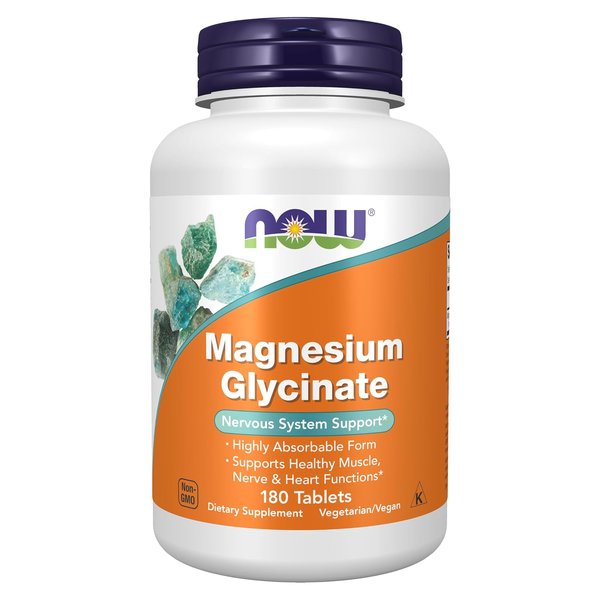
NOW Magnesium Glycinate Tablets (180 tablets)
Best for: A verified, low-cost tablet
The same Albion bisglycinate in a coated tablet, with the 2,000 mg compound weight printed on the panel and a restrained listing, at about $0.22 per 200 mg. The tablets are large, and the label's upper dose of 4 tablets is 400 mg, above the supplement limit.
- The Supplement Facts panel states 200 mg of magnesium from 2,000 mg of Albion magnesium bisglycinate, a 10 percent ratio that fits an unbuffered chelate
- About $0.22 per 200 mg, the cheapest pill here
- 8,838 ratings averaging 4.7 stars, and a restrained listing
- Each tablet carries about 1,000 mg of bisglycinate, so they are large
- Tablet binders and a coating (citric acid, hydroxypropyl cellulose, stearic acid, silicon dioxide, hypromellose, sunflower lecithin and more)
- The label suggests 2 tablets once or twice daily; 4 tablets is 400 mg, above the 350 mg upper limit for supplemental magnesium
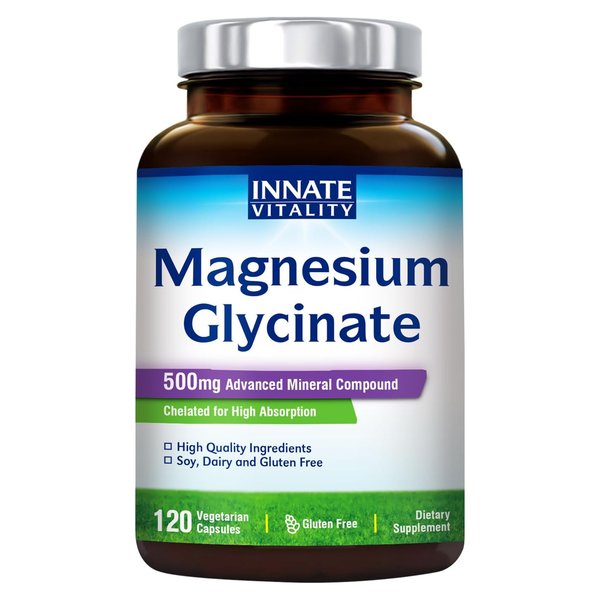
Innate Vitality Magnesium Glycinate 500 mg (120 capsules)
Best for: Small, flexible doses
A capsule whose panel states 70 mg of magnesium from 500 mg of glycinate (14 percent) and whose title says non buffered, with almost nothing else inside. The low dose per capsule is handy for splitting doses but means three capsules for 200 mg, and the listing overstates glycinate's absorption.
- The panel states 70 mg of magnesium from 500 mg of magnesium glycinate (14 percent), and the listing describes it as non-buffered
- Only organic rice concentrate and a vegetable capsule besides the glycinate
- 70 mg per capsule makes it easy to take small doses through the day; more than 11,000 ratings averaging 4.7 stars
- Three capsules for about 200 mg of magnesium
- Calls glycinate the most bioavailable form and the easiest to absorb, which human studies do not establish
- A third-party-tested claim with no named lab, and a 'no fillers' claim beside organic rice concentrate, a common flow agent
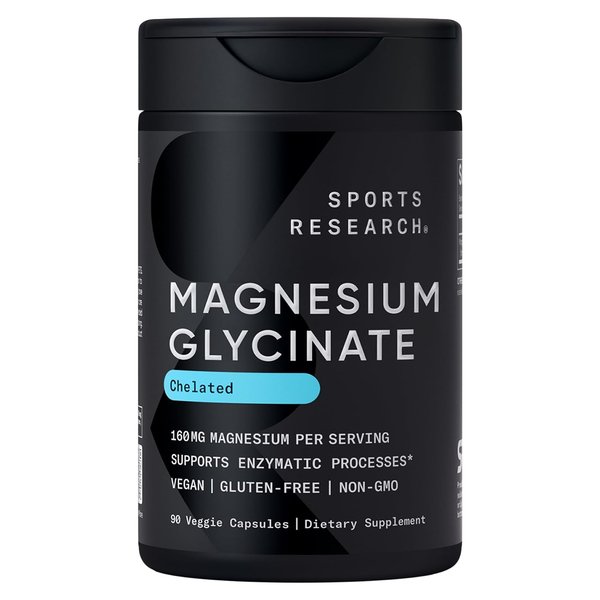
Sports Research Magnesium Glycinate (90 veggie capsules)
Best for: A stated compound in a clean capsule
A clean capsule that states 160 mg of magnesium from 1,441 mg of glycinate (11 percent) and calls itself non-buffered. It is the priciest per 200 mg here, and its listing promises restful sleep through GABA and superior absorption that trials do not show.
- The panel states 160 mg of magnesium from 1,441 mg of chelated magnesium glycinate (11 percent), and a gallery image describes it as non-buffered
- A short label: hypromellose capsule and organic rice hulls
- Non-GMO Project Verified and certified vegan; 4.8 stars from about 2,600 ratings
- About $0.50 per 200 mg, the most expensive here
- Says it promotes restful sleep by stimulating GABA and shows superior absorption over non-chelated forms, beyond what trials show
- A third-party-tested claim with no named lab, and the label says filler-free while listing rice hulls, which are commonly used as a flow agent
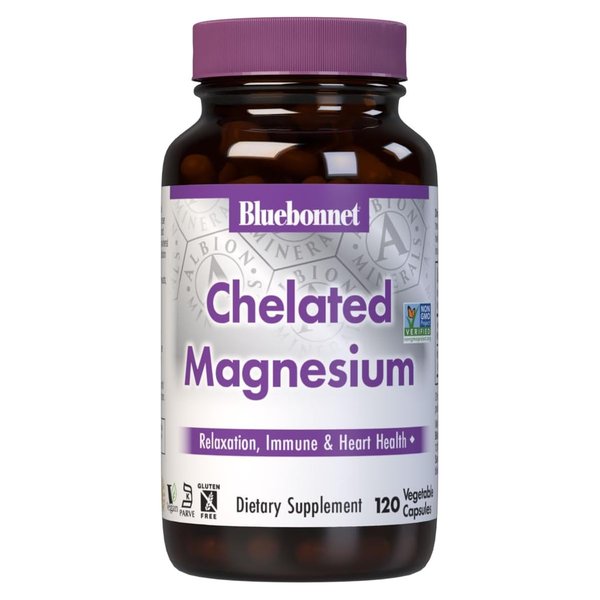
Bluebonnet Albion Chelated Magnesium (120 vegetable capsules)
Best for: Albion glycinate in a simple capsule
Albion bisglycinate that the brand's own label calls fully reacted, in a simple capsule at about $0.39 per 200 mg. There is no compound weight to check, and the brand also sells a buffered version, so read the label before you buy.
- The brand's label, filed in NIH's Dietary Supplement Label Database, describes fully reacted magnesium bisglycinate from Albion
- Only a vegetable capsule and magnesium stearate besides the chelate
- 4.7 stars from about 1,000 ratings
- The panel gives no compound weight, so the ratio cannot be checked
- Bluebonnet also sells a Buffered Chelated Magnesium with oxide; make sure you buy this one
- A stress relief headline in the title
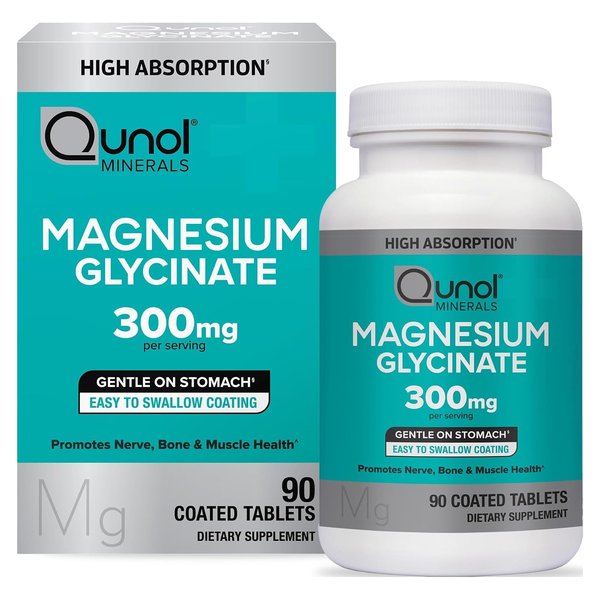
Qunol Magnesium Glycinate 300 mg (90 tablets)
Best for: 300 mg in two tablets
Two tablets give 300 mg of magnesium that the brand says is fully chelated, from a single form with no oxide, at about $0.24 per 200 mg. It has the longest excipient list here and an absorption chart against oxide that cites a laboratory solubility study.
- Says it is 100 percent and fully chelated and uses a single form of magnesium (the brand's own statement), with no oxide on the label
- About $0.24 per 200 mg, 150 mg of magnesium per tablet
- 7,167 ratings averaging 4.6 stars
- The longest excipient list here, including talc, dicalcium phosphate and maltodextrin
- An absorption chart against 100 percent magnesium oxide cites a laboratory solubility study, not a human trial
- No compound weight and no third-party certification; 300 mg sits close to the 350 mg upper limit
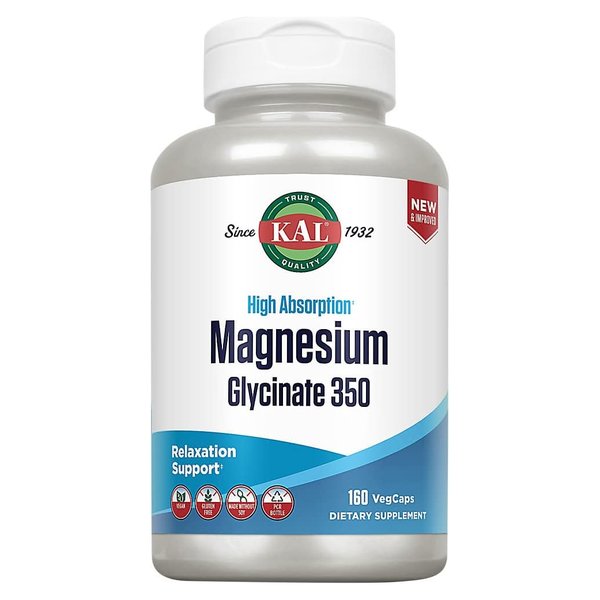
KAL High Absorption Magnesium Glycinate 350 (160 capsules)
Best for: The most magnesium per serving
Labeled fully chelated with glycinate as the only magnesium source, at about $0.31 per 200 mg. A full serving is 350 mg, the entire supplement limit, and it adds black pepper extract with an absorption claim no human study we found has shown for magnesium.
- Labeled fully chelated (the brand's own statement), with magnesium from glycinate as the only magnesium source listed
- About $0.31 per 200 mg
- 6,788 ratings averaging 4.6 stars
- A full serving of 4 capsules is 350 mg, the entire upper limit for supplemental magnesium
- Adds BioPerine black pepper extract and says it may make magnesium more absorbable, which no human magnesium study we found shows; the bottle also claims a 'better form'
- No compound weight, and testing is in the brand's own lab
The full lineup, side by side
Amounts come from each product's Supplement Facts panel on its Amazon listing, with compound weights and brand statements checked against labels filed in NIH's Dietary Supplement Label Database where available. Magnesium share is our arithmetic: elemental magnesium divided by the stated compound weight.
| Product | Magnesium per serving | Compound and % magnesium | Non-buffered evidence | Other ingredients | Cost per 200 mg | Score |
|---|---|---|---|---|---|---|
| #1 NOW Powder | 250 mg per 2.5 g | 2,500 mg Albion bisglycinate, 10% | Compound weight stated | Citric acid | $0.13 | 4.4 |
| #2 NOW Tablets | 200 mg per 2 tablets | 2,000 mg Albion bisglycinate, 10% | Compound weight stated | Tablet binders, coating | $0.22 | 4.2 |
| #3 Innate Vitality | 70 mg per capsule | 500 mg glycinate, 14% | Compound weight stated; listing says non-buffered | Rice concentrate, capsule | $0.45 | 3.9 |
| #4 Sports Research | 160 mg per 2 capsules | 1,441 mg glycinate, 11% | Compound weight stated; gallery says non-buffered | Rice hulls, capsule | $0.50 | 3.7 |
| #5 Bluebonnet | 200 mg per 2 capsules | Not stated (Albion bisglycinate) | Labeled fully reacted | Capsule, magnesium stearate | $0.39 | 3.7 |
| #6 Qunol | 300 mg per 2 tablets | Not stated | Labeled 100% chelated, single form | Long list incl. talc | $0.24 | 3.5 |
| #7 KAL | 350 mg per 4 capsules | Not stated | Labeled fully chelated | BioPerine, capsule, magnesium stearate, silica | $0.31 | 3.4 |
Prices are Amazon prices on October 28, 2026 and change often. Cost per 200 mg is the price divided by the number of 200 mg portions of elemental magnesium in the container. A ratio in the pure range fits an unbuffered chelate but does not by itself prove the magnesium is chelated; no product here carries an independent certification of chelation.
How to choose, and what to check first
Read the parentheses and the other ingredients. On the Supplement Facts panel, look at what follows "Magnesium (as ...)" and at the other ingredients list. If you see magnesium oxide, carbonate, or the words "buffered chelate," it is not pure glycinate. If a compound weight is given, divide the magnesium by it; about 10 to 14 percent fits pure glycinate.
Compare by elemental magnesium. A "500 mg magnesium glycinate" capsule may hold only 70 mg of magnesium. Compare products by cost per 200 mg of magnesium, and count how many capsules that takes.
Pick the form you will take. Powder is cheapest and easy to dose in small steps; capsules are convenient; tablets pack more per pill but are larger. Glycinate is bulky, so expect two to four capsules for 200 to 350 mg. If you want a different form, such as citrate for regularity or threonate, see our guide to which magnesium for which goal; for sleep specifically, see our magnesium for sleep and anxiety guide.
- The 350 mg limit. The adult upper limit for magnesium from supplements is 350 mg a day; food does not count toward it. Some labels suggest more.
- Kidneys. Impaired kidney function raises the risk of magnesium building up; ask your doctor first.
- Medicines. Take magnesium at least 2 hours apart from bisphosphonates, and take tetracycline or quinolone antibiotics at least 2 hours before or 4 to 6 hours after it.
- Low magnesium from medicines. Long-term proton pump inhibitors and some diuretics can lower magnesium; a blood test is better than guessing.
- Diarrhea. Loose stools usually mean the dose is too high, or that the product contains a laxative form such as oxide.
Frequently asked questions
What does fully reacted magnesium glycinate mean?
It is a brand term for magnesium that is entirely bound to glycine, rather than a blend that also contains magnesium oxide. There is no regulatory definition. The label test is to divide the elemental magnesium by the compound weight: pure magnesium glycinate is at most about 14 percent magnesium.
What is buffered magnesium glycinate?
Magnesium glycinate mixed with magnesium oxide to raise the magnesium per capsule. Suppliers list buffered grades at about 18 percent magnesium, against at most about 14 percent for pure glycinate. Several popular products list the oxide right on the label, often as a buffered chelate.
Is magnesium glycinate better absorbed than other forms?
Better than oxide is plausible, but it is not well proven against other good forms. A small 1994 study found glycinate and oxide absorbed about equally overall, a 2003 trial found citrate raised blood magnesium more than an amino acid chelate, and a 2024 single-dose study funded by the maker of a competing ingredient found no significant rise after bisglycinate. Organic forms in general appear better absorbed than oxide.
Is magnesium bisglycinate the same as magnesium glycinate?
Yes. Bisglycinate describes the usual structure, one magnesium bound to two glycine molecules, and the two names are used for the same ingredient.
Does magnesium glycinate help with sleep?
The evidence is modest. In a trial of 155 adults with poor sleep, 250 mg of magnesium as bisglycinate improved an insomnia score slightly more than placebo over four weeks, and a 2026 review of 12 trials concluded magnesium is not a routine insomnia treatment. Persistent sleep problems are worth discussing with a clinician.
How much magnesium glycinate should I take?
Count elemental magnesium, not the glycinate weight. The adult upper limit for magnesium from supplements is 350 mg a day; the sleep trial above used 250 mg. Stay at or under the limit unless your clinician advises otherwise, and ask first if you have kidney disease.
Why is magnesium glycinate so bulky?
Glycine is heavy, so pure magnesium glycinate is only about 10 to 14 percent magnesium. 200 mg of magnesium needs roughly 1.4 to 2 g of compound, which is why most products take two to four capsules or large tablets.
The bottom line
The best magnesium glycinate is the kind you can prove is glycinate: a label that states the compound weight in the pure range, or says plainly that it is fully reacted or non-buffered, with no oxide in the parentheses. NOW's powder and tablets lead because their labels show it and they cost the least; Innate Vitality and Sports Research are the cleanest capsules with stated compound weights; Bluebonnet, Qunol and KAL state it in words. Expect gentle, everyday magnesium rather than a sleep fix, and stay at or under 350 mg a day from supplements. Check with your doctor first if you have kidney disease or take bisphosphonates or antibiotics, and lower the dose if it causes diarrhea.