L-carnitine helps move fatty acids into mitochondria, where they are burned for energy, which is why it is sold as a fat burner. The body makes its own, and meat supplies more, so healthy people are rarely short of it. Swallowing more does not simply load your muscles: the trials that raised muscle carnitine paired it with large carbohydrate doses for about six months. What carnitine supplements have shown is smaller and narrower: less soreness after hard training, in research largely run with the maker of the Carnipure ingredient, and about a kilogram of extra weight loss in adults with overweight.
So this ranking rewards what you can check: how much carnitine the label delivers at its own directions, the cost of 2 g of carnitine, whether an independent program verified the contents, how many pills it takes, and how far the claims outrun the research. It covers the tartrate form used in recovery trials, a plain L-carnitine liquid, and acetyl-L-carnitine (ALCAR), which is sold for the brain. We read the Supplement Facts panel on every product's current Amazon listing and scored all seven on the same five criteria.
The short version
- Best overall: Nutricost L-Carnitine Tartrate Powder, plain tartrate at about $0.28 per 2 g of carnitine, with no benefit claims.
- Best tablet: NOW L-Carnitine 1,000 mg, Carnipure tartrate labeled as carnitine, two tablets for the 2 g studied.
- Best certified: Momentous Acetyl L-Carnitine, the only single-ingredient carnitine we found on NSF Certified for Sport's listing, though its label dose is low.
- Not a fat burner. Pooled trials found about 1.1 to 1.3 kg more weight loss than control, mostly in adults with overweight; the larger analyses found 1 to 2 kg less fat mass but no significant change in waist size or body fat percent.
- Recovery is the best sports use. Pooled trials found less soreness and lower muscle damage markers, but much of that research was done with the Carnipure maker, and strength and endurance results were mixed, with several trials finding no significant difference.
- ALCAR is not proven for memory. A Cochrane review found no benefit on objective memory and thinking tests.
- Check your medicines. Carnitine can interact with some hormone, blood-thinner and seizure medicines; see the warnings below the rankings.
How we ranked them
Carnitine products differ in form, dose, price, testing and claims, so we scored those, comparing every product by its grams of carnitine:
- Label daily dose (20%). Recovery trials used 2 g of carnitine a day, and the weight-loss dose response peaked around 2 g. Labels whose directions reach 1.5 to 2.5 g score highest; above 2.5 g, 1 to 1.4 g, 0.5 to 0.9 g and less score lower.
- Cost per 2 g of carnitine (25%), from Amazon prices on October 25, 2026.
- Verification (20%). Highest for NSF Certified for Sport, which checks label contents and screens for banned substances, confirmed on NSF's listing. Then a certification logo or claim we could not confirm on the certifier's site, then an unnamed or in-house testing claim, then nothing.
- Form (15%). Plain powder scores highest, then 2 pills for 2 g, then 3 to 4, then 5 to 6, with sweetened liquids scored like 5 to 6 pills.
- Marketing restraint (20%). Products start at 4 of 5, and half a point comes off for each category present: unverifiable superiority claims; benefits beyond the evidence, such as fat burning, energy, motivation or performance boosts, memory, focus, mood or fertility; and misused research or absorption claims. Recovery and soreness claims match the evidence and are not deducted.
Products are ordered by their unrounded scores, shown rounded to one decimal; exact ties are broken by verification, then marketing. We also looked at Thorne's acetyl-L-carnitine (about $2.69 per 2 g, with an NSF contents claim we could not confirm and mood, nerve and sperm claims); it would score about 3.0, just above Momentous, but we kept Momentous because its certification is the only one we could confirm, which matters for drug-tested athletes. We also looked at Nutricost's ALCAR capsules, BulkSupplements powders, other liquid shots, GPLC and multi-carnitine blends. No brand paid to be included, and none sent product.
What L-carnitine research actually shows
Why a capsule does not load your muscles. Only about 5 to 18 percent of a supplement dose is absorbed, compared with much more from food, and muscle takes up carnitine only when insulin is high. The trials that raised muscle carnitine, by about 20 percent, gave it with large carbohydrate doses for about six months: one used 2 g of tartrate (1.36 g of carnitine) with 80 g of carbohydrate twice a day for 24 weeks. Those trials found more fat burned during moderate exercise, but they do not show that a pill on its own does the same.
Weight. Three meta-analyses agree on a small effect: about 1.1 to 1.3 kg more weight loss than control. The larger two found about 1 to 2 kg less fat mass but no significant change in waist size or body fat percent, one found the effect only in adults with overweight or obesity, and another found the effect shrank the longer people took it. One trial cited by two of these analyses now carries an expression of concern, and a sister paper from the same research group has been retracted. For the wider picture, see our fat burner guide.
Recovery and performance. A 2020 meta-analysis of 7 trials found less muscle soreness for up to 96 hours after exercise and lower muscle damage markers at 24 hours, and a 2024 umbrella review rated the effect on damage markers and soreness moderate certainty. Many of the recovery trials used Carnipure tartrate at about 2 g of carnitine a day. Lonza, its maker, describes nine University of Connecticut papers from 2001 to 2010 as done in collaboration with the company, and the largest recent trial, 80 adults over 5 weeks, was funded by Lonza with two company employees among the authors. Performance is less clear: a trial in middle-aged adults found lower damage markers but no change in strength or power, a 4-week trial in trained men found no gain in a 20 km time trial, and a 24-week trial in older women found no change in strength. A systematic review of 11 studies found some gains in high-intensity exercise but none at moderate intensity.
Acetyl-L-carnitine and the brain. A Cochrane review of 11 trials in people with dementia found no benefit on objective memory and thinking tests, and a 2003 meta-analysis in mild cognitive impairment and early Alzheimer's disease found only a small advantage over placebo. A second Cochrane review, of carnitine in all its forms in healthy young adults, found only two small trials, too few to draw conclusions. ALCAR is not a proven memory supplement; see our nootropic ranking for better-supported options.
Safety signals. In a trial of 409 women having taxane chemotherapy, 3 g a day of ALCAR to prevent nerve damage made nerve symptoms worse at 24 weeks, and nerve symptoms stayed worse over 2 years of follow-up. Gut bacteria turn carnitine into TMAO, a compound linked to heart disease in observational and animal studies; 24 weeks of supplementation raised blood TMAO about tenfold in older women, without changes in inflammation or cholesterol, while a 6-month trial in adults with metabolic syndrome found no difference in its main measure, total plaque volume in the neck arteries, but more narrowing of those arteries and higher LDL cholesterol with 2 g a day. Carnitine also blunts the action of thyroid hormone, and there are case reports of interactions with acenocoumarol, a warfarin-type blood thinner. A safety review by scientists at the Council for Responsible Nutrition, a supplement trade group, found strong evidence of safety up to 2 g a day for long-term use, adding that higher intakes may be safe but the data were too thin to be sure.
The 7 best L-carnitine supplements
Tap any product to jump straight to its full review.
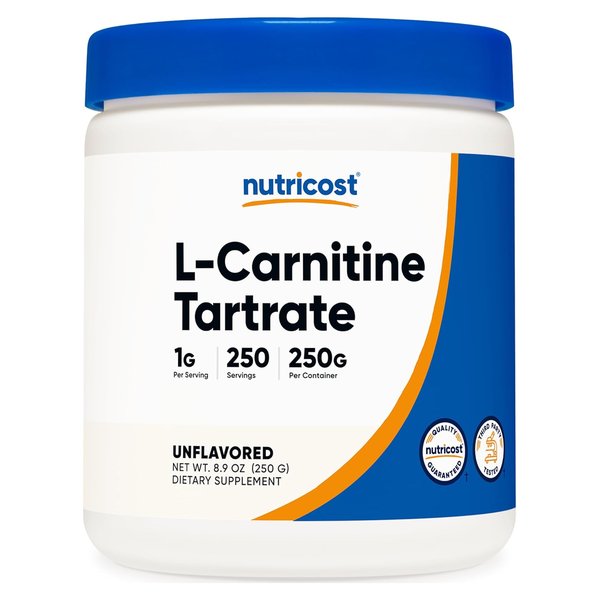
Nutricost L-Carnitine Tartrate Powder (250 g)
Best for: Low-cost tartrate powder
The top pick because it does the basics best: tartrate, the form used in the recovery trials, with nothing added, a listing with no benefit claims, and about $0.28 for 2 g of carnitine. The scoop holds 1 g of tartrate, so the 2 g of carnitine studied takes about 3 scoops, and its testing claim names no lab.
- L-carnitine tartrate, the form used in the recovery trials, with nothing added
- About $0.28 for 2 g of carnitine, the lowest cost here
- A listing with no benefit claims
- The 1 g scoop holds about 0.68 g of carnitine; the 2 g studied takes about 3 scoops
- "Third party tested" names no lab
- The listing text names calcium silicate, which the label panel does not
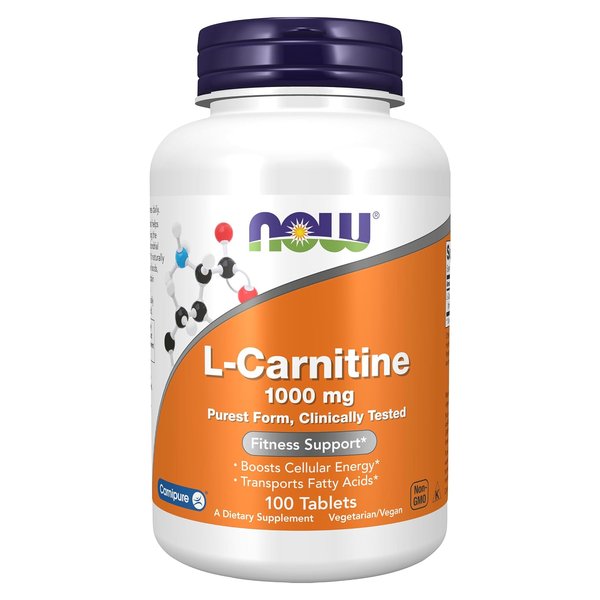
NOW L-Carnitine 1,000 mg (100 tablets)
Best for: 2 g of carnitine in two tablets
Carnipure tartrate labeled clearly as carnitine, 1 g per tablet, so the label maximum of two tablets reaches the 2 g studied. It costs about $0.56 per 2 g, testing is NOW's own, and the front label calls it the "Purest Form" and says it "Boosts Cellular Energy".
- Labels the actual carnitine, 1 g per tablet, from Carnipure tartrate
- Two tablets, the label maximum, reach the 2 g studied
- The label tells anyone who takes medication or has a medical condition to check with a physician first
- Testing is NOW's own; its Intertek certification covers manufacturing practices, not this product's contents
- Calls itself the "Purest Form" and says it "Boosts Cellular Energy"
- About $0.56 per 2 g, twice the powder
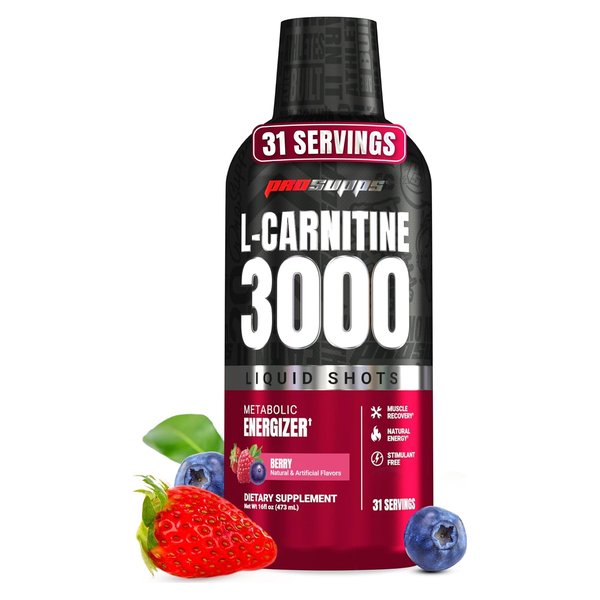
ProSupps L-Carnitine 3000 Liquid Shots, Berry (16 fl oz)
Best for: People who prefer a liquid
A liquid with 3 g of carnitine per tablespoon and an Informed Choice logo we could not confirm on the certifier's site. That tablespoon is above the 2 g a day level a safety review found well supported, the formula is artificially sweetened, and the listing promises more energy and motivation.
- Carries the Informed Choice logo for banned-substance screening (we could not check the certifier's listing)
- Says to take it with carbohydrate; the trials that raised muscle carnitine paired it with large carbohydrate doses
- No pills to swallow
- One tablespoon is 3 g, above the 2 g a day that a safety review found well supported for daily use; around 3 g a day can cause stomach upset and a fishy body odor
- Sweetened with sucralose and acesulfame potassium, with two preservatives
- Sold as a "Metabolic Energizer" promising "natural energy" and to "boost motivation", which trials have not shown
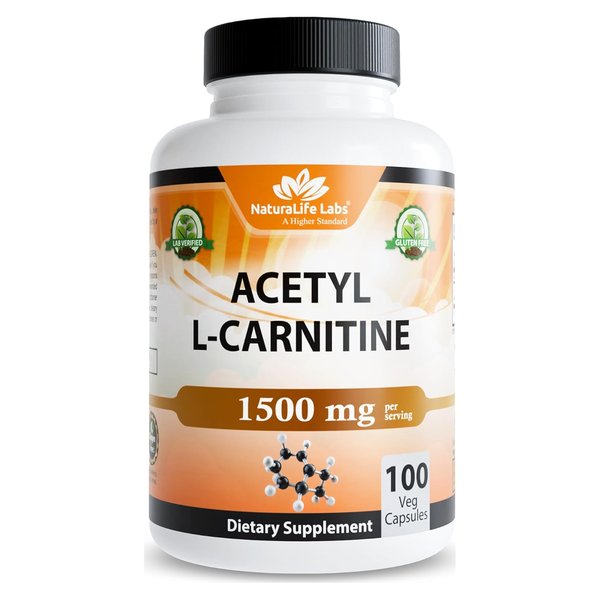
NaturaLife Labs Acetyl L-Carnitine 1,500 mg (100 capsules)
Best for: Low-cost ALCAR capsules
The cheapest acetyl-L-carnitine per gram here, 1.5 g of ALCAR per two plain capsules, with a listing that makes no benefit claims and more than 13,000 ratings. Its testing claim names no lab, its "A Higher Standard" slogan cannot be checked, and the label does not give the salt weight behind its 1,500 mg.
- 1.5 g of ALCAR per serving, the low end of the doses studied
- Nothing but ALCAR in a plant capsule
- More than 13,000 Amazon ratings averaging 4.5 stars, and a listing with no benefit claims
- "Third-party tested" names no lab, and the label's "A Higher Standard" slogan is a quality claim no one can check
- Unlike NOW's ALCAR, the label does not give the weight of the ALCAR HCl salt behind its 1,500 mg
- A bottle lasts 50 days at the label dose
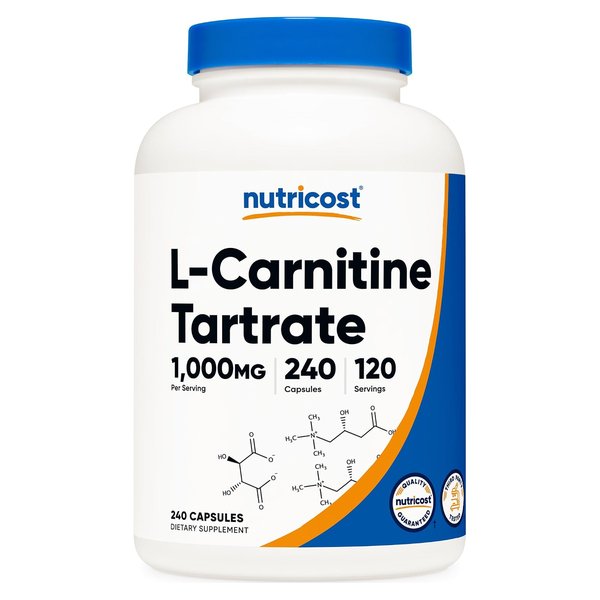
Nutricost L-Carnitine Tartrate 1,000 mg (240 capsules)
Best for: Tartrate in capsules
Plain tartrate capsules at about $0.49 per 2 g of carnitine, with a listing that makes no claims. The label serving gives only about 0.68 g of carnitine, so 2 g takes 6 capsules, and the testing claim names no lab.
- Tartrate capsules at about $0.49 per 2 g of carnitine
- A listing with no benefit claims
- More than 4,400 Amazon ratings averaging 4.7 stars
- The label serving gives about 0.68 g of carnitine; 2 g takes 6 capsules
- Gelatin capsules with several fillers
- "Third party tested" names no lab, and its NSF mention refers to the factory
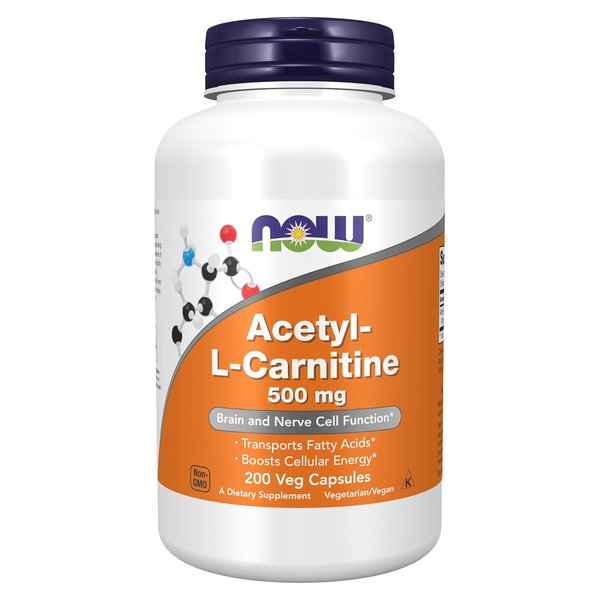
NOW Acetyl-L-Carnitine 500 mg (200 veg capsules)
Best for: A clearly labeled ALCAR dose
The clearest ALCAR label here, stating both the ALCAR and the salt weight, with a label maximum of 2 g inside the studied range. It costs about $0.70 per 2 g of carnitine, and the listing leans on brain claims and calls ALCAR "highly bioavailable".
- States both the ALCAR and the HCl salt weight, so the dose is clear
- The label maximum, 2 g of ALCAR, sits inside the studied range
- Markets "Brain Energy" and brain and nerve function; trials found little or no effect on objective memory tests
- Calls ALCAR "highly bioavailable"; it is partly broken down in the gut
- About $0.70 per 2 g, and testing is NOW's own
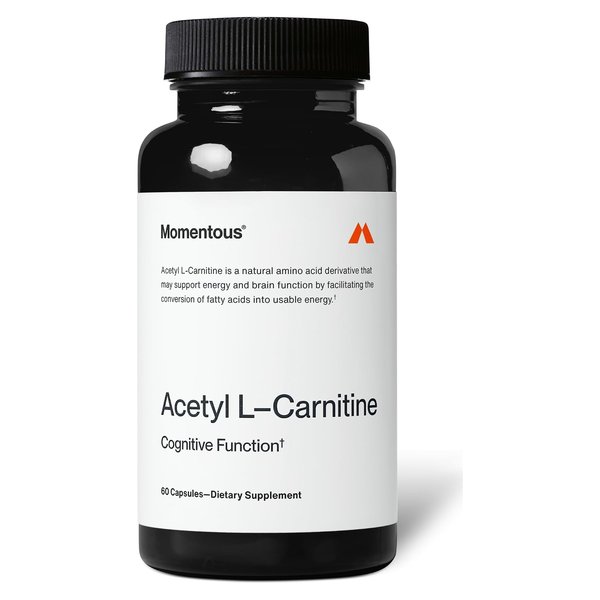
Momentous Acetyl L-Carnitine 500 mg (60 capsules)
Best for: Drug-tested athletes
The only single-ingredient carnitine we found on NSF Certified for Sport's listing, which matters for drug-tested athletes. But its label dose is one 500 mg capsule, a third of the lowest dose studied, it costs about $2.52 per 2 g of carnitine, and the listing makes memory, mood and fat-metabolism claims the research does not support.
- NSF Certified for Sport, which checks label contents and screens for banned substances; we confirmed it on NSF's listing
- The only single-ingredient carnitine we found on that listing
- The label dose, one 500 mg capsule, is a third of the lowest dose studied
- About $2.52 per 2 g of carnitine, nine times the powder
- Claims better memory, focus, mood and fat metabolism, and says "extensive studies have shown" it, which trials do not support
The full lineup, side by side
Amounts come from each product's Supplement Facts panel on its Amazon listing. Labels list either L-carnitine itself, the tartrate salt (about 68 percent carnitine) or acetyl-L-carnitine (about 79 percent carnitine), so the table converts each to grams of carnitine at the label's maximum daily directions.
| Product | Form | Per serving | Carnitine at label max | Testing claim or certification | Cost per 2 g carnitine | Score |
|---|---|---|---|---|---|---|
| #1 Nutricost Powder | Powder (tartrate) | 1 g tartrate | 0.68 g | Unnamed third party | $0.28 | 3.9 |
| #2 NOW Tablets | Tablets (tartrate) | 1 g carnitine | 2 g | In-house testing | $0.56 | 3.8 |
| #3 ProSupps | Liquid (L-carnitine) | 3,000 mg (1 tbsp) | 3 g | Informed Choice logo (not confirmed) | $0.64 | 3.6 |
| #4 NaturaLife | Veg capsules (ALCAR) | 1,500 mg ALCAR | 1.19 g | Unnamed third party | $0.57 | 3.6 |
| #5 Nutricost Capsules | Capsules (tartrate) | 1,000 mg tartrate (2 caps) | 0.68 g | Unnamed third party | $0.49 | 3.6 |
| #6 NOW ALCAR | Veg capsules (ALCAR) | 1 g ALCAR (2 caps) | 1.59 g | In-house testing | $0.70 | 3.5 |
| #7 Momentous | Veg capsules (ALCAR) | 500 mg ALCAR | 0.40 g | NSF Certified for Sport | $2.52 | 2.9 |
Prices are Amazon prices on October 25, 2026 and change often. Cost per 2 g is the bottle price divided by the grams of carnitine it holds, times 2; 2 g of carnitine is about 2.9 g of tartrate or 2.5 g of ALCAR. NSF Certified for Sport was confirmed on NSF's listing; NSF's dietary supplement listing and the Informed Choice site could not be reached.
How to choose, and what to check first
Pick the form for your goal. For training recovery, choose tartrate, the form used in the soreness trials, at about 2 g of carnitine (about 3 g of tartrate) a day. ALCAR is sold for the brain, but trials found little or no benefit on objective memory tests. Plain liquid carnitine works like tartrate but usually comes with sweeteners.
Read the units. "1,000 mg of L-carnitine tartrate" is about 680 mg of carnitine, while NOW's "L-carnitine 1 g" is a full gram. ALCAR labels may state the acetyl-L-carnitine or the heavier HCl salt.
Ignore fat-burner promises. The weight effect in pooled trials is about a kilogram, mostly in adults with overweight, and the trials that raised muscle carnitine needed large carbohydrate doses for months. Taking it with a meal is sensible; expecting it to burn fat is not.
- Chemotherapy. In a large trial, ALCAR taken during taxane chemotherapy made nerve damage worse; do not take it during cancer treatment unless your oncology team agrees.
- Thyroid medicine. Carnitine can blunt the action of thyroid hormone; ask your doctor if you take levothyroxine or have a thyroid condition.
- Blood thinners and seizure medicine. There are case reports of interactions with a warfarin-type blood thinner, and some seizure medicines lower carnitine levels; ask your prescriber.
- Stomach upset and odor. Around 3 g a day can cause nausea, cramps, diarrhea and a fishy body odor.
- Pregnancy and heart health. Safety in pregnancy is not established, and carnitine raises TMAO; talk to your doctor first if you are pregnant or have heart disease.
Frequently asked questions
Does L-carnitine help you lose weight?
Only a little. Pooled trials found about 1.1 to 1.3 kg more weight loss than control, mostly in adults with overweight; the larger analyses found 1 to 2 kg less fat mass but no significant change in waist size or body fat percent. It is not a stand-alone fat burner.
What is L-carnitine best for?
Recovery from hard training. Pooled trials found less muscle soreness and lower muscle damage markers, mostly with about 2 g of carnitine a day as tartrate, though much of that research was run with the ingredient's maker. Effects on strength and endurance were mixed.
How much L-carnitine should you take?
Recovery trials used about 2 g of carnitine a day, which is about 3 g of L-carnitine tartrate. ALCAR trials used 1.5 to 3 g a day. Around 3 g a day can cause stomach upset and a fishy body odor.
L-carnitine tartrate or acetyl-L-carnitine?
Tartrate for training recovery, since that is the form the soreness trials used. ALCAR is sold for the brain, but a Cochrane review found no benefit on objective memory tests in people with dementia.
Should you take L-carnitine with carbs?
It may help. Muscle takes up carnitine when insulin is high, and the trials that raised muscle carnitine paired it with large carbohydrate doses for months. Taking it with a meal is a reasonable habit.
Is L-carnitine safe?
At about 3 g a day it can cause stomach upset and a fishy body odor, according to the NIH. It raises TMAO, a compound linked to heart disease in observational studies, it can blunt thyroid hormone, and ALCAR worsened nerve damage during taxane chemotherapy. Safety in pregnancy is not established.
Is Carnipure better than other L-carnitine?
It is the same compound. Carnipure is the branded tartrate many recovery trials used, often in collaboration with its maker, Lonza; we found no trial showing it works better than other L-carnitine.
The bottom line
The best L-carnitine supplement for most people is plain tartrate at about 2 g of carnitine a day, at a price you will not notice. Nutricost's powder does that best, NOW's tablets make the dose easiest, and Momentous is the only option we found on NSF Certified for Sport's listing. Keep expectations modest: carnitine is not a fat burner, the recovery benefit comes mostly from research run with the ingredient's maker, and ALCAR has not proven itself for memory.