GABA, short for gamma-aminobutyric acid, is the brain's main calming, or inhibitory, neurotransmitter, the chemical brake that quiets an overactive mind. So it is easy to see the appeal of a GABA supplement for stress and sleep. There is a catch that most product pages skip over: it has long been thought that the GABA in a pill does not easily reach the brain, and the human evidence for calm and sleep is genuinely thin. We took that seriously. We compared the leading GABA products on form, dose, delivery, testing, and price, led with the form that actually appears in the research, and kept the science honest, so you can decide with clear eyes rather than hype.
The short version
- Best overall: Thorne PharmaGABA-250. The studied, fermentation-derived form (PharmaGABA), NSF certified, from a trusted brand.
- Best chewable: Natural Factors PharmaGABA for fast, water-free calm, and best stress stack: Jarrow GABA Soothe (adds L-theanine and ashwagandha).
- Best value: NOW GABA, and best sublingual: Source Naturals GABA Calm.
- Reality check: whether oral GABA reaches the brain is debated, and the evidence for stress and sleep is limited. Treat it as a low-risk experiment in relaxation support, not a proven treatment.
How we ranked them
Because the evidence here is modest, we did not just rank by dose or price. We weighed five things, in this order:
- Form. PharmaGABA, the natural GABA made by fermentation, is the exact form used in most of the small human studies, so we ranked it above generic synthetic GABA. The molecule is the same, but matching what was actually studied counts for something.
- Dose that matches the research. The studies used modest amounts, roughly 100 to 300 mg. We did not reward large synthetic megadoses, since more is not proven to be better.
- Testing and quality. NSF certification, independent third-party testing, and a reputable manufacturer counted most in a category full of hype.
- Delivery. Capsules for simple daily use, or faster chewables and lozenges for in-the-moment calm.
- Value and formulation. Cost per serving, useful add-ins like L-theanine, and clean labels.
Scores are our editorial assessment on a five-point scale, not customer ratings. You will notice even our top pick tops out in the mid-fours: that is deliberate, and it reflects how limited the evidence for oral GABA really is.
The 7 best GABA supplements
Tap any product to jump straight to its full review.
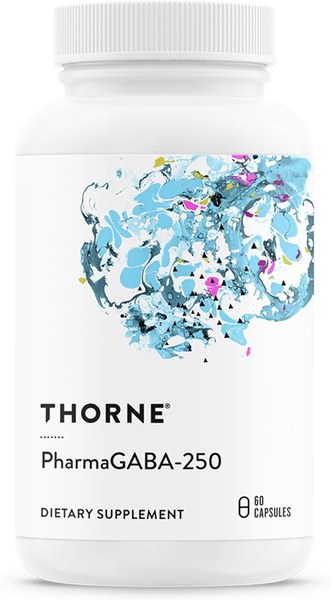
Thorne PharmaGABA-250
Form: PharmaGABA, fermentation-derived · 250 mg · veg capsule
The quality-first default. Thorne uses PharmaGABA, the naturally fermented form that appears in the small human relaxation studies, rather than generic synthetic GABA, and it is NSF Contents Certified, so an independent body has verified the label. In a category thick with hype, buying the studied form from a practitioner-grade brand is the sensible move. The dose is a touch above the amounts used in the sleep research, and it is pricier than synthetic GABA, but as a clean, credible daily GABA, it is the easiest to recommend.
- PharmaGABA, the fermentation-derived form used in the human studies
- NSF Contents Certified, independently verified label
- Single clean ingredient, no flavors or sweeteners
- Trusted practitioner brand, flexible one-to-three-a-day dosing
- Premium price versus synthetic GABA
- 250 mg per capsule is above the studied 100 to 200 mg, and you cannot split it
- Capsule acts slower than a chewable or lozenge
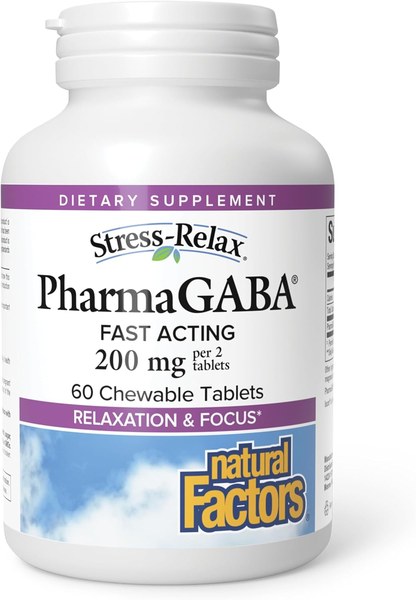
Natural Factors Stress-Relax PharmaGABA
Form: PharmaGABA · 200 mg · fast-acting chewable
The pick for fast, in-the-moment calm. This is PharmaGABA in a fruit-flavored chewable, so it starts dissolving right away with no water, which suits a stressful moment or a pre-bed wind-down better than a swallowed capsule. It is Non-GMO Project Verified and third-party tested through ISURA, and vegan. At 200 mg it is a middle-of-the-road dose, and if you prefer a pure, unflavored product you will want a capsule instead, but for a tasty, quick-acting PharmaGABA, this is our favorite.
- PharmaGABA in a fast-acting chewable, no water needed
- Non-GMO Project Verified and ISURA third-party tested
- Vegan and pleasantly flavored for easy daily use
- Good value per serving for the studied form
- Contains natural flavors and sweeteners, not for purists
- Chewable texture and taste will not suit everyone
- Fixed 200 mg per tablet
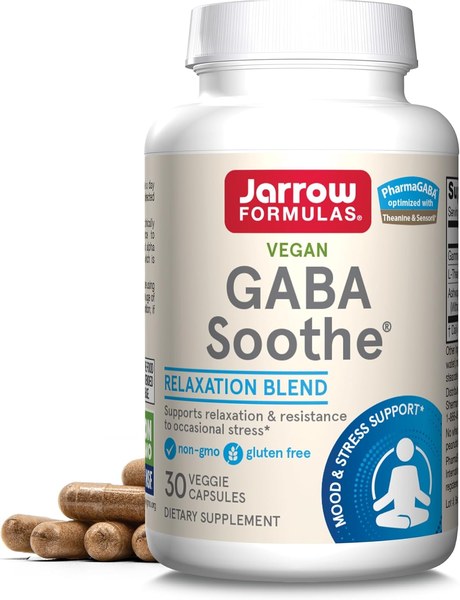
Jarrow Formulas GABA Soothe
Form: PharmaGABA + Suntheanine L-theanine + Sensoril ashwagandha
The smartest all-in-one for everyday stress. Rather than lean on GABA alone, Jarrow stacks 100 mg of PharmaGABA with Suntheanine L-theanine and Sensoril ashwagandha, two calming ingredients with their own, arguably stronger, human evidence, each in a branded, clinically studied form. That covers more bases than GABA can on its own. It is a once-daily capsule, the bottle is a smaller 30 count so the cost per day is higher, and ashwagandha is not for everyone, including during pregnancy or with some thyroid conditions.
- Three calming actives, each in a studied branded form
- Built on PharmaGABA, not synthetic GABA
- Adds L-theanine and ashwagandha mechanisms GABA lacks
- Convenient once-daily capsule
- Only 30 servings, higher cost per day
- Fixed combo; you cannot dose the three separately
- Ashwagandha is not appropriate for everyone
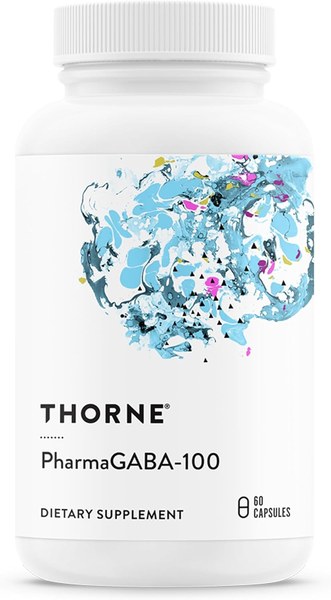
Thorne PharmaGABA-100
Form: PharmaGABA · 100 mg · veg capsule
The same quality as our top pick at the lighter, research-aligned dose. Thorne's 100 mg PharmaGABA matches the amount used in several of the small human studies, which makes it a better fit for daytime calm when you do not want to feel over-sedated, and it is NSF Contents Certified like its 250 mg sibling. It is a clean, single-ingredient capsule. The trade-off is simply that 100 mg can feel subtle if you were expecting a strong effect, and a capsule acts more slowly than a chewable.
- Research-aligned 100 mg PharmaGABA dose
- NSF Contents Certified, same pedigree as the 250 mg
- Ideal for gentle daytime use without over-sedation
- Single ingredient, no flavors or fillers of concern
- 100 mg may feel too subtle for some
- Capsule is slower than a lozenge or chewable
- Still pricier per mg than synthetic GABA
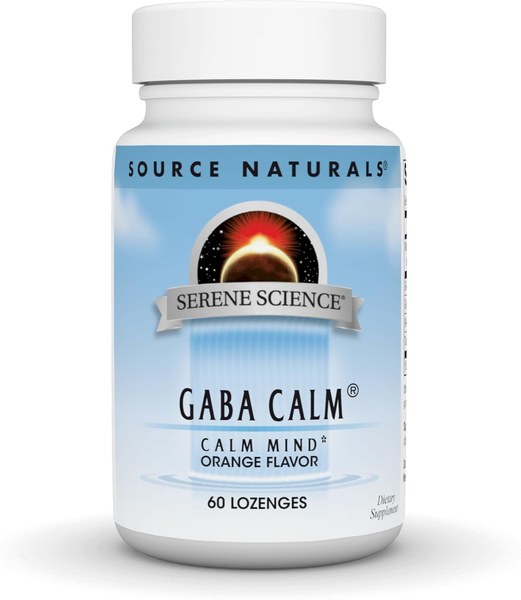
Source Naturals GABA Calm
Form: Synthetic GABA 125 mg + glycine, taurine, tyrosine, magnesium
The cult favorite for on-demand calm. GABA Calm is a sublingual lozenge you let dissolve in your mouth, which is why fans reach for it in a stressful moment, and it pairs 125 mg of GABA with glycine, taurine, and a little tyrosine and magnesium. The trade-offs are real: it uses synthetic GABA rather than the studied PharmaGABA, the added N-acetyl-tyrosine can feel mildly activating for some, and Source Naturals does not claim third-party certification. Still, for a fast, inexpensive lozenge, it has earned its following.
- Fast sublingual lozenge for in-the-moment calm
- Long-running favorite for situational stress
- Adds glycine, taurine, and tyrosine
- Inexpensive per serving
- Synthetic GABA, not the studied PharmaGABA
- Added tyrosine can feel activating for some
- No third-party certification claimed
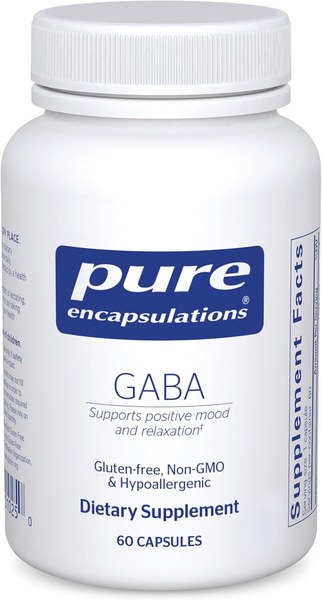
Pure Encapsulations GABA
Form: Synthetic GABA 700 mg · hypoallergenic veg capsule
The pick for sensitive users who want the cleanest possible label. Pure Encapsulations is the hypoallergenic practitioner brand, and this GABA is essentially free of excipients, allergens, gluten, and GMOs, and independently third-party tested. If fillers or flavorings bother you, it is the most minimalist option here. Two honest caveats: it is synthetic GABA, not the studied PharmaGABA, and the 700 mg dose is far above the amounts used in research, with no proven advantage, so many people would do just as well splitting a smaller dose.
- Ultra-clean, hypoallergenic, essentially no excipients
- Independently third-party tested practitioner brand
- Free of gluten, common allergens, and GMOs
- Good for people who react to fillers or flavors
- Synthetic GABA rather than the studied PharmaGABA
- 700 mg is a high dose with no proven added benefit
- Premium price for plain GABA
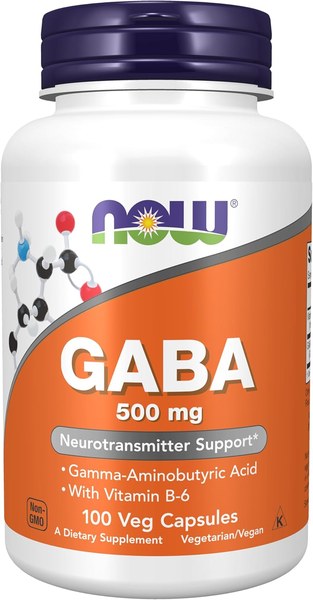
NOW GABA 500 mg with B-6
Form: Synthetic GABA 500 mg + vitamin B-6 · veg capsule
The honest budget choice. NOW delivers a dependable 500 mg of synthetic GABA plus vitamin B-6, a cofactor the body uses to make GABA, at by far the lowest cost per serving here, in a large 100-count bottle from a high-volume brand with extensive in-house testing. It lands last only because it embodies exactly what our ranking cautions against: a synthetic megadose, well above the research amounts, on a SKU with no third-party seal. If you simply want to try GABA cheaply, though, this is the sensible way to do it.
- By far the lowest cost per serving
- Large 100-count bottle lasts over three months
- Adds vitamin B-6, a cofactor in GABA synthesis
- Reputable brand with extensive in-house testing
- Synthetic GABA, not the studied PharmaGABA
- 500 mg is well above the research dose, no proven benefit
- In-house GMP only, no NSF or third-party seal on this SKU
The full lineup, side by side
| Product | Dose | Form | Added | Delivery | Testing | ~Cost/serving |
|---|---|---|---|---|---|---|
| Thorne PharmaGABA-250 | 250 mg | PharmaGABA | None | Capsule | NSF Certified | ~$0.49 |
| Natural Factors | 200 mg | PharmaGABA | None | Chewable | ISURA third-party | ~$0.35 |
| Jarrow GABA Soothe | 100 mg | PharmaGABA stack | L-theanine, ashwagandha | Capsule | Third-party | ~$0.82 |
| Thorne PharmaGABA-100 | 100 mg | PharmaGABA | None | Capsule | NSF Certified | ~$0.33 |
| Source Naturals GABA Calm | 125 mg | Synthetic | Glycine, taurine, tyrosine | Lozenge | In-house GMP | ~$0.25 |
| Pure Encapsulations | 700 mg | Synthetic | None | Capsule | Third-party | ~$0.50 |
| NOW GABA with B-6 | 500 mg | Synthetic | Vitamin B-6 | Capsule | In-house GMP | ~$0.12 |
Prices are approximate and change often. Doses are per serving; check the label for how many capsules or tablets that takes. Confirm current pricing and details on the retailer page.
Does GABA actually work?
This is the question that matters most, and it deserves a straight answer rather than marketing. Here is the honest version.
The biology is real. GABA is the main inhibitory neurotransmitter in the brain, the signal that calms neural activity down. Low GABA signaling is linked to feeling tense and wired. So the idea of topping it up is intuitive, and that intuition is what sells these products.
The catch is getting it to your brain. A supplement has to reach the brain to calm it directly, and for years the standard view has been that GABA does not easily cross the blood-brain barrier. A widely cited 2015 review in Frontiers in Psychology put it plainly: the studies that tried to settle this are contradictory, there is some evidence of a calming effect, but most of that evidence came from researchers with a potential conflict of interest, and the mechanism is "far from clear." The authors suggested that any real effect might work indirectly, through the gut's own nervous system, the enteric nervous system, rather than by GABA reaching the brain itself.
The human studies are small, and some are conflicted. A few do report a signal. In a small 2006 study, a single dose of GABA raised alpha brain waves, a signature of relaxation, and lowered beta waves within an hour, and it blunted a stress-related dip in an immune marker during an anxiety-provoking task. Another small study found oral GABA shortened the time to fall asleep, with blood levels peaking about 30 minutes after a dose. The honest footnote: both of those studies were run by researchers at the company that makes the branded PharmaGABA ingredient, which is a conflict of interest worth knowing. A cleaner 2018 trial, with no declared industry funding, gave people with insomnia symptoms 300 mg of GABA from fermented rice germ for four weeks and found they fell asleep faster, from about 13 minutes to under 6, and slept more efficiently, though the study was small and had only ten people in its placebo group.
The overall verdict is modest. A 2020 systematic review that examined 14 trials reached the fair conclusion: there is limited evidence that oral GABA helps with stress and very limited evidence that it helps with sleep. In plain terms, GABA supplements may do something for some people, the downside risk is low, but no product can honestly claim proven, reliable effects. Some users feel a distinct sense of calm or a light tingling; others feel nothing at all. If you want the better-evidenced calming tools, L-theanine crosses the blood-brain barrier reliably and has more consistent research, and magnesium glycinate and glycine have stronger support for sleep. We cover those in our guides to supplements for sleep and the best magnesium for sleep and anxiety.
How to choose the right one
A few questions narrow the field fast:
- Form. If you want to match what was actually studied, choose PharmaGABA, the fermented form. Synthetic GABA is the same molecule and much cheaper, but it is what most of the mega-dose bargain products use.
- Dose. Start low. The research used roughly 100 to 300 mg, and there is no evidence that 500 or 700 mg works better. Beginning at 100 to 200 mg lets you find your own response.
- Speed. For calm in the moment, a chewable or sublingual lozenge acts faster than a swallowed capsule. For a simple daily habit, a capsule is easiest.
- Testing. In a hype-prone category, favor NSF-certified or clearly third-party-tested products from reputable brands.
- Stacking. Because GABA's evidence is thin, a formula that pairs it with better-studied calmers like L-theanine or ashwagandha, as our stress-stack pick does, can be a smarter buy than GABA alone.
Frequently asked questions
Do GABA supplements actually work?
The honest answer is that the evidence is thin and mixed. GABA is the brain's main calming neurotransmitter, but whether the GABA in a pill reaches your brain is debated, because it has long been thought that oral GABA does not easily cross the blood-brain barrier. A handful of small human studies have reported a calming signal, such as increased alpha brain waves within an hour and slightly faster sleep onset, but the studies are small, short, and several were run by the company that sells the branded ingredient. A 2020 systematic review concluded there is limited evidence for stress and very limited evidence for sleep. Some people notice a subjective sense of calm or a light tingling, and others feel nothing. It is reasonable to try, with modest expectations, and it is not a proven treatment for anxiety or insomnia.
Does GABA cross the blood-brain barrier?
This is the central question, and it is unsettled. For years the standard view was that GABA cannot easily cross the blood-brain barrier, which would mean an oral dose could not directly calm the brain. Reviews of the research note that the studies testing this are contradictory, so a firm answer does not yet exist. Because of that, scientists have proposed that any real effect of GABA supplements might work indirectly, for example through the gut's own nervous system, the enteric nervous system, and the vagus nerve, rather than by GABA reaching the brain itself. Part of the effect may also be placebo. In short, GABA supplements may do something for some people, but the mechanism is far from clear.
Is PharmaGABA better than synthetic GABA?
PharmaGABA is a natural form of GABA made by fermentation using the bacterium Lactobacillus hilgardii, while most cheap GABA is synthetic. The molecule is the same, so there is no proven difference in how they work in the body. PharmaGABA earns its edge for a practical reason: it is the specific form used in most of the small human studies that reported calming and sleep effects, so if you want to match what was actually tested, PharmaGABA is the closer bet. Synthetic GABA is much cheaper and is often sold at higher doses, but higher doses have no proven advantage, which is why our ranking leads with PharmaGABA and treats big synthetic doses as a value option rather than a premium one.
How much GABA should I take, and when?
The small human studies mostly used modest amounts, roughly 100 to 300 mg, not the 500 to 750 mg found in many synthetic products, and more is not proven to be better. A sensible approach is to start low, around 100 to 200 mg, and see how you respond. For relaxation, people take it during the day or before a stressful event; for sleep, about 30 to 60 minutes before bed, since one small study found blood levels of GABA peak around 30 minutes after a dose. Fast formats like chewables and lozenges are popular for in-the-moment calm, while capsules are simpler for daily use. Take it consistently for a couple of weeks before deciding whether it helps you.
Is GABA safe, and what are the side effects?
For most healthy adults, GABA is generally well tolerated at typical supplement doses, and studies report few serious side effects. The most common complaints are mild: a brief tingling or flushing sensation, especially at higher doses, and occasionally a short-lived shortness of breath or a drop in blood pressure. Because GABA may lower blood pressure slightly and is calming, it is sensible to be cautious if you take blood-pressure medication or other sedatives, and to avoid combining it with alcohol. There is not enough safety data for pregnancy or breastfeeding, so it is best avoided then. If you take medication or have a health condition, check with your doctor before starting.
GABA or L-theanine for sleep and stress?
If you want the better-evidenced option, L-theanine is the stronger pick for most people. L-theanine, the calming amino acid in green tea, reliably crosses the blood-brain barrier and has more consistent human research for relaxation and stress than oral GABA does. Magnesium, especially magnesium glycinate, and glycine also have more supportive evidence for sleep than GABA. That does not make GABA useless, and some people clearly prefer how it feels, but if you are choosing where to put your money first, L-theanine, magnesium, and glycine are the more reliable bets, and some products, like a good stress stack, simply combine them.
The bottom line
GABA is one of those supplements where the biology is exciting and the delivery is the unsolved problem. It is the brain's calming signal, but whether an oral dose reaches the brain is genuinely debated, and the human evidence for stress and sleep is limited. That is why we ranked by the studied form and honest dose rather than by the biggest number on the label. If you want to try it, Thorne PharmaGABA-250 is the credible all-rounder, Natural Factors is the fast chewable, Jarrow GABA Soothe hedges your bet with better-studied calmers, and NOW is the cheap way to experiment. Keep your expectations modest, start with a low dose of a well-tested product, and remember that L-theanine, magnesium, and good sleep habits are the more reliable place to start.