Algae omega-3 is the vegan way to get EPA and DHA, the two long-chain omega-3 fatty acids found in fish. Fish do not make them: they get them from algae up the food chain, so supplement makers grow the algae directly, mostly in fermentation tanks. Plant foods such as flax, chia and walnuts supply a different omega-3, ALA, and the body converts only a small share of it into EPA and very little into DHA.
We screened more than 20 algae omega-3 products sold on Amazon US scored every one that lists both EPA and DHA on a readable Supplement Facts panel, and ranked the top seven. The ranking rewards the real EPA and DHA per pill and per dollar, testing we could confirm with the certifier, and clean capsules, and it deducts for marketing that overreaches. For fish-based options, see our fish oil ranking; for the rest of a plant-based routine, see our supplements for vegans and vegetarians guide.
The short version
- Best overall: Momentous Vegan Omega-3, 1,000 mg of EPA and DHA per 2 capsules and the only product here with a purity and potency certification (NSF Certified for Sport) we could confirm on the certifier's site, but at about $0.88 per 500 mg, nearly twice the cost of Sports Research.
- Best liquid: Nature's Way Algal Oil Omega-3, 1,000 mg per teaspoon, EPA-rich, about $0.46 per 500 mg.
- Best value softgel: Sports Research Vegan Omega-3, 980 mg per 2 carrageenan-free softgels at about $0.46 per 500 mg.
- Read EPA plus DHA, not the front label. Algal oil weight and total omega-3 are bigger numbers than the EPA and DHA you actually get.
- Most testing claims are unconfirmable. The main fish oil purity program (IFOS) does not cover algae; the same company's algae program (IAOS) began in 2024, and only one product here has a purity and potency certification we could confirm on the certifier's site. Non-GMO and vegan marks check sourcing, not purity.
- Expect higher blood DHA, not proven health outcomes. Algal oil reliably raises blood EPA and DHA, but none of the large heart outcome trials we found used it, and large fish oil trials mostly found no reduction in heart events.
- Mind the dose. Guidelines for general health suggest 250 to 500 mg of EPA and DHA a day; ask a doctor first if you take blood thinners.
How we ranked them
To qualify, a product had to use algal oil as its only omega-3 source and state both EPA and DHA on a readable US Supplement Facts panel. We then scored each one:
- EPA and DHA per pill (25%). Full marks for 450 mg or more per softgel, capsule or teaspoon; less for products that need more pills for the same amount.
- Cost per 500 mg of EPA and DHA (20%), from Amazon prices on November 1, 2026.
- Third-party verification (20%). Full marks only for a certification that tests contents or contaminants and that we could confirm on the certifier's own site for this product. Partial credit for a brand-posted lab certificate, and less for sourcing-only marks (non-GMO, vegan) or testing claims we could not confirm.
- EPA share (10%). Most algal oils are DHA-rich; products with more EPA score higher, since most omega-3 research tested both.
- Capsule ingredients (10%). Half a point off for each of carrageenan, sorbitol, added color and added flavor.
- Label transparency (5%). Naming the algae species and giving exact EPA and DHA amounts rather than ranges.
- Marketing restraint (10%). Products start at 4 of 5, and half a point comes off for each category present: unverifiable superiority claims, health benefits stated beyond the evidence, absorption claims that overreach, and a listing that contradicts its label.
Products are ordered by their unrounded scores, shown rounded to one decimal; Nordic Naturals Algae Omega, Amandean and MAV Nutrition all score 3.70, and ties go to the lower cost per 500 mg, which leaves MAV just outside the seven. We rank one strength per product line, so Deva's 300 mg version is represented by Deva 500. Prices are single-bottle, one-time prices; multipacks and Subscribe & Save are excluded. Also just missed: Calgee (a brand-posted Eurofins certificate from 2024, but about $1.04 per 500 mg and a gallery claim that it may reduce the risk of cardiovascular diseases), Nature Made's life'sOMEGA softgels (sorbitol, carrageenan and added colors; labeled vegetarian rather than vegan), Future Kind (225 mg per softgel; its posted certificate checks metals but not EPA or DHA) and iwi (250 mg per softgel at about $2.26 per 500 mg, with a 50 percent more absorption claim). Not eligible: Freshfield, Naturelo, Garden of Life Minami and Carlyle state no EPA, and Nature's Bounty lists only a combined EPA and DHA total; Testa's Amazon listing shows no US Supplement Facts panel and disagrees with its box on the DHA amount. Ovega-3, Nested Naturals and NOW Foods algae products were not available on Amazon US when we checked. No brand paid to be included, and none sent product.
What algae omega-3 does, and what the evidence shows
Where it comes from. Most algae omega-3 comes from Schizochytrium, a marine microbe grown in fermentation tanks. Its oil is naturally rich in DHA, and some strains also make EPA, which is why products range from DHA-heavy to EPA-rich. Nannochloropsis, a true microalga, makes EPA but no DHA. Because most of these algae are grown in tanks, ocean pollutants such as methylmercury and PCBs are not an expected concern, though we found no published survey of contaminants in algae supplements.
It raises blood EPA and DHA. In a German trial in 104 vegetarians, 0.94 g of algal DHA a day for 8 weeks raised the omega-3 index (the share of EPA and DHA in red blood cell membranes) from 4.8 to 8.4 percent. In a Spanish crossover trial that included vegans, 250 mg of DHA a day from Schizochytrium raised blood DHA in every diet group, most in vegans. In a US study of 165 long-term vegans, the average omega-3 index was 3.7 percent, and a subgroup with low levels went from 3.1 to 4.8 percent after 4 months of 254 mg a day, without a comparison group. A 2017 review found every vegetarian study it included reported a rise.
As good as fish oil? Likely close, but the head-to-head evidence is thin and company-run. A 2008 study by researchers linked to Martek, then the maker of a leading algal DHA ingredient, found algal capsules and cooked salmon raised blood DHA about equally over 2 weeks in 32 people, an open-label study with the equivalence analysis done after the fact. A 2025 analysis by authors employed or paid by dsm-firmenich, the oil's maker, found algal oil met a pre-set test for being no worse than fish oil, but that was a secondary question for the trial, and the algal group took more omega-3.
Why not just eat flax? A review of tracer studies estimated that adults convert about 5 percent of ALA into EPA and less than 0.5 percent into DHA, and in one tracer study in young men no labeled DHA appeared at all. A UK study of 232 vegan men found lower blood EPA and DHA than in meat eaters, levels that stayed stable however long people had been vegan. We found no study showing that lower DHA in vegans causes harm, but algal oil is the main direct way to close the gap.
What it does for health is less clear. None of the large heart outcome trials we found used algal oil. In VITAL, a trial of about 26,000 adults, 1 g of fish oil a day did not significantly reduce major cardiovascular events, and a 2020 Cochrane review of 86 trials found omega-3 supplements had little or no effect on deaths or cardiovascular events overall. DHA-rich oils also raise LDL cholesterol slightly: a pooled analysis of algal DHA trials at a median of 1.68 g a day found triglycerides fell and LDL rose.
Pregnancy has the most algae-specific data, and it is mixed. In a US trial of 350 pregnancies, 600 mg of algal DHA a day lengthened gestation by about 3 days, and births before 34 weeks were fewer (0.6 versus 4.8 percent, a small number of births). In a second US trial, 1,000 mg versus 200 mg of algal DHA gave 1.7 versus 2.4 percent early preterm births, with a larger gap in women who started with low DHA. A 2018 Cochrane review, mostly of fish oil, also found fewer births before 34 weeks (2.7 versus 4.6 percent without omega-3). But the largest later trial, of fish oil in 5,486 pregnancies, found no difference (2.2 versus 2.0 percent), and a Mexican trial of 400 mg of algal DHA a day in 1,094 women found no change in pregnancy length or birth size. The right dose is a decision for your prenatal provider. For prenatal vitamins that include DHA, see our prenatal vitamin ranking.
Testing is a weak spot. The best-known fish oil purity program, IFOS, covers marine oils only; its operator launched a separate algae program, IAOS, in 2024. Non-GMO and vegan marks check sourcing, not potency or freshness. We found no published evidence that algal oils are less oxidized than fish oil (a large testing database found similar peroxide values), and in a 2024 analysis of 72 omega-3 products, flavored oils exceeded a freshness limit far more often than unflavored ones (68 versus 13 percent).
A note on carrageenan. Two softgels here, both from Nordic Naturals, use carrageenan, a seaweed thickener. European regulators kept it approved in 2018 but called their acceptable intake temporary pending better data, and early human studies are small and mixed. The amount in a softgel is not disclosed; if you prefer to avoid it, four of the six capsule and softgel picks use carrageenan-free shells.
The 7 best algae omega-3 supplements
Tap any product to jump straight to its full review.
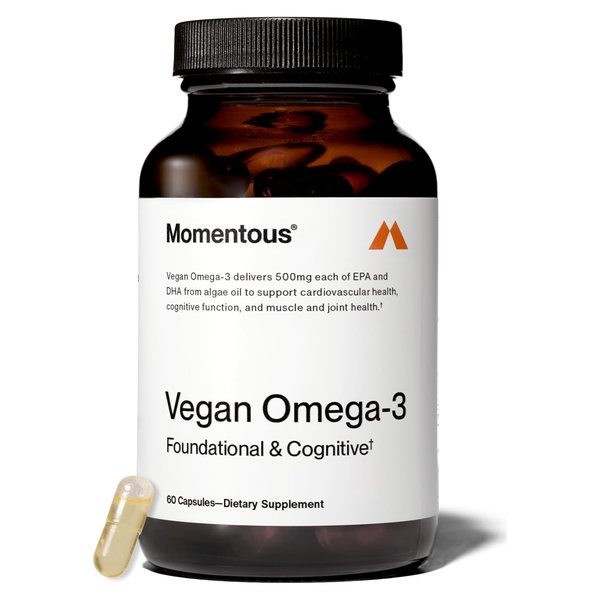
Momentous Vegan Omega-3 (60 capsules)
Best for: Confirmed third-party testing
The top pick because it is the only product here whose third-party purity and potency testing we could confirm for this exact product, and it delivers 1,000 mg of EPA and DHA in an even split in two clean cellulose capsules. You pay for it at about $0.88 per 500 mg, ratings are few, and the listing's absorption, brain and recovery claims go beyond the evidence. If confirmed testing matters less to you than price, Sports Research gives nearly the same EPA and DHA for about half the cost per 500 mg.
- The only product here with a purity and potency certification we could confirm for this exact product: NSF Certified for Sport, which lists the product and five lots
- 1,000 mg of EPA and DHA in an even 500 mg split, from Schizochytrium algae, in two capsules
- A plant cellulose capsule with no carrageenan, sorbitol, colors or flavors
- About $0.88 per 500 mg, the most expensive here
- Only 58 ratings, averaging 3.7 stars
- Calls its formula unmatched, though Nordic's Ultimate Omega Plant-Based has more EPA and DHA, and claims superior bioavailability and brain and recovery benefits; its listing also gives two storage instructions (refrigerate after opening, or a cool, dark place)
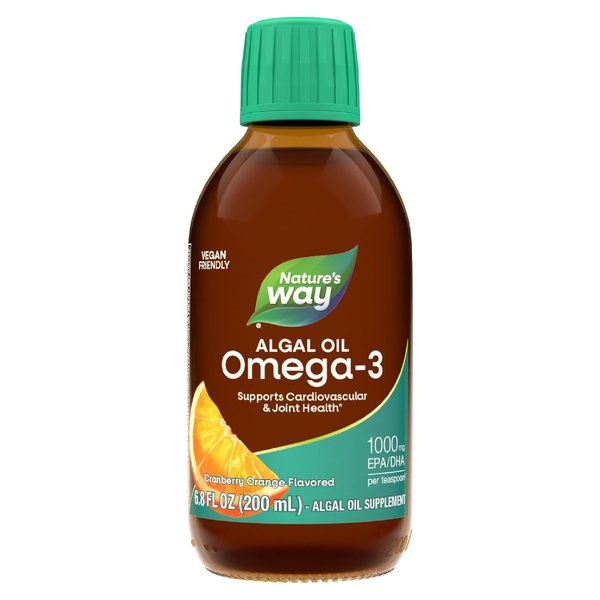
Nature's Way Algal Oil Omega-3 Liquid (6.8 fl oz)
Best for: People who prefer a liquid
A teaspoon gives 1,000 mg of EPA and DHA, EPA-rich at 600 mg, for about $0.46 per 500 mg, with no pills to swallow. It is flavored, its PureCheck lot-testing claim could not be confirmed for this product, and a gallery image gives the wrong EPA and DHA numbers.
- 1,000 mg of EPA and DHA per teaspoon, EPA-rich at 600 mg, for about $0.46 per 500 mg
- No pills to swallow; the label names Schizochytrium algae
- Antioxidants in the formula (rosemary and green tea extracts, mixed tocopherols)
- Nature's Way says every lot is tested by an independent lab (PureCheck), but reports are looked up by lot number and we could not confirm one for this product
- Flavored with cranberry and orange; flavored oils failed freshness limits far more often in a published survey of 72 products, and a teaspoon carries 3 g of saturated fat, mostly from the MCT oil base
- A gallery image says 300 mg EPA and 600 mg DHA, which contradicts the label's 600 mg and 400 mg
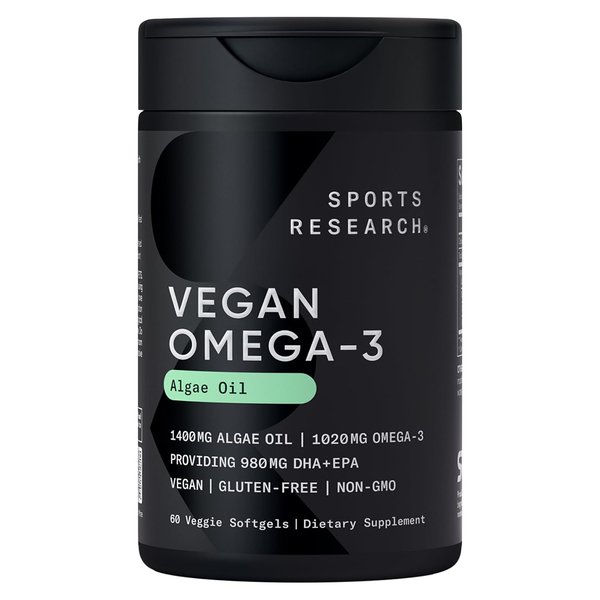
Sports Research Vegan Omega-3 (60 veggie softgels)
Best for: The most EPA and DHA per dollar in a softgel
The best value softgel: 980 mg of EPA and DHA per two carrageenan-free tapioca softgels at about $0.46 per 500 mg, with the algae and oil amount named. It is DHA-heavy, its IAOS testing claim is not in the public directory for this product, and its listing's claim to be the only vegan omega-3 in a carrageenan-free tapioca softgel does not hold, since two other picks here use one.
- 980 mg of EPA and DHA in two softgels at about $0.46 per 500 mg, the lowest cost among the softgels here
- A tapioca softgel with no carrageenan or sorbitol, plus mixed tocopherols
- Names the algae (Schizochytrium) and the algal oil amount (1,400 mg); about 4,900 ratings averaging 4.6 stars
- DHA-heavy: 280 mg of EPA against 700 mg of DHA
- Shows an IAOS testing claim, but when we checked on November 1, 2026, Nutrasource's public directory listed two sister products, not this one
- Its listing says it is the only vegan omega-3 in a carrageenan-free tapioca softgel, but Deva and Amandean here use one too, and it warns that fish oils often contain mercury and dioxin
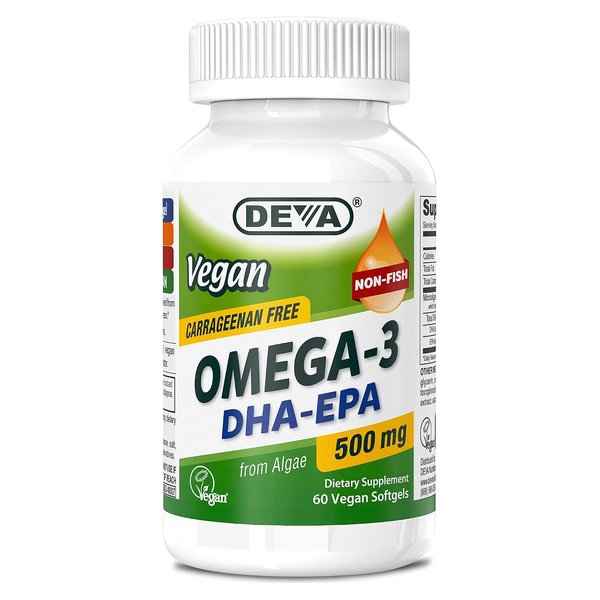
Deva Vegan Omega-3 DHA-EPA 500 mg (60 softgels)
Best for: One softgel a day
One carrageenan-free softgel a day for about 500 mg of EPA and DHA at about $0.53 per 500 mg, with a restrained listing. The label states EPA and DHA as typical ranges and does not name the algae, and the Amazon copy calls it a multivitamin.
- One softgel a day for about 500 mg of EPA and DHA, about $0.53 per 500 mg
- A carrageenan-free tapioca softgel with antioxidants (mixed tocopherols, rosemary, ascorbyl palmitate)
- Registered with the Vegan Society, which we confirmed on its trademark list
- The label gives EPA and DHA as ranges that the oil typically provides, not fixed amounts, and does not name the algae species
- Adds annatto color and orange oil
- The listing calls it a multivitamin and its ingredient text leaves out the algal oil itself
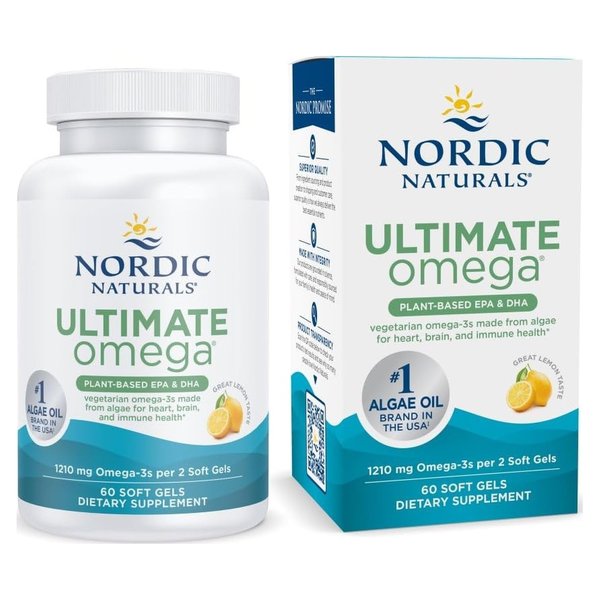
Nordic Naturals Ultimate Omega Plant-Based (60 soft gels)
Best for: A high EPA dose
The most EPA and DHA per serving here, 1,100 mg with an unusual 660 mg of EPA, from a well-known brand. It costs about $0.63 per 500 mg, uses carrageenan and sorbitol, and its Amazon title overstates the EPA and DHA by counting total omega-3.
- The most EPA and DHA here, 1,100 mg per 2 soft gels, and unusually EPA-rich at 660 mg
- Names the algae species; its IGEN non-GMO certification is listed on Nutrasource's site
- Antioxidants in the fill (mixed tocopherols, rosemary extract); about 240 ratings averaging 4.5 stars
- About $0.63 per 500 mg
- The soft gel shell uses carrageenan and sorbitol, plus added flavor
- The Amazon title says 1,210 mg of EPA and DHA, but the panel shows 1,210 mg is total omega-3 and EPA plus DHA is 1,100 mg; also claims better absorption against ethyl ester oils
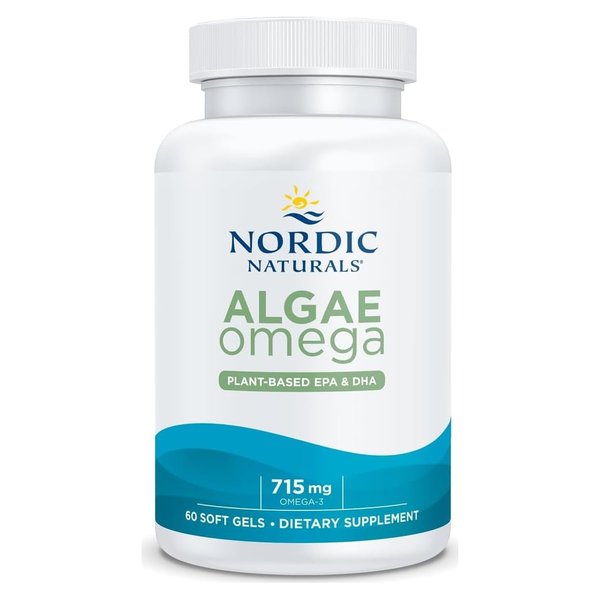
Nordic Naturals Algae Omega (60 soft gels)
Best for: A modest daily dose from a known brand
The familiar vegan pick at the lowest bottle price: 585 mg of EPA and DHA per two soft gels from dsm-firmenich's life'sOMEGA oil. Higher amounts take more pills, the shell has carrageenan and sorbitol, and its absorption claim compares triglyceride oils with ethyl ester oils rather than with other algal oils.
- 585 mg of EPA and DHA per 2 soft gels, a typical daily amount, at the lowest bottle price here (a 30-day bottle; Deva and Amandean cost less per day, and three picks cost less per 500 mg)
- Uses dsm-firmenich's life'sOMEGA algal oil and names the species; IGEN non-GMO certification listed on Nutrasource's site
- About 3,600 ratings averaging 4.7 stars; Nordic says a lot certificate is available for any of its products
- Two soft gels for under 600 mg, so higher amounts mean more pills
- The shell uses carrageenan and sorbitol, plus carob color
- Calls itself the number one vegetarian omega-3, citing sales data for its number one algae oil brand claim, and claims superior absorption against ethyl ester oils, a comparison that does not apply to other algal oils
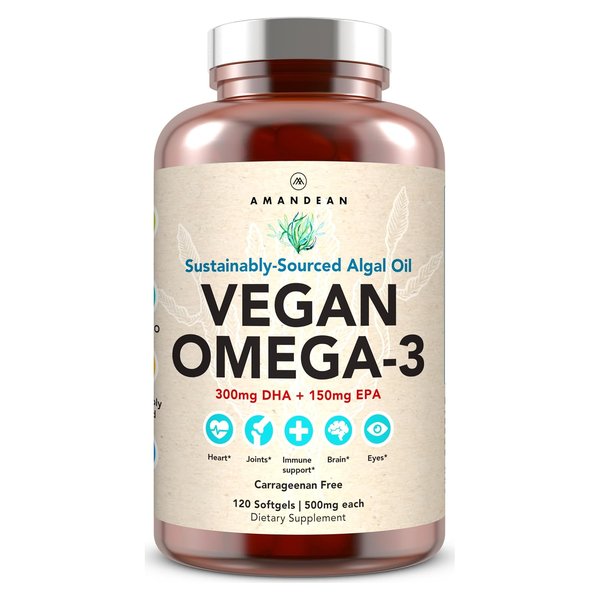
Amandean Vegan Omega-3 (120 softgels)
Best for: A large, carrageenan-free bottle
A two-month bottle of carrageenan-free softgels at a moderate price, with the algae named. At 450 mg per two softgels it is the lowest dose here, its testing claim names no lab, and the listing reaches for bone, longevity and absorption benefits.
- 120 softgels, a two-month supply at the label dose (as with Deva's 60 one-a-day softgels), in a carrageenan-free tapioca softgel, for about $0.58 a day
- Names the algae (Schizochytrium) and lists antioxidants
- About 1,900 ratings averaging 4.7 stars
- 450 mg of EPA and DHA per 2 softgels, the lowest dose here, at about $0.65 per 500 mg
- A third-party testing claim with no named lab and no certificate we could find
- Claims bone density, longevity and absorption benefits, its comparison chart labels other brands generic from China or India, and a gallery image adds DPA that the panel does not list
The full lineup, side by side
Amounts come from each product's Supplement Facts panel on its Amazon listing, read November 1, 2026. EPA plus DHA is the number that matters; total omega-3 and algal oil weight on the front of a bottle are larger numbers.
| Product | EPA + DHA per serving | EPA / DHA | Testing | Shell or form | Cost per 500 mg | Score |
|---|---|---|---|---|---|---|
| #1 Momentous | 1,000 mg per 2 capsules | 500 / 500 | NSF Certified for Sport (confirmed) | Cellulose capsule | $0.88 | 4.4 |
| #2 Nature's Way Liquid | 1,000 mg per teaspoon | 600 / 400 | PureCheck lot claim; not confirmed | Liquid, flavored | $0.46 | 4.3 |
| #3 Sports Research | 980 mg per 2 softgels | 280 / 700 | IAOS claimed; not in public directory | Tapioca softgel | $0.46 | 4.2 |
| #4 Deva 500 | About 500 mg per softgel | 150 to 210 / 300 to 420 | Vegan registration (sourcing only) | Tapioca softgel | $0.53 | 4.0 |
| #5 Nordic Ultimate Plant | 1,100 mg per 2 soft gels | 660 / 440 | IGEN non-GMO (sourcing only) | Carrageenan, sorbitol, flavor | $0.63 | 3.9 |
| #6 Nordic Algae Omega | 585 mg per 2 soft gels | 195 / 390 | IGEN non-GMO (sourcing only) | Carrageenan, sorbitol, color | $0.58 | 3.7 |
| #7 Amandean | 450 mg per 2 softgels | 150 / 300 | Unnamed claim | Tapioca softgel | $0.65 | 3.7 |
Prices are Amazon prices on November 1, 2026 and change often. Cost per 500 mg is the price divided by the number of 500 mg portions of EPA plus DHA in the container, using single-bottle one-time prices (multipacks and Subscribe and Save excluded). Testing is what we could confirm on a certifier's own site; non-GMO and vegan marks check sourcing, not purity or potency.
How to choose, and what to check first
Find EPA and DHA on the panel. The front of the bottle often shows algal oil weight (1,000 mg or more) or total omega-3. Add the EPA and DHA lines and compare products on cost per 500 mg of those two.
Decide how much you want. European authorities set an adequate intake of 250 mg of EPA and DHA a day for adults, and many guidelines suggest 250 to 500 mg for general health. In pregnancy, an extra 100 to 200 mg of DHA is commonly advised; ask your clinician, since some prenatal vitamins already include it. Most products here give 450 to 1,100 mg per serving, so half a serving may be enough for some people.
Look for testing you can check. NSF Certified for Sport and Nutrasource's IAOS directory list certified products online; an IFOS seal on an algae product would be a red flag, since IFOS covers marine oils only. Treat unnamed "third-party tested" claims as unverified.
Prefer unflavored and fresh. Flavors can mask rancidity. Keep oils cool and closed, and discard any that smell sharp or paint-like. For fish and krill alternatives, see our fish oil ranking and krill oil ranking.
- Blood thinners. Omega-3s can add to the effect of anticoagulants and antiplatelet drugs at higher doses; ask your doctor.
- Heart rhythm. In trials, the risk of atrial fibrillation rose most clearly above about 1 g a day; see our fish oil and atrial fibrillation review.
- Pregnancy. Algal DHA was used in pregnancy trials, but the right dose depends on your diet and other supplements; ask your clinician.
- Cholesterol. DHA-rich oils can raise LDL cholesterol slightly; worth knowing if you are tracking it.
Frequently asked questions
Is algae omega-3 as good as fish oil?
For raising blood EPA and DHA, it appears to be close. Small studies, mostly run by ingredient makers, found algal oil raised blood DHA about as much as salmon or fish oil per milligram. None of the large heart outcome trials we found used algal oil, and large fish oil trials mostly found no reduction in heart events, so neither has proven health benefits for most adults.
Do vegans need an omega-3 supplement?
Vegans typically have lower blood EPA and DHA, because the body converts only a small share of plant ALA into them. We found no study showing that this causes harm, but an algal supplement is the main direct way to raise levels. It is a reasonable choice, especially in pregnancy; discuss it with your clinician.
How much algae omega-3 should I take?
European authorities set an adequate intake of 250 mg of EPA and DHA a day for adults, and many guidelines suggest 250 to 500 mg. In pregnancy, an extra 100 to 200 mg of DHA is commonly advised. Higher doses are best discussed with a doctor, especially above 1 g a day.
What is the difference between EPA and DHA?
Both are long-chain omega-3 fatty acids. DHA is concentrated in the brain and eyes, while EPA was the main ingredient in some heart and mood trials. Most algal oils are DHA-rich; a few, such as Nordic Naturals Ultimate Omega Plant-Based and Nature's Way's liquid, are EPA-rich.
Is flaxseed oil a substitute for algae oil?
Not for EPA and DHA. Flax supplies ALA, and adults convert only about 5 percent of it into EPA and less than 0.5 percent into DHA. ALA has its own modest evidence, but it does not replace preformed DHA.
Does algae omega-3 cause fishy burps?
It contains no fish, so there is no fish taste, but we found no trial comparing burping between algal and fish oils. Taking it with a meal may help.
Is carrageenan in softgels safe?
Food-grade carrageenan is an approved additive, and European regulators reaffirmed it in 2018 while calling their acceptable intake temporary pending more data. Early human studies are small and mixed. If you prefer to avoid it, choose a carrageenan-free shell, such as Momentous, Sports Research, Deva or Amandean.
The bottom line
Algae omega-3 is the direct, fish-free source of EPA and DHA, and it reliably raises blood levels in vegans and vegetarians. Compare products on EPA plus DHA per 500 mg, not on the algal oil weight on the front. Momentous is the pick if you want testing you can confirm; Nature's Way's liquid is the strongest no-pill option; Sports Research gives the most EPA and DHA per dollar in a softgel; and Deva covers one-a-day dosing. Keep expectations to higher blood levels rather than proven health outcomes, take it with a meal, and check with your doctor first if you take blood thinners, have a heart rhythm condition or are pregnant.